
Something is changing in the way high-productivity teams use software.
I am spending more time inside tools such as ChatGPT, Claude Code, Codex, and Hermes, and less time manually moving between every system underneath them. The software and data still matter. But the place where I ask, decide, coordinate, and execute is starting to move.
That shift is what I mean by an AI harness.
An AI harness is an operating layer that gives an AI model the context, tools, permissions, procedures, and memory needed to coordinate work across connected systems. In more established technical language, this sits close to AI agent orchestration: turning an objective into actions across tools while carrying the right context and controls.
This is not another prediction that SaaS is dead. It is not. But the SaaS interface is under pressure.
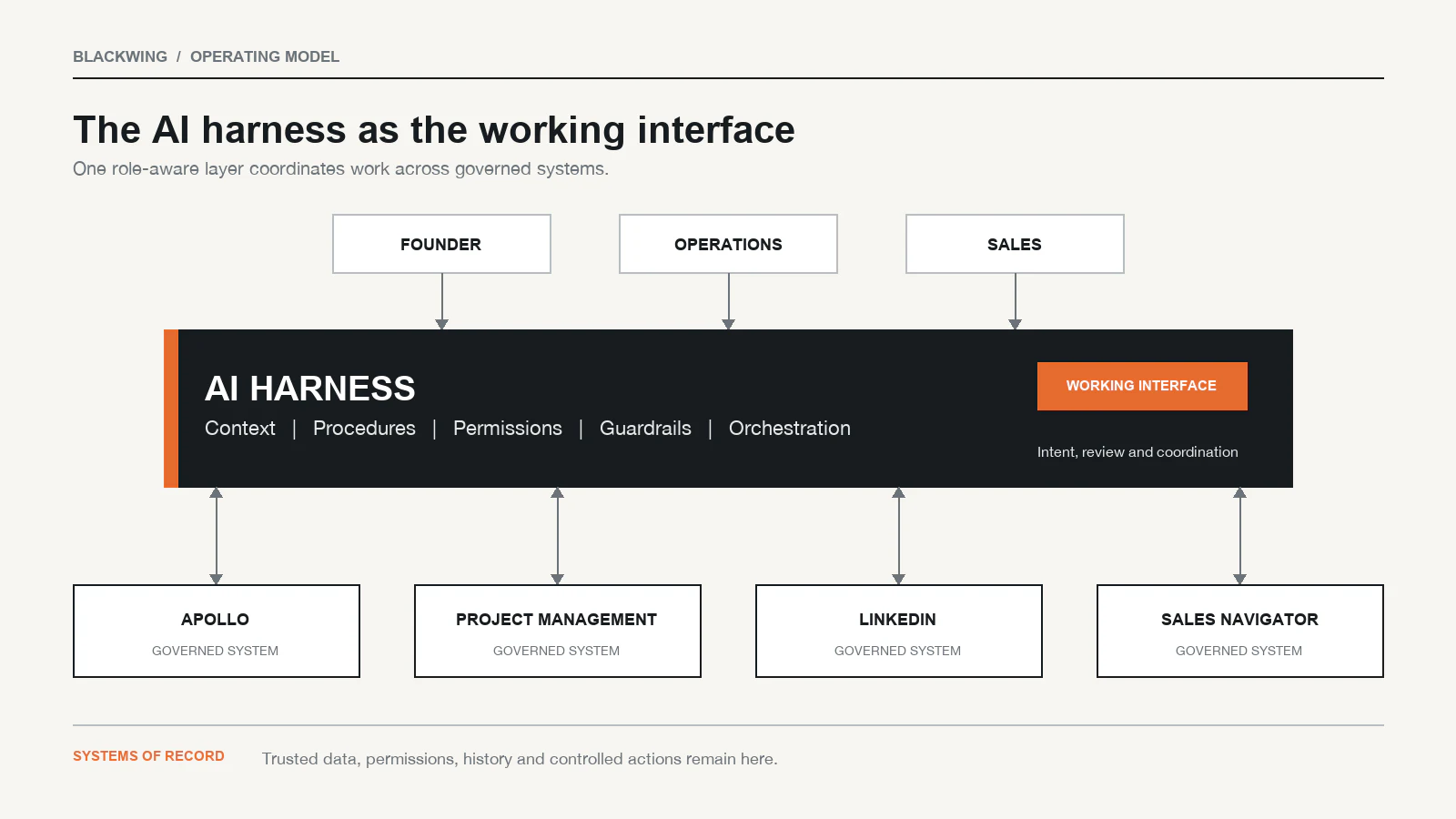
Why AI agent orchestration puts pressure on the SaaS interface
Much of SaaS differentiation came from making work easier through a clean interface. Project management products are a good example. monday.com, ClickUp, and Asana structure tasks, ownership, dates, comments, and reporting.
But what happens when a harness can update tasks, annotate records, chase information, prepare a status report, and coordinate other systems without an employee opening five tabs?
The project-management interface becomes less central to the employee's day. The system underneath it may become more important.
This sounds like a small distinction. It is not.
The interface is where people experience the product. The system of record holds governed data, permissions, history, and accountability. AI harnesses may reduce direct interface work while increasing the need for reliable systems underneath.
Project management software may become more like a data layer
I do not think monday.com, ClickUp, or Asana are becoming irrelevant. Their role may change. For some teams, they could look less like the main workplace and more like a structured database holding tasks, owners, dependencies, comments, and history. The harness becomes the layer employees use to act on that information.
That pressure will not affect every SaaS category equally. A simple, interface-led product is more exposed than a configured ERP, regulated financial system, or mission-critical platform whose data model, transaction logic, and controls are much harder to replace.
| Layer | Primary role | What remains valuable |
|---|---|---|
| AI harness | Working interface | Intent, context, coordination, review, and action across tools |
| SaaS system | Governed system of record | Data, permissions, transaction logic, history, and accountability |
| Human owner | Judgment and authority | Approvals, exceptions, relationships, and responsibility for outcomes |
So the better question is not, 'Will AI replace SaaS?' It is, 'What remains valuable when the user no longer needs to click through the interface to get the work done?'
Embedded SaaS agents are the obvious response
SaaS vendors can see the shift. Asana offers AI Teammates. ClickUp has Super Agents and Brain. monday.com has an agent layer and pathways for external agents to work with monday data. These sensible moves add intelligence where the data lives and inherit platform permissions.
My concern is that this may not be the long-term winning model for business adoption.
Most businesses do not run on one platform. If every vendor provides the main agent, the business gets competing assistants, memories, billing models, and versions of context.
A relatively neutral harness has a stronger strategic position. It can coordinate the stack around the business's workflow, rather than one vendor's world. That does not remove the individual tools. It changes who owns the working interface.
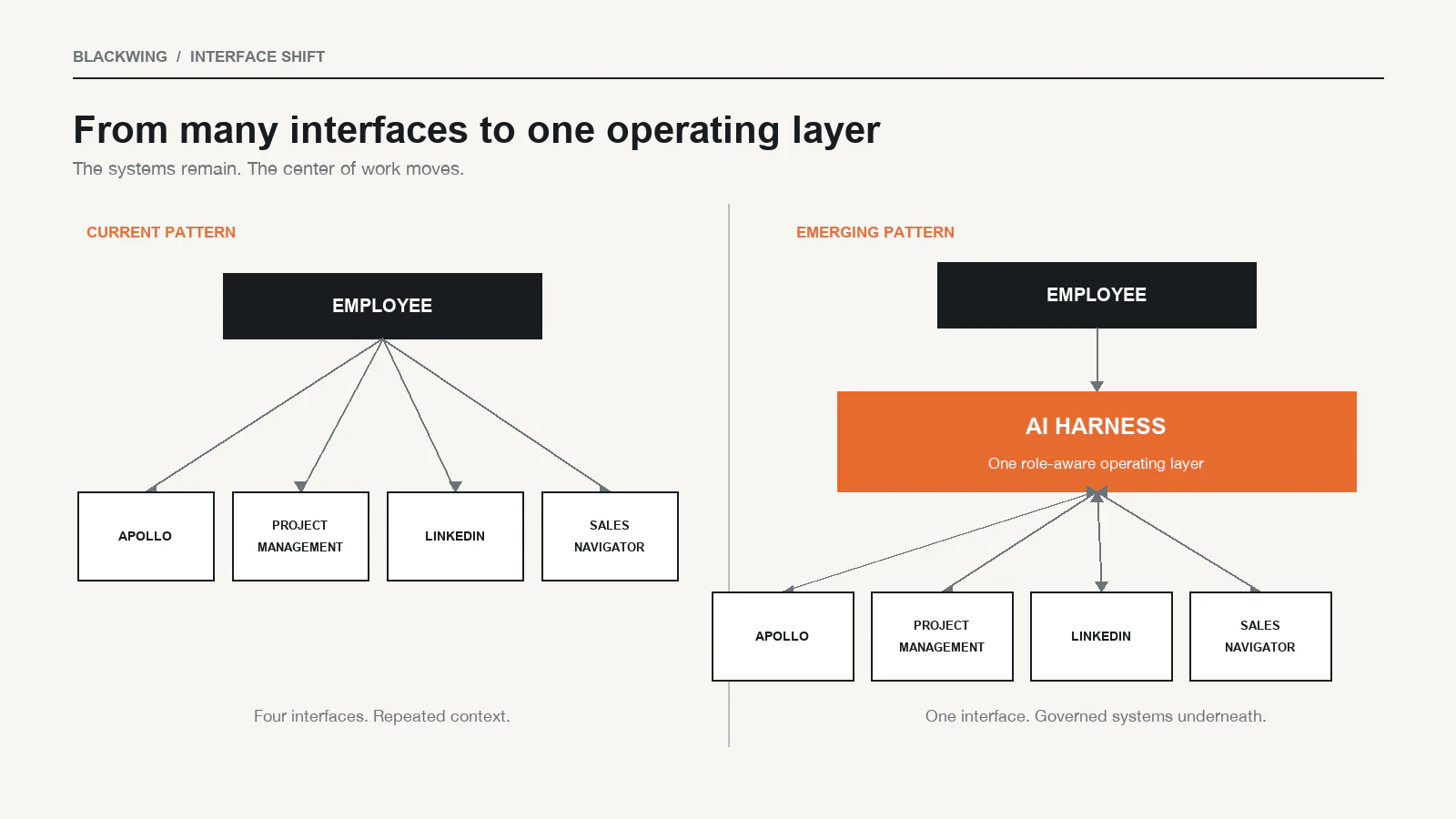
A sales workflow makes the shift easier to see
Imagine a sales process using Apollo for prospect data, LinkedIn and Sales Navigator for research, and a project-management system for assignments, approvals, and pipeline visibility.
Today, an employee may move between those systems manually, copy information, update statuses, and leave notes. With a properly designed harness, the employee could start with the outcome:
- Identify accounts that match the approved target profile.
- Review permitted information across Apollo, LinkedIn, and Sales Navigator.
- Prepare an account brief and draft outreach.
- Update the correct project-management record.
- Assign the next action and request approval where required.
The exact actions depend on each tool's permissions, terms, and connections. The point is the architecture. The harness becomes the place where intent is expressed. The tools remain valuable because they provide data, identity, permissions, records, and controlled actions.
The neutral layer becomes the interface. The SaaS products remain the governed foundation.
A connector is not a harness strategy
Connecting the tools is the easier part. The harder part is teaching the harness how the business works. If employees must explain their role, process, approval limits, and expected output from zero every time, the harness is just a capable blank page.
A business harness strategy needs at least six things:
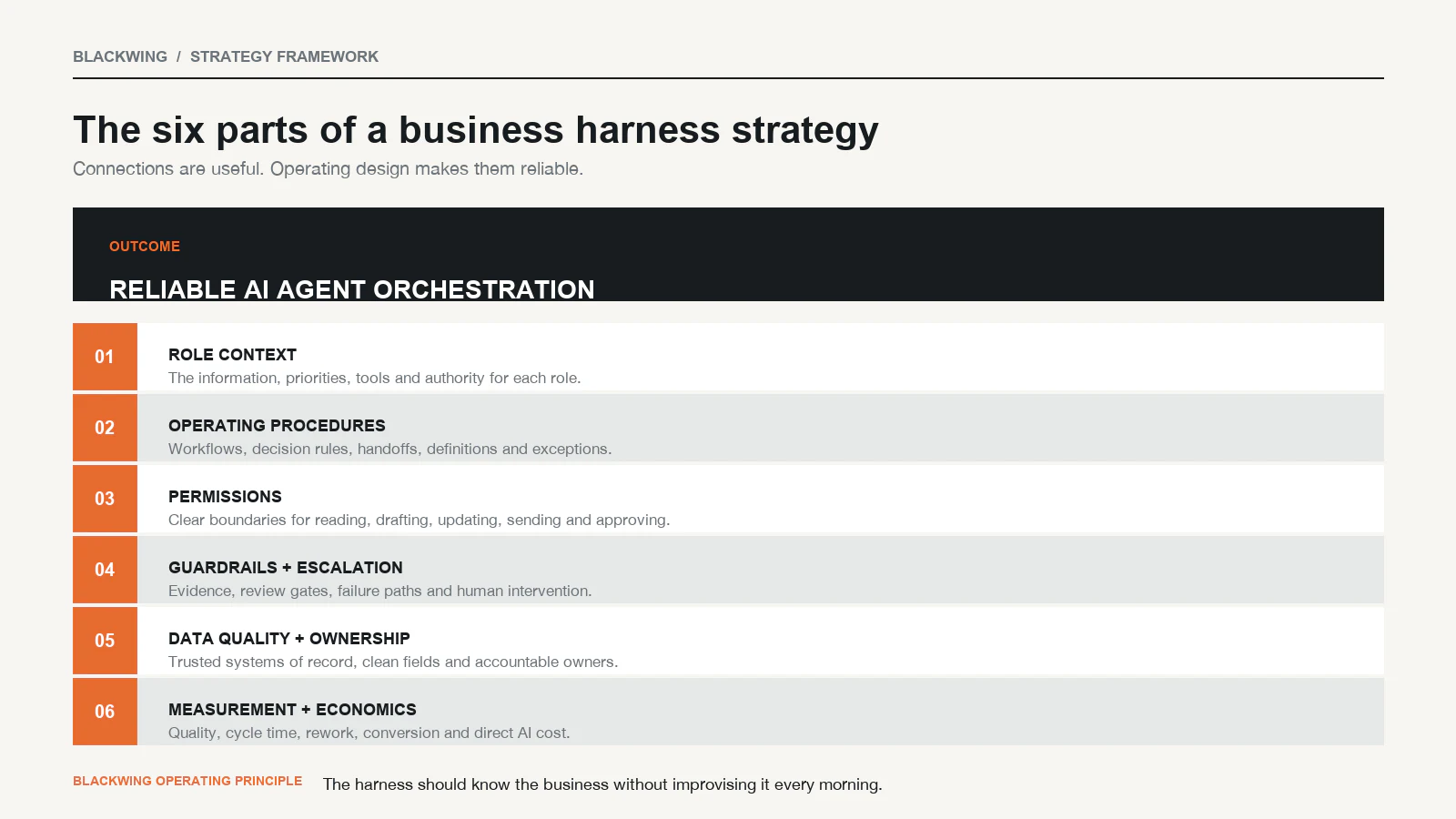
1. Role-specific context
The harness should know the employee's role. A founder, salesperson, operations manager, and project lead need different context, tools, and authority.
2. Operating procedures
The harness needs clear workflows, decision rules, handoffs, and exception paths. SOPs are not magic, but undocumented work gives it nothing stable to follow.
3. Permissions
Reading a record, changing a due date, sending a message, and approving a commercial decision are different levels of authority. Do not bundle them casually.
4. Guardrails and escalation
The harness needs to know when it can act, when it must ask, what evidence to preserve, and when a human must take over.
5. Data quality and system ownership
If the source systems are cluttered, duplicated, or unreliable, the harness will move bad information faster. Every important data object still needs an owner and a trusted home.
6. Measurement and economics
Each workflow needs a baseline and outcome. Track cycle time, errors, conversion, rework, quality, and direct AI cost. Otherwise, the business is measuring excitement.
This is where things usually break. Companies buy the agent before designing the operating model around it.
The productivity is visible. The economics are still messy.
Research, documentation, analysis, reporting, and cross-system administration can move much faster when a capable harness has the right context.
Inside a specific business, a ten-person team might carry the same workload with seven or eight. That is a planning scenario, not a benchmark. A field study in customer support found an average productivity gain from generative AI, but results varied by worker and task. It cannot be generalized to every company.
The harder question is profitability. What did the company spend on subscriptions, tokens or credits, implementation, review, corrections, and governance? Did faster output create revenue, better service, lower cost, or simply more activity?
AI usage is increasingly visible as a metered operating cost. That is useful because it can be measured. It also means leaders need workflow-level unit economics, not a general belief that AI makes everybody faster.
What leaders should do now
Do not begin company-wide. Start with one cross-system workflow where the interface burden is obvious and the outcome matters.
- Map the workflow as it happens today.
- Name the systems of record and the data owner for each important object.
- Define what the harness may read, draft, update, or execute.
- Load the role context, SOPs, decision rules, and escalation paths.
- Measure the before-and-after economics for a fixed period.
Then decide what deserves to scale. The winners will not have the longest list of connected apps. Their harness will understand the business well enough to coordinate work without improvising the rules every morning.
The winning move is to design the layer
My view is simple: designing a harness strategy is likely to be a winning move in the next phase of AI adoption.
The goal is not to replace every SaaS product. The goal is to stop treating every SaaS interface as the only place where work can happen.
Keep the systems that hold trusted data, permissions, transactions, and history. Put a governed, role-aware operating layer above them. Let employees work through a harness that can understand intent and coordinate action across the stack.
The software does not disappear. The center of gravity moves.
Frequently asked questions about AI harnesses
What is an AI harness in business?
An AI harness is an operating layer that combines an AI model with business context, memory, procedures, permissions, tools, and guardrails. It helps a person or agent coordinate work across connected systems instead of starting with a blank prompt or opening every application manually.
How is an AI harness different from an embedded SaaS agent?
An embedded SaaS agent usually works primarily inside one vendor's product and context. A neutral AI harness is designed to coordinate work across multiple tools and systems of record. The two can work together, but they give different parties control over the main working interface.
Will AI harnesses replace project management software?
Not necessarily. Project management software can remain valuable as the governed system that stores tasks, owners, dates, dependencies, comments, permissions, and history. The change is that employees may perform more work through an AI harness and spend less time navigating the project-management interface directly.
What should an AI harness strategy include?
A business harness strategy should include role-specific context, documented workflows, permissions, guardrails, escalation rules, data ownership, trusted systems of record, and workflow-level measurement. Connections alone are not enough.
How should a company measure AI agent orchestration ROI?
Measure one workflow before and after implementation. Track cycle time, labor effort, error and rework rates, output quality, conversion or service outcomes, and all direct AI and implementation costs. The useful question is not whether the agent is impressive. It is whether the workflow produces better economics.