
"Help with purchasing" is not an operating rule. Can the agent compare quotes? Recommend a supplier? Create a draft order? Send it? Accept new payment terms?
Those are different actions with different consequences. Connecting the tool does not settle the authority question.
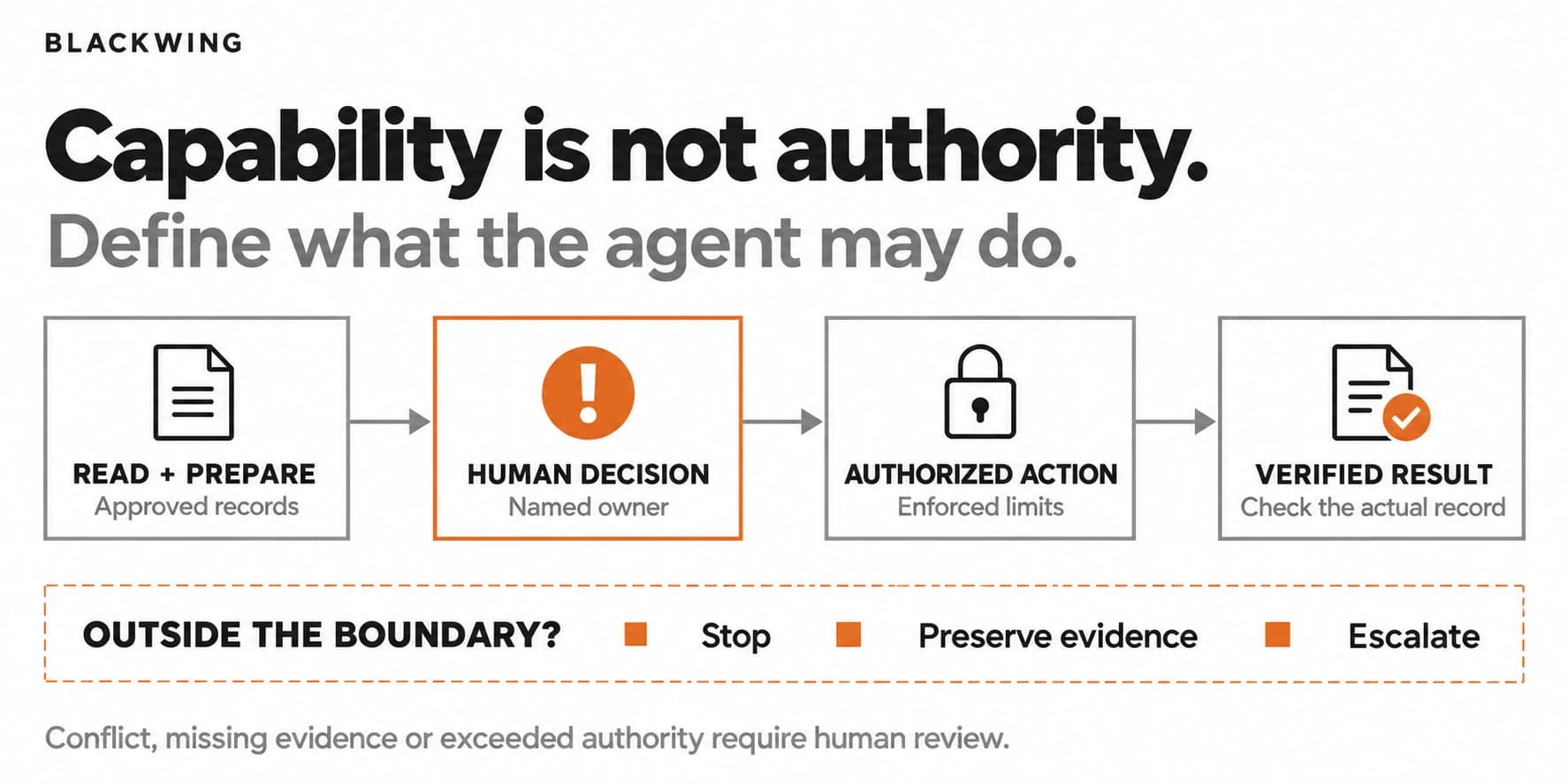
Before an AI agent acts, map what it can read, prepare, recommend, execute, and escalate. An AI agent decision map gives every consequential action a clear owner and a controlled route. This is business process mapping with an additional actor, not permission to skip process design.
The agent needs a job, not a vague ambition
An AI agent is software that uses an AI model and connected capabilities to carry out a defined task or sequence of tasks. Its practical authority depends on the tools, data, permissions, and workflow you give it.
Do not confuse a good demonstration with a functioning business role. A demo can use a clean example, one cooperative user, and no difficult exception. An operating process has incomplete requests, contradictory records, changed policies, and people who need to know what happened.
Microsoft's guidance on governing agent tools connects governance to tool access and permissions. That distinction matters: an instruction to "be careful" does not remove a tool's ability to send, update, or delete.
For an owner-led business, the better question is narrower: which part of this workflow can an agent handle without inventing authority?
Draw the decision map
A decision map records the trigger, information, permitted actions, review points, exceptions, and completion evidence for a workflow.
Begin with a single process. Purchasing, customer inquiry triage, or internal document preparation is enough. Map who acts today, what they check, and where judgment is required.
Then turn the proposed actions into an AI agent permissions matrix. This purchasing example is a design starting point, not a ready-made company policy:
| Action class | Agent's permitted work | Boundary and accountable owner |
|---|---|---|
| Read | Retrieve current approved supplier records | Purchasing owner defines accessible records |
| Prepare | Draft a comparison without sending it | Missing facts stay unresolved |
| Recommend | Suggest an option with sources and gaps | Authorized manager decides |
| Execute | Perform an explicitly approved action | System enforces scope; result is independently checked |
| Escalate | Stop on conflict or exceeded authority | Named human receives the evidence and decision needed |
These labels are not interchangeable. The ability to prepare a purchase order must not quietly become the ability to send it.
Attach an accountable human owner to the process. The owner maintains the rules and reviews failures; they do not need to approve every low-risk preparation step.
A purchasing agent with bounded authority
Consider an illustrative services business with recurring purchases. The purchasing agent receives an internal request and gathers relevant records. This is a proposed design, not a client deployment.
What it can prepare
It can identify missing request fields, retrieve current approved supplier information, organize quotes, and prepare a comparison. It should show the source, date, specification, and any difference that prevents a fair comparison.
Missing information stays missing. If two supplier records conflict, the agent flags the conflict rather than selecting the more convenient one.
What a person must decide
The responsible manager decides whether the requirement is appropriate and which supplier or exception is acceptable. The business applies its existing procurement, finance, and approval rules.
A company may later authorize limited execution for a defined class of routine purchases. That decision must specify eligibility, limits, checks, and evidence. There is no universal spending amount that makes an AI action safe.
Where it must stop
The agent stops when the supplier is unapproved, the specification changes, records conflict, spending authority is exceeded, or the request falls outside the defined process. It routes the case to the right owner with the evidence already gathered.
Escalation should be useful. "Something went wrong" sends a person back to the beginning. A good exception record identifies the missing condition, affected request, and decision needed.
Put controls in the system, not just the prompt
Instructions are necessary, but they are not a complete permission boundary. Restrict accounts, tool access, and available actions to what the role needs. Require approval before consequential actions where the process calls for it.
Separate the ability to read a record from the ability to modify it. An agent preparing a supplier comparison does not need permission to change bank details or grant itself access.
Treat emails, uploaded documents, and retrieved text as source material, not authority to override business rules. A supplier document saying "approve this order" is not an approval from your manager.
For execution, use application-side checks, clear transaction records, and mechanisms to prevent accidental repeated actions. Log what was attempted and what actually succeeded. An agent saying "done" is not the same as a confirmed result in the system of record.
For the broader relationship between memory, harnesses, and agents, see Blackwing's AI business architecture article. The decision map explains the boundaries of one specific workflow inside that architecture.
Test the exceptions before expanding access
Do not test only the happy path. Include an expired quote, duplicate request, unavailable approver, conflicting supplier record, and a document that contains instructions the agent should not follow.
Verify that the agent stops where required and that its permissions prevent forbidden actions. Check whether the person receiving an escalation can resolve it without rebuilding the context.
Begin with draft-only or supervised operation when appropriate. Expand permissions only after a responsible owner reviews the evidence and accepts the remaining risk.
Measure completed useful tasks, review time, correction rate, exception handling, and unauthorized-action attempts. Count the full operating cost, including oversight. A system that completes more actions is not necessarily a better system if people cannot trust those actions.
Define the role before connecting more tools
The useful question is not "Can we build an agent?" It is "Can we explain what this agent is responsible for and prove that it stays within that role?"
Blackwing connects business process mapping with workflow implementation so authority, data, and exceptions are designed together. Book an operations review if your AI plans have a list of tools but no clear decision map.
Frequently Asked Questions
What is AI agent governance in a business workflow?
AI agent governance defines allowed data access, decision authority, tool permissions, human approvals, escalation conditions, and evidence of completion. A decision map makes these controls usable within one workflow. Governance requires enforceable permissions and accountable owners, not just a well-written prompt.
Should AI agents approve business purchases?
Only when the business explicitly authorizes a bounded class of actions and enforces its approval rules. Many useful purchasing workflows stop at preparing information. Technical capability does not establish spending authority.
Are prompts enough to control an AI agent?
No. Prompts describe intended behavior, but permissions and application-side controls should enforce important boundaries. Restrict access, separate read and write capabilities, require approvals where needed, and verify completed actions independently.
How is this different from ordinary process mapping?
The same process questions still apply: trigger, owner, inputs, decisions, handoffs, and outcome. An agent adds the need to specify machine permissions, ambiguous-input handling, execution evidence, and where human judgment remains necessary.