
Someone still has to explain the client, find the current procedure, clarify who can approve the work, and correct the assistant when it confidently follows an outdated instruction. The next employee may repeat the same explanation tomorrow.
That is the gap I think the next phase of business AI will address. The AI business architecture that matters is not just a model. It is a connection between people, shared business memory, an AI harness, and agents that can do useful work within clear boundaries.
My view is that this will become a common operating model. The products may change. The need for the business to remember how it works will not.
The architecture I have in mind
Employees access AI through a working interface, or harness. The harness connects their request to the relevant company knowledge, reusable skills, AI models, and agents. Those agents can then work in connected business systems, within the employee's authority and the workflow's limits.
Useful lessons from the work return to shared memory through a controlled update process.
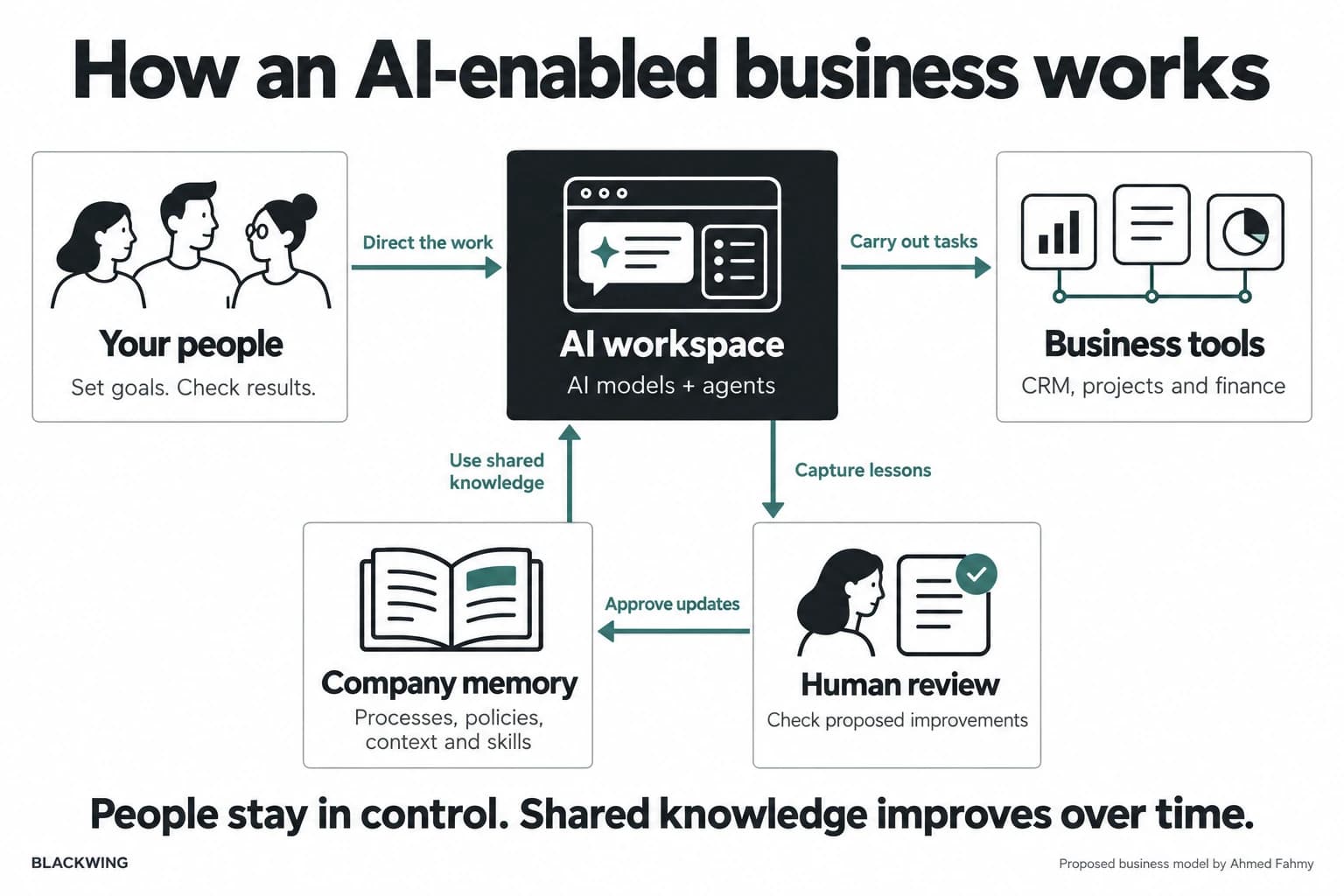
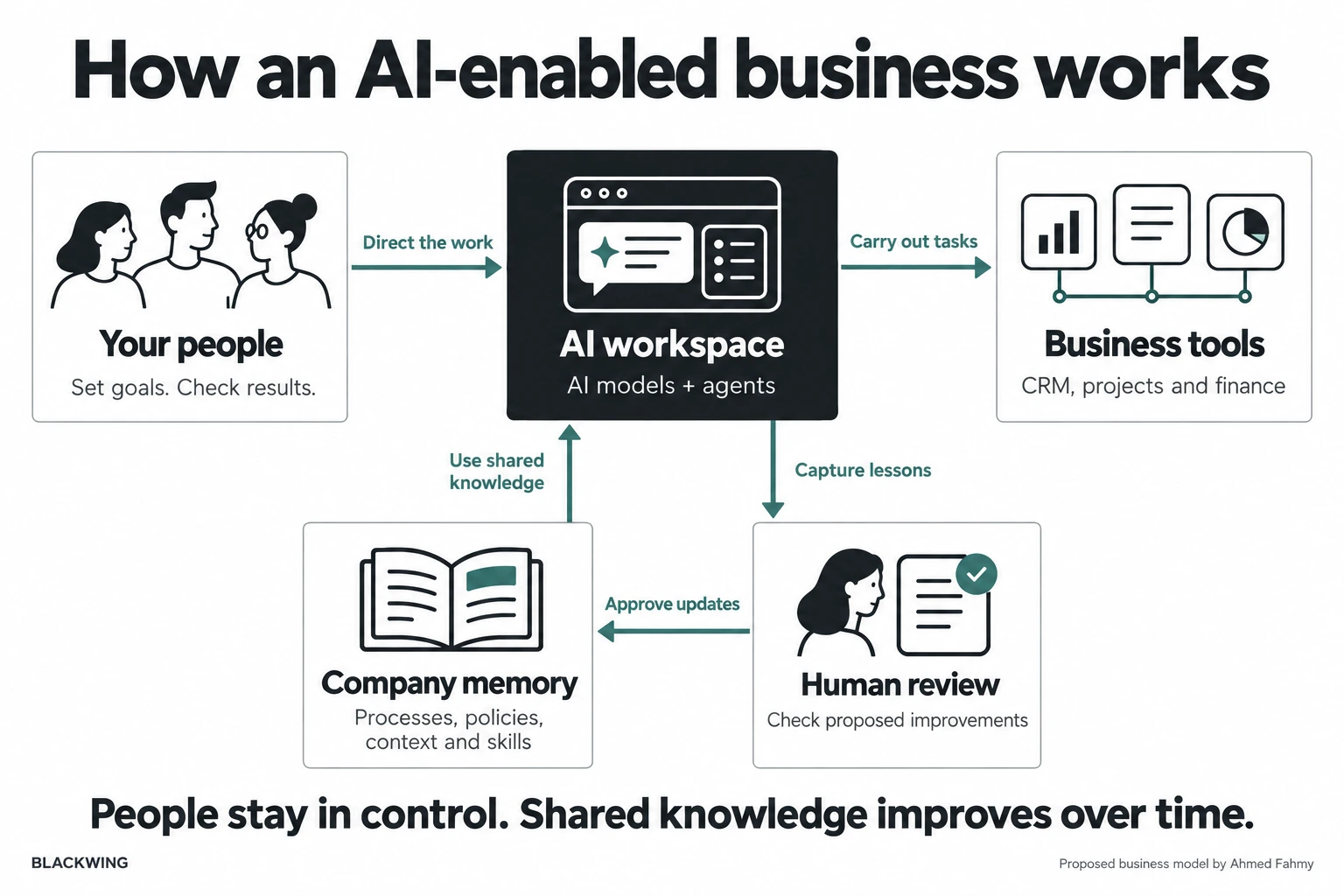
These are responsibilities, not necessarily separate software subscriptions. One product might cover several of them. The important thing is knowing what each part is responsible for.
Shared memory holds what the business knows
The memory and context platform contains the knowledge people need to work: approved processes, policies, client context, past decisions, useful examples, and lessons worth keeping.
It is closer to a working knowledge base than a collection of old chats. A useful entry should make its source, owner, approval status, and review date clear. Otherwise, the assistant may retrieve something relevant without knowing whether it still applies.
Basic Memory is one example of this direction. Its documentation describes readable Markdown knowledge, connected notes, and shared access across AI tools. That makes it a useful example, not a prediction that one platform will own the category.
Shared memory also needs boundaries. Shared does not mean every employee can read every client file or personnel record.
The model and the harness do different jobs
The model interprets a request and generates responses or proposed actions. The harness is the software around it that manages the working context, tools, execution, and interaction with the user.
For a business, I would expect that harness to load the right role and project context, retrieve applicable instructions, expose authorized tools, and make approvals and results visible. Some controls belong in the harness; others must be enforced by the connected systems.
This is not only a business metaphor. Anthropic's work on agent harnesses explores how context management, persistent work records, and verification support continuity across coding sessions. It illustrates the engineering problem, not proof that the same setup will run every business process.
Skills explain how to do the work
A skill packages reusable instructions, reference material, and sometimes executable code for a task. Anthropic's Agent Skills documentation describes this approach.
In business terms, the policy might say who can approve a purchase. The skill explains how to prepare and route the purchase request. They should agree, but they are not the same thing.
The business should not have five agent skills containing five slightly different copies of its approval policy.
People direct agents through the harness
An agent is a model-driven system that can work toward a delegated objective using tools. It might prepare a handover, check a document package, or reconcile information across systems.
Employees should be able to assign the work, inspect what happened, and handle exceptions through the harness. Some jobs can run on approved triggers; others need a person involved throughout. More autonomy is not automatically better.
The agent still needs a defined scope, allowed actions, completion checks, and a rule for when to stop. Naming it "Operations Manager" does not give it the authority of one.
Business memory should be alive but not uncontrolled
This is the part I find most interesting.
Employees discover useful things while working. A checklist misses an important input. A client requirement changes. A recurring exception turns out to need its own decision rule.
In this architecture, the harness can help capture that knowledge instead of leaving it in one conversation. Periodically, or when a relevant change occurs, the right owner reviews it and updates the shared material.
That does not mean every interaction becomes permanent company knowledge. Most conversations do not belong in the shared knowledge base. Some contain sensitive information. Others contain guesses, temporary workarounds, or mistakes.
The loop I would build is:
- Capture a useful observation with its source and context.
- Separate a verified fact from a proposed change.
- Route policy or process changes to the responsible owner.
- Release the approved version and retire outdated guidance.
An employee saying "we skipped that approval yesterday" is evidence of what happened. It is not permission to remove the approval tomorrow.
Alive should mean maintained, not uncontrolled.
Saving a note also does not retrain the underlying model. It changes the information the system can retrieve for future work. Whether the right information is actually found still needs testing.
What this looks like in a real workflow
Consider an illustrative construction-business handover from estimating to project delivery.
A project manager asks the harness to prepare a handover for an accepted job. The harness retrieves the approved handover procedure and the project context the manager is allowed to access. An agent checks the estimate, scope, exclusions, and outstanding commitments in the relevant systems.
If a required item is missing, it flags the gap. It does not quietly invent the answer. The manager reviews the package before it goes to the delivery team.
During that review, the team notices that site-access arrangements were missing from the standard checklist. The harness records a suggested improvement with evidence. The process owner decides whether to update the checklist. Once approved and released, the next project team can retrieve the revised version.
The useful outcome is not simply a faster handover document. It is that one team's discovery can improve the next team's work without turning an exception into an unofficial rule.
Your business systems still matter
The memory platform should not become a second accounting system, CRM, or project-management database.
It can explain how invoice approval works and point to the authoritative record. Current invoice status should still come from the designated financial system. Otherwise, the business creates two competing answers to the same question.
I explored the interface shift in my earlier article on AI harnesses and SaaS. Here, the distinction is simpler: the harness coordinates the work, shared memory supplies reusable knowledge, and systems of record retain authoritative operational data.
Start with one process worth remembering
I would start with a process that repeatedly sends people back to an experienced colleague for clarification.
Document its decisions, exceptions, sources, and approval boundaries. Give a second employee access through their own authenticated account. Then test whether they can complete the work using the correct guidance, without receiving information or powers they should not have.
Measure quality, rework, expert intervention, and maintenance effort alongside time and AI costs. A faster draft is not a better business process if someone spends the afternoon repairing it.
This is where process mapping and documentation become part of AI adoption. Blackwing's work starts with making the process and its ownership clear. Connecting a model comes after understanding what it is supposed to do.
The architecture I expect to matter is one in which employees can access capable agents, those agents can access the right knowledge, and the business can improve that knowledge without losing control of it.
Buying AI access is the easy part. Building a business that can remember, apply, and improve its own way of working is the more valuable work.
Frequently asked questions
What is AI business architecture?
AI business architecture describes how people, models, agent harnesses, organizational knowledge, and business systems work together. A useful design also defines permissions, approvals, and how results are checked.
How is shared AI memory different from chat history?
Chat history records conversations. Shared business memory contains selected, maintained knowledge with sources, ownership, and access boundaries. A conversation can inform memory without becoming an approved instruction.
Does a memory platform replace existing business software?
No. The memory layer holds reusable knowledge and links to authoritative records. Financial, customer, and project transactions should remain in their designated systems of record.
Should agents update company policies automatically?
Agents can propose policy changes and attach supporting evidence. Approval and release should remain with the designated owner. Permission to suggest a change is different from permission to make it official.