
Construction allowance reconciliation compares an allowance's agreed basis with the actual costs that belong against it, then traces the difference through customer communication, the required approval, and the project's billing records. The job is not finished when the customer chooses an item or when a vendor invoice arrives.
A remodeler can have every finish selected and still have an unclear allowance balance. Perhaps freight is on another invoice. A return credit is pending. The customer approved an option, but no one checked whether the final adjustment reached the account.
The useful control is a clear chain from original allowance to supported final position. Keep each link visible.
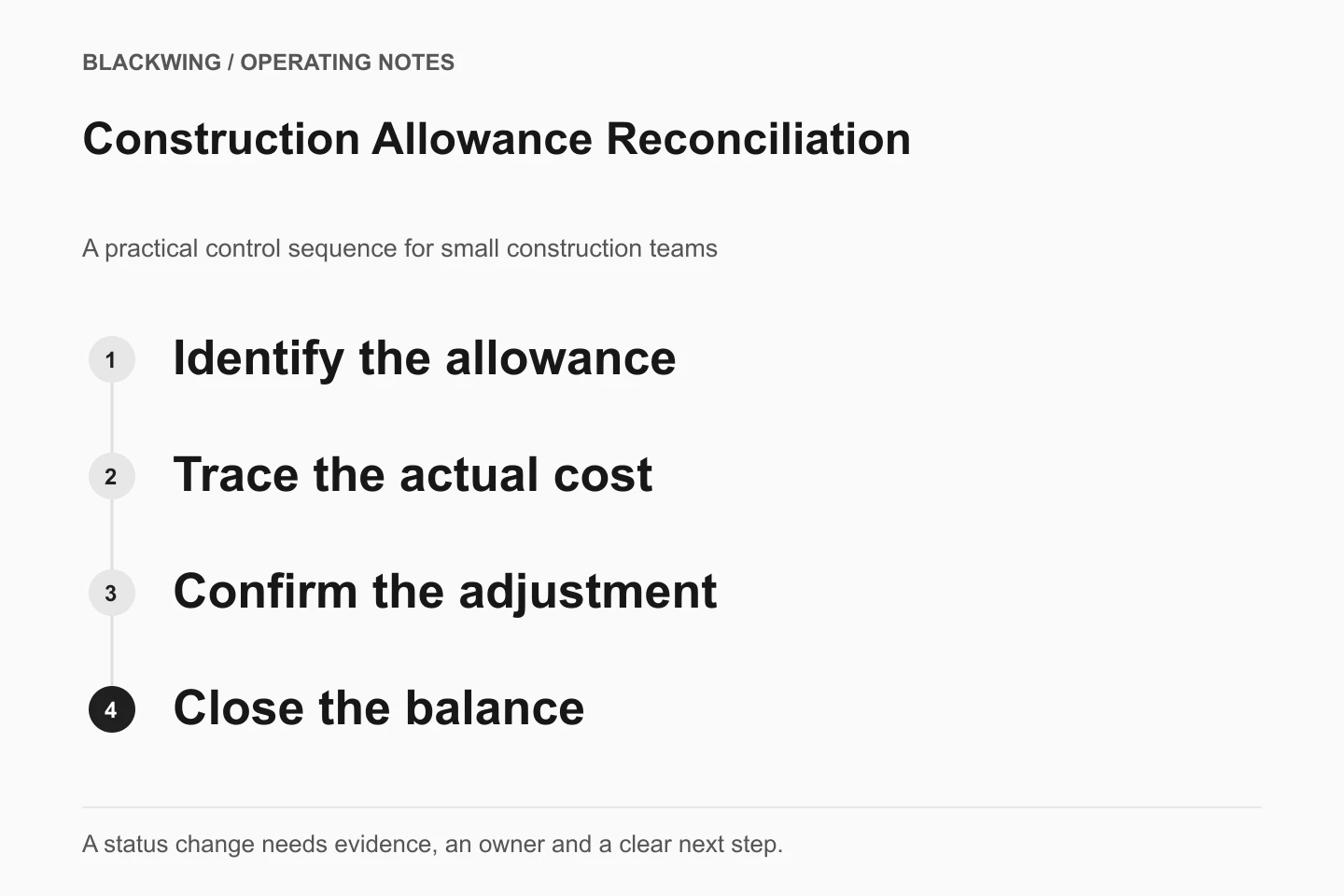
Establish what the allowance actually covers
Start with the project agreement and allowance schedule. Identify the item, original amount, quantity or unit basis, and included cost categories. Confirm how the agreement treats delivery, taxes, installation, discounts, fees, and changes. Do not assume every project uses the same allowance definition.
The AIA guidance on allowance use identifies allowance fields in both stipulated-sum and certain guaranteed-maximum-price agreements, alongside assumptions and clarifications. The practical implication is to read the allowance in its actual agreement, not infer its treatment from the project's pricing label.
Create one allowance ID and use it across the approved option, purchase records, vendor bills, credits, and customer adjustment. A general cost code may contain several allowances; it is not always precise enough to explain one customer-facing balance.
Build the allowance-to-adjustment bridge
Use a separate reconciliation row for each allowance. Keep original figures rather than replacing them with a final number. The following structure is a proposed working register for a small project team.
| Stage | Record to preserve | Question before moving on |
|---|---|---|
| Original basis | Allowance ID, amount, scope, agreement reference | Which costs are eligible? |
| Customer decision | Selected option, approved revision, decision date | What did the customer actually accept? |
| Cost evidence | Purchase records, bills, delivery charges, credits | Are all amounts mapped once? |
| Reconciled position | Eligible actual cost and unresolved amounts | Is this provisional or final? |
| Adjustment decision | Required approval and explanation of difference | Has the responsible person authorized it? |
| Posted and checked | Billing or credit reference and readback | Does the account match the approved position? |
Show committed cost separately from actual cost. A purchase order supports a commitment. A supplier bill records a charge. A pending return request is not yet a confirmed credit. They can all belong in the record without being treated as the same kind of evidence.
The financial owner should also identify costs that do not belong against the allowance. If installation was already covered elsewhere, moving it into this allowance could create a misleading overage. Preserve the reason for excluding an amount so another reviewer can follow the calculation.
Reconcile the approved option and the actual bills separately
In Buildertrend's allowance documentation approved options update allowance-related budget figures, and marking an underused allowance complete finalizes the approved total rather than leaving the original amount in place. That is a product-specific example of why selection approval and financial completion are separate events.
Your process still needs to establish whether the approved option total agrees with the eligible actual costs and the customer-facing treatment. Do not assume a software completion action has checked vendor credits, duplicate charges, or the terms of your agreement.
Keep the explanation readable. The customer should be able to see the original allowance, the comparable final cost basis, the difference, and the proposed handling. If a fee or another category changes the total, show that separately with its agreement reference rather than hiding it inside a single adjustment.
Illustrative example: an overage that changes after a credit
Consider a fictional $8,000 fixture allowance defined for this example as supply and delivery only. Installation is already included elsewhere. Eligible vendor bills total $8,650, but a $250 return credit is still being processed. These are made-up figures demonstrating the reconciliation, not a client case or a suggested allowance amount.
Before the credit is confirmed, the register shows $8,650 billed, $250 expected credit, and a provisional net cost of $8,400. The expected $400 overage is not labeled final. The coordinator owns follow-up for the credit reference and identifies any other open costs.
Once the $250 credit is confirmed and no other eligible charges remain open, the comparable cost is $8,400 against $8,000. The $400 difference then follows the agreement's approval and adjustment process. If another charge appears later, reopen the reconciliation with a reason and revision history.
Do not bill the $400 again if it was already included in an approved and posted adjustment. The register needs both the adjustment reference and its billing destination. That connection is what turns a correct calculation into a settled record.
Give each handoff a completion signal
- Project manager: confirms the selected scope and identifies outstanding purchases or returns.
- Bookkeeper or cost owner: maps eligible bills and credits, checks duplicates, and prepares the comparison.
- Authorized customer-facing owner: explains the difference and obtains the required decision.
- Billing owner: records the approved adjustment and checks it against what has already been billed.
Use statuses that reveal unfinished work: collecting costs, awaiting credit, ready for review, awaiting approval, posted, and reconciled. Avoid one generic "complete" status that could mean the selection was chosen, the material arrived, or the account was checked.
At the end, read the account back independently against the approved reconciliation. Check the relevant invoice or credit, the remaining allowance balance, and any unresolved items. Keep internal cost records separate from the customer-facing adjustment while making their relationship traceable.
Blackwing's workflow systems implementation can connect allowance IDs, customer decisions, purchasing, and billing handoffs. Define the evidence and completion signals first so software does not simply move an unclear balance faster.
Frequently asked questions
Is allowance reconciliation the same as tracking customer selections?
No. Selection tracking establishes what the customer chose and approved. Allowance reconciliation establishes which costs belong against that allowance, what difference remains, and whether the authorized financial adjustment has been recorded correctly. The two records should connect, but they serve different decisions.
Does an unused allowance automatically become a customer credit?
Do not assume a universal treatment. Review the actual agreement, cost basis, outstanding charges, and required adjustment procedure with the responsible commercial adviser. The register should show a supported difference and its authorized disposition, not create a refund rule.
When is an allowance ready to close?
Close it when eligible costs and credits are sufficiently resolved, the required customer and internal decisions are documented, and the posted adjustment agrees with the approved reconciliation. If amounts remain uncertain, keep the position provisional and name the person responsible for resolving them.
Close the record, not just the selection
Construction allowance reconciliation should leave a clear explanation of the money and the decision. Start with one open allowance. Recover its original basis, map the actual costs, resolve missing credits, and trace the approved difference into billing before marking it settled.