
Construction cash flow management is the work of planning when money will arrive, when it must leave, and what needs to happen between completing work and collecting payment. A full pipeline does not answer any of those questions.
For a growing contractor, more work can mean more payroll, deposits, and materials to fund before the next payment arrives. The business can look healthy from the jobsite and uncomfortable from the bank account.
Some of that pressure comes from the contract or the customer's payment behavior. Some comes from an internal process that treats billing as something accounting sorts out later. It is worth knowing which problem you actually have.
Profit and cash answer different questions
A job can be profitable on paper while consuming cash today. Profit concerns the revenue and costs of the work. Cash flow concerns the timing of receipts and payments.
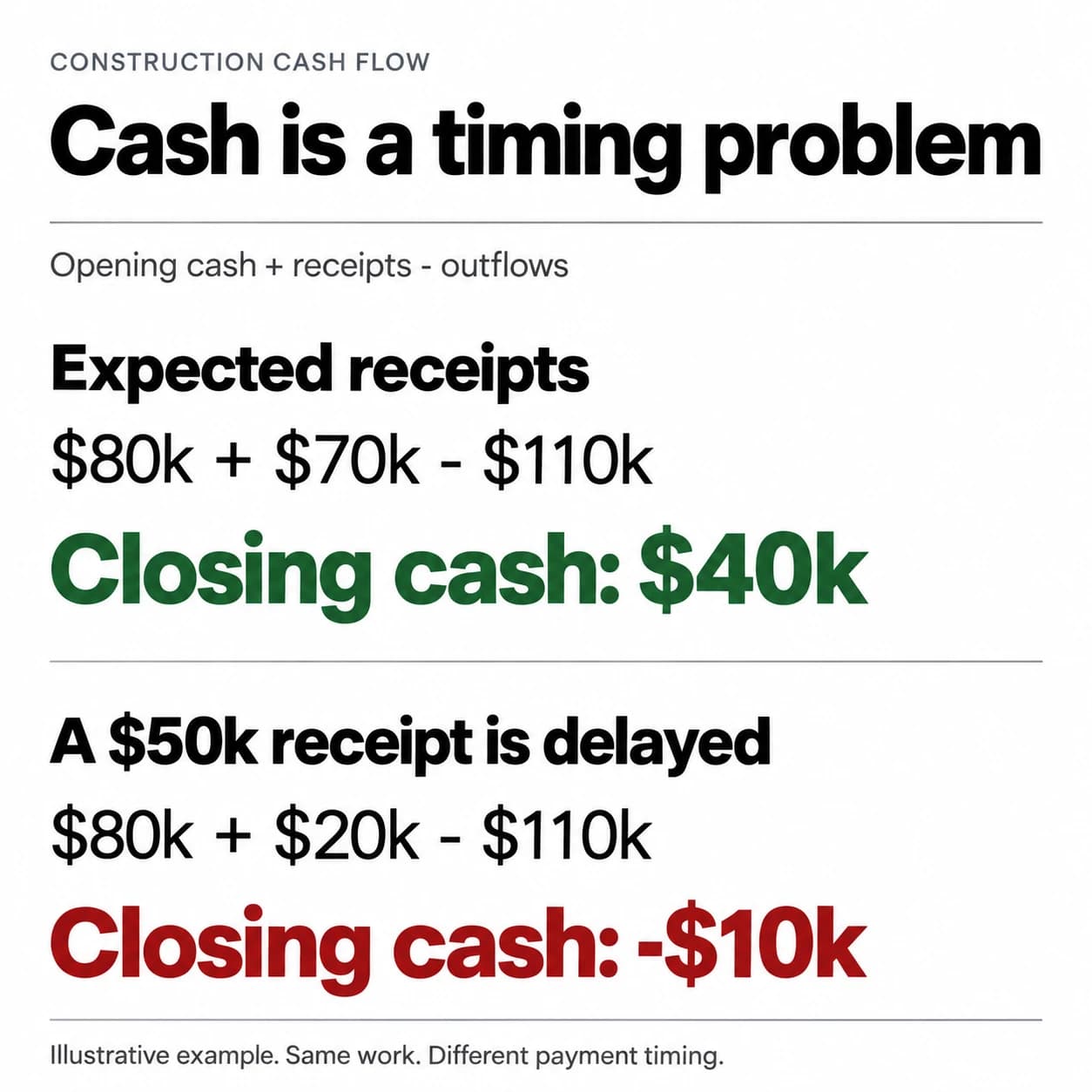
Imagine a contractor starting a month with $80,000 in available cash, expecting $70,000 in receipts and $110,000 in outflows. The forecast closes at $40,000.
Now move $50,000 of those receipts into the following month. The same forecast closes at negative $10,000. The jobs have not necessarily become less profitable. The timing has changed, and the business needs to respond before the payments fall due.
These figures are illustrative, not a client example. They show why a profit report cannot replace a cash forecast.
Slow payment is also a genuine external pressure. Billd's 2026 subcontractor report, describing respondents' experience in 2025, identifies slow GC payments and material pricing volatility as concerns. That is useful industry context, not a diagnosis of your company.
Find where completed work stops moving toward payment
Start with one recent payment that arrived later than expected. Reconstruct the sequence rather than asking everyone whether they followed up.
Completed work still needs billing evidence
The field team knows what happened. Accounting needs enough reliable information to prepare the right request for payment. Depending on the contract, that might include progress confirmation, approved changes, delivery evidence, or other supporting documents.
If the project manager sends this information after the billing cutoff, the delay began before the invoice existed. An accounts receivable report will not show that missing time.
Submitted does not mean approved
A payment application can be returned, disputed, or held for missing information. Construction payment applications have requirements that depend on the project and billing arrangement. Treating every submission as money arriving on its due date creates false confidence.
Track the actual state: ready to submit, submitted, returned, approved, due, or received. For a returned item, record what is missing and who is resolving it.
Retainage needs its own line
Do not mix retainage with ordinary near-term receivables. Track the amount withheld, the contractual release conditions, and a realistic expected receipt date separately. Requirements vary by contract and jurisdiction; the forecast should reflect the terms your team has verified.
Build the billing process before buying another dashboard
I would start by making the handoff between operations and finance explicit. A dashboard can display a missing approval very neatly. Someone still has to obtain it.
For each active project, keep a billing calendar with:
- The contractual billing date and an earlier internal preparation deadline.
- The person responsible for confirming progress and approved changes.
- The documents required for that payment application.
- The person responsible for checking and submitting it.
- The next follow-up date and owner if it is returned or unpaid.
Accounting should not have to reconstruct the job from messages. Equally, the project manager should not have to guess what accounting needs this month.
This is a useful application of process mapping and documentation: follow a real payment through the business, identify the delays you control, and agree how the next one should move.
Use a rolling cash forecast that admits uncertainty
A practical starting point is a 13-week forecast, updated weekly with finance. It is a planning horizon, not a guarantee that distant receipts can be predicted precisely.
For each week, record opening available cash, expected receipts, expected outflows, and the resulting closing balance. Include payroll, materials, subcontractors, overhead, and other obligations relevant to the business. Keep restricted funds and unapproved borrowing out of available cash.
Give each material receipt a basis for its expected date. An approved payment with a confirmed processing date is different from a disputed change order someone hopes to resolve.
Run a second view that delays uncertain receipts. This makes the discussion specific: which week becomes tight, how large is the gap, and which decision needs attention now?
The forecast should prompt a conversation with the people responsible for the business's finances. It should not become permission to assume financing will be available or to ignore payment obligations.
Hold a short weekly billing review
Bring operations and finance together around exceptions, not a tour of every job. Review work awaiting billing evidence, returned applications, overdue amounts, and changes to expected receipt dates.
For each stuck item, leave with an amount, a reason, an owner, and a dated next action. “Follow up with the customer” is too vague if the customer is waiting for a corrected application from you.
Over time, measure the days from billable work to submission, the value of returned applications, overdue receivables, and the difference between forecast and actual receipts. Keep those measures distinct. They tell you whether the delay is inside the business, with the customer, or in an optimistic forecast.
Fix what the process can actually fix
Better billing administration will not make an underpriced job profitable. It will not remove unfavorable terms or force an insolvent customer to pay. Those problems need separate commercial and financial decisions.
What it can do is reduce avoidable delay and make the remaining exposure visible sooner. That is a worthwhile result for a contractor trying to grow without relying on the owner to chase every payment personally.
If nobody can explain how completed work becomes collected cash across your projects, start there. Blackwing can help define the handoffs, responsibilities, and systems around that process. Book an operations review to examine where the work is getting stuck.
Frequently asked questions
Why do profitable construction companies have cash flow problems
Profitable contractors can face cash shortages because payroll, materials, and other payments fall due before customers pay. Billing delays, disputed applications, and retainage can widen that timing gap. Profitability and available cash need separate monitoring.
How can contractors improve their construction billing process
Set preparation deadlines before contractual billing cutoffs, assign responsibility for supporting evidence, and track submission through approval and collection. Resolve returned applications with a named owner and next action instead of treating submission as completion.
What should a construction cash flow forecast include
Include opening available cash, expected customer receipts, payroll, supplier and subcontractor payments, overhead, and other relevant obligations by week. Record the basis for receipt dates and test delayed-payment scenarios. Keep retainage and uncertain receipts visible separately.
Does construction software solve cash flow problems
Software can help coordinate billing information and show payment status. It cannot replace reliable data, clear ownership, realistic assumptions, or suitable commercial terms. Define the process and responsibilities before choosing or reconfiguring a tool.