
Construction job costing means assigning costs to individual projects and work categories so you can compare performance with the estimate. For an owner trying to protect profit, recording yesterday's spending is only half the job. You also need a credible view of what the remaining work will cost.
If you discover the loss at closeout, you can explain it. You have fewer options to change it.
A budget balance is not a profit forecast
Suppose a job has a $400,000 cost budget and the report shows $220,000 spent. That leaves $180,000 against budget. It does not tell you whether $180,000 is enough to finish.
You may have subcontract commitments that have not been invoiced, materials delivered but not recorded, or labor still needed for work that has fallen behind. A report based only on paid invoices will miss costs the business has already incurred.
Procore's guide to job costing describes allocating project costs and comparing them with estimates, including direct and indirect costs. The operational question is what your team does when that comparison starts moving in the wrong direction.
I would rather see a simple report with an honest forecast than a detailed dashboard whose numbers are three weeks late.
Forecast the cost of finishing the work
Use three separate amounts, measured on the same date and with the same cost definitions:
- Actual costs incurred to date, including valid accruals for costs not yet invoiced.
- Remaining committed costs that have not yet been incurred.
- Forecast remaining costs not already included in those commitments.
Add them to estimate the final cost. The separation matters. If an invoice is included in actual costs, do not count it again as a remaining commitment. If labor is already covered by a subcontract commitment, do not add the same work as another forecast amount.
Finance and the project manager should agree these definitions before comparing jobs. Otherwise, one project looks healthier simply because its team records costs differently.
A worked example of margin moving before closeout
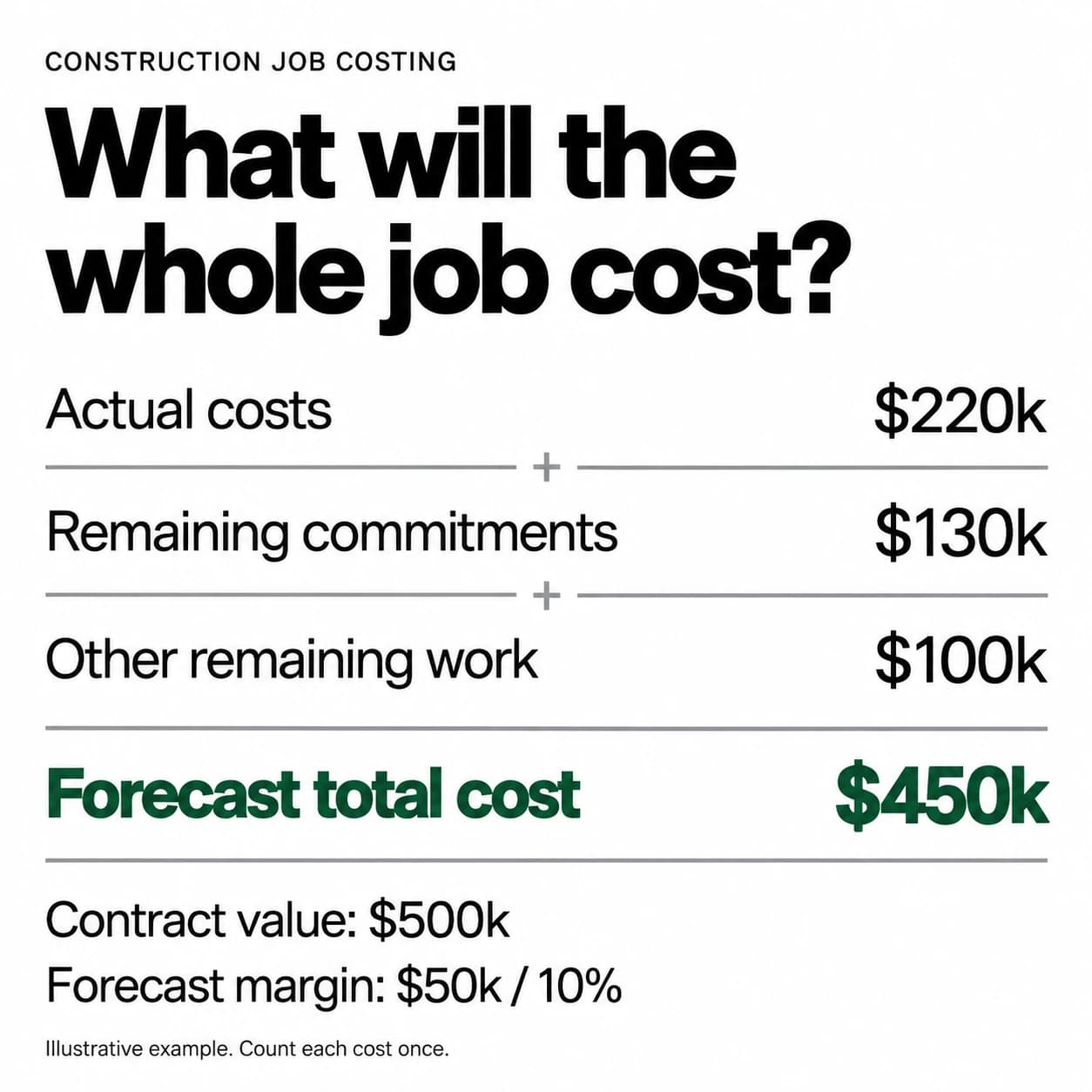
Consider a hypothetical job with an approved contract value of $500,000 and an original cost budget of $400,000. The original forecast margin is $100,000, or 20% of contract value.
At the latest review, the team records:
- $220,000 in costs incurred to date.
- $130,000 in remaining commitments not yet incurred.
- $100,000 in additional, uncommitted costs needed to finish.
The forecast final cost is $450,000. The forecast margin is now $50,000, or 10%.
The original budget has not changed. The expected outcome has.
This example assumes consistent treatment of project costs and a fixed approved contract value. That project margin is not automatically the company's net profit; company overhead, financing costs, and other items may still apply according to the accounting model.
Make field information usable for cost decisions
Accurate construction cost tracking depends on what happens before the monthly report is produced. Time, purchases, subcontract work, and progress need to reach the right job and cost category promptly.
Use cost codes people can apply consistently
Keep enough detail to identify meaningful differences between estimate and actual work. Do not create categories so elaborate that supervisors guess where time belongs.
Agree how labor hours, materials, equipment, subcontractors, and relevant indirect costs are recorded. Use the same categories in the estimate, purchasing records, field reporting, and job cost report wherever practical.
When the categories differ, document the mapping. Otherwise, the comparison may look precise while measuring different things.
Compare labor hours with progress
Using half the labor budget does not tell you much without knowing how much work is complete.
For example, a crew may have used 60% of its planned hours while completing roughly 40% of a clearly defined work package. That is a reason to investigate productivity, access constraints, rework, or an unrealistic estimate. It is not enough evidence to blame the crew.
Use appropriate production measures where available. Record how progress was assessed instead of letting an optimistic percentage become the basis for the next forecast.
Separate pending changes from approved revenue
Track the costs and potential value of changes, but keep unapproved recovery separate from the base forecast of approved contract value. Show the exposure and the approval status explicitly.
A project manager saying “we will recover that” is not the same as an approved change. Keep the commercial conversation visible without using hoped-for revenue to conceal current cost pressure.
Make the weekly review produce a decision
For active jobs with meaningful cost exposure, a short weekly review can catch changes that should not wait for month-end. Finance reconciles actual costs and commitments; the project manager updates the estimate to complete; the field lead explains progress and constraints.
Focus on the largest forecast movements. Ask what changed, what evidence supports the new estimate, and what the team can still influence.
A delayed delivery might require resequencing. Repeated rework may need a quality check earlier in the workflow. An estimating omission should be recorded so the next bid does not repeat it. Commercial disputes belong with the person authorized to handle them.
Assign the decision, owner, and review date. Do not turn the meeting into a ritual where everyone acknowledges the overrun and carries on.
Start with one live job
Choose a project with reliable enough records to reconcile. Connect its estimate, time records, purchasing commitments, subcontract costs, and remaining-work forecast. Resolve differences with finance rather than building a parallel set of numbers nobody trusts.
Then define the handoffs needed to keep that view current. Who codes time? Who records a commitment? Who updates the forecast when the site sequence changes? Who investigates an unexplained movement?
Those are system requirements. Blackwing's workflow systems implementation work starts with that kind of agreed process, then builds the fields, responsibilities, and reporting around it.
Better job costing does not guarantee a profitable project. It gives the team an earlier, more usable view of the decisions affecting the outcome. Book an operations review to examine how field information becomes a management decision in your business.
Frequently asked questions
What is construction job costing
Construction job costing assigns costs to individual projects and categories so contractors can compare them with estimates. An effective management view also includes remaining commitments and an updated estimate of the work still needed.
How do you forecast the final cost of a construction job
Add costs incurred to date, remaining commitments not yet incurred, and other forecast remaining costs. Reconcile the categories to avoid double counting. Subtract the forecast total from approved contract value to estimate margin on the same cost basis.
How often should contractors review job costs
Match the frequency to project activity and exposure. A weekly operational review can identify material changes on active jobs, while finance maintains its formal reconciliation and reporting schedule. Review major changes when they arise rather than waiting for the next meeting.
What is the difference between job costing and cash flow management
Job costing assesses the cost and expected profitability of a project. Cash flow management assesses when money will be received and paid. A profitable job can strain cash, and an early customer payment can make a loss-making job temporarily look comfortable.