
A construction equipment rental off-hire process records the request to end a rental, the supplier's confirmation, physical pickup or return, and the invoice check. Off-hire, off-rent, and call-off are terms teams may use for this request. None should be treated as a universal promise that every charge or responsibility has ended.
The key distinction is between three events: work finished, the supplier-confirmed billing treatment, and equipment returned. A machine can stop being needed before the supplier has received the request. It can remain on site after a confirmed billing stop. Payment can remain open after both.
Define What "Off-Hire" Means for This Rental
Start with the actual agreement and rental reference. Identify how notice must be given, who can give it, the relevant branch, any timing conditions, pickup or return responsibilities, and the evidence the supplier provides. Record questions for the supplier rather than filling gaps from a different rental company's process.
Sunbelt's US terms, section 13, provide a useful supplier-specific example. For delivered equipment, they describe obtaining a pickup number as evidence of the call and make cessation of rental charges after that date conditional on compliance with the contract. They also distinguish this from continuing loss or damage exposure until the required return is confirmed.
That is not a rule for every supplier or agreement. It shows why a pickup reference, billing stop, and return confirmation deserve separate fields. Check the applicable terms with your supplier and responsible reviewer. This article is an administrative workflow, not legal or financial advice.
Keep a Rental Closure Record, Not Another Asset List
General equipment tracking answers where a machine is and who is using it. Rental closure answers which agreement is ending, what notice was made, what the supplier confirmed, and whether the billed period matches the applicable record.
Use one rental-line record for each item or clearly defined group covered by the same instruction. Record the supplier, agreement number, supplier asset ID, your project, delivery method, planned end date, and responsible coordinator. A site nickname alone can lead the office to call off the wrong unit.
Link accessories and attachments that must be accounted for. If only part of a rental is ending, make the remaining on-rent items explicit. Do not close an entire agreement because one machine leaves the job.
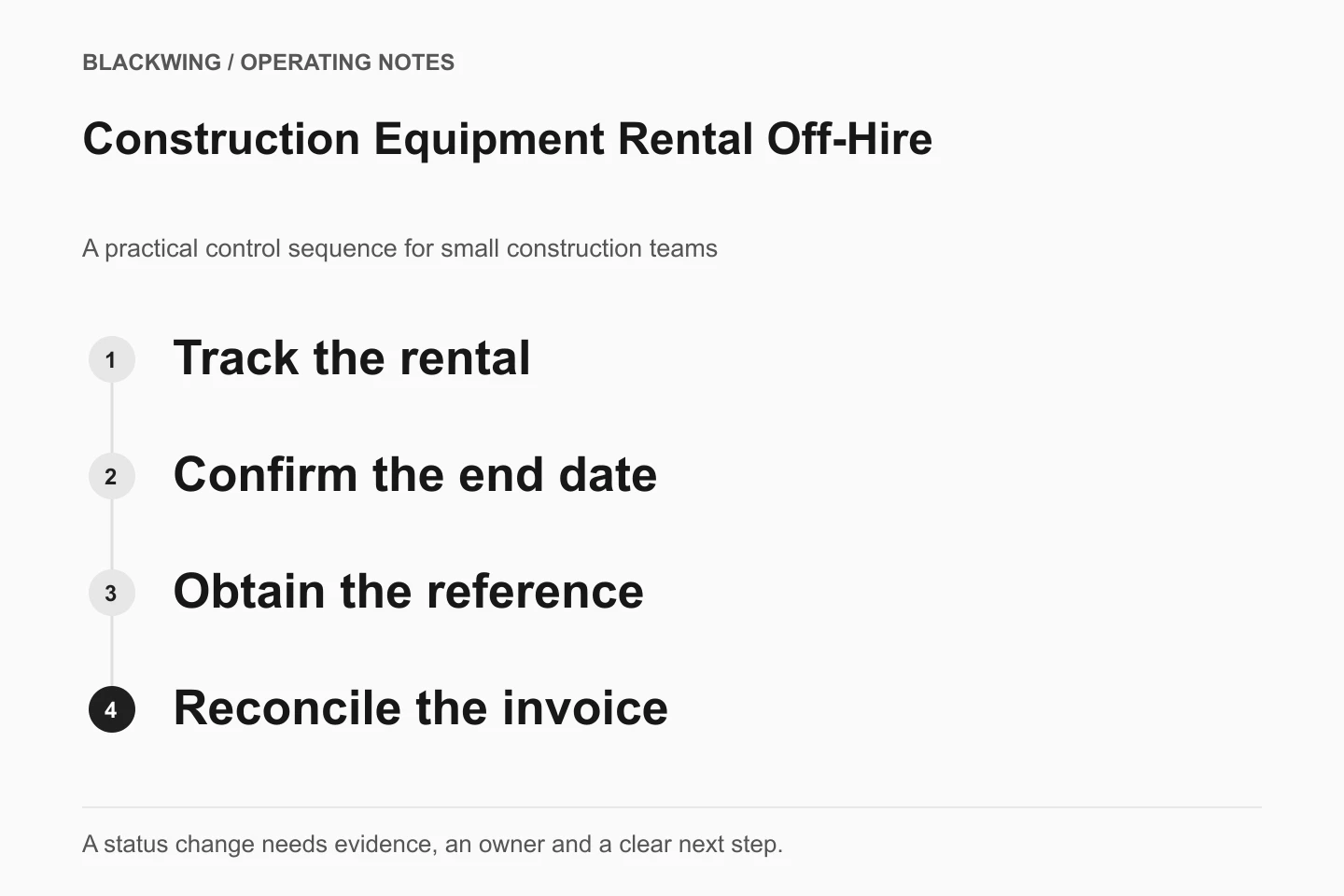
A Four-Step Equipment Rental Off-Hire Process
1. Confirm Release From the Work
The field owner confirms that the identified equipment is no longer needed for the planned work and checks with the PM before release. A machine that appears idle may still be required for a scheduled activity. Record the actual decision and the person responsible.
Separate planned finish from confirmed release. If work changes, update the plan and tell the rental coordinator. An internal date on a project board is not a supplier notification, even if the date has passed.
2. Request Off-Hire and Retain the Supplier Reference
The coordinator uses the agreement's approved route to request pickup, return, or call-off. Identify the correct equipment, agreement, location, readiness, contact, and any access constraints. Retain the request time and evidence of submission.
Obtain the supplier's confirmation or reference and record what it actually confirms. Ask about the effective billing treatment if that is unclear. An automated acknowledgment may show receipt of a request without confirming its acceptance or a stop date.
If confirmation is missing, keep an exception open with a named owner and follow-up action. Do not replace an unknown reference with "called branch" and then mark the rental closed. A conversation note can be evidence, but it should not claim a supplier confirmation that was never received.
3. Record Physical Pickup or Return
Coordinate site access and follow the applicable return requirements. Retain the pickup or return document, item identity, date, relevant condition record, and any noted exceptions. Route condition or missing-item disputes to the responsible owner.
Keep the custody status separate from billing status. The team may still need to account for an item awaiting pickup even where a supplier has confirmed a billing-stop arrangement. Conversely, moving equipment out of the work area does not prove it was returned to the supplier.
If a different unit is collected or an attachment remains on site, preserve that mismatch as an open item. A driver arriving is not, by itself, proof that every line on the agreement has been returned.
4. Reconcile the Invoice Before Closing the Cost
When the invoice arrives, compare its agreement and asset references, billed period, rates, and other charges with the agreement and confirmations. The last day of site use is not automatically the chargeable end date. Do not calculate a credit by assuming a daily proration rule.
Keep fuel, transport, cleaning, missing items, or other questioned charges separate from the rental-period question. Ask for clarification using the relevant records. Record any agreed credit or correction and its actual posting reference.
Close the cost-review workflow only when the required records and unresolved exceptions have a documented disposition. Payment approval, payment processing, and reconciliation remain separate accounting events. "Off-hired" should not mean "invoice paid."
A Rental Closure Register
| Field | Purpose | Example status |
|---|---|---|
| Agreement and asset | Identify exactly what is ending | Agreement R-218; unit L-07 |
| Field release | Record the internal work decision | PM confirmed release |
| Supplier request | Preserve route and timestamp | Request submitted; reference pending |
| Supplier confirmation | Record reference and billing treatment | Reference received; effective date checked |
| Custody end | Record physical return evidence | Pickup recorded; attachment unresolved |
| Invoice disposition | Explain differences and closure | Billed period queried; response pending |
These entries are hypothetical. Adapt the register to the actual supplier process. It should expose uncertainty rather than convert every row into a green checkbox.
Illustrative Example: Two Dates, Two Open Questions
Imagine a hypothetical contractor finishes using a rented lift on Wednesday. The coordinator requests pickup on Thursday and receives a supplier reference. The lift is physically collected on Monday. This is a teaching example, not a Blackwing client story or a savings claim.
The office does not use Wednesday, Thursday, or Monday as the billing end date merely because it seems reasonable. It checks the agreement and the supplier's confirmation. It also retains the Monday collection record to establish what was physically returned.
If the invoice covers a different period, the coordinator sends a focused query with the agreement, unit, request reference, and confirmation. The case remains open until the supplier's explanation or correction is reviewed. The workflow makes the question answerable without promising a credit.
Connect the Field, Rental Desk, and Office
Assign one coordinator and a backup. Let field leads signal release, but make supplier contact and invoice reconciliation visible to the office. A useful exception view shows missing references, equipment awaiting pickup, incomplete returns, and invoice questions separately.
Blackwing's construction systems work connects those handoffs. Workflow systems implementation can place the approved fields, reminders, and review steps in your existing tools. Automation can flag a missing confirmation; it should not infer that a supplier accepted call-off or waived a charge.
Frequently Asked Questions
Does Equipment Stop Accruing Rent When We Stop Using It?
Not necessarily. The billing treatment depends on the agreement, required notice, supplier confirmation, and applicable conditions. Record the last use date, but verify the commercial stop basis separately rather than treating idle equipment as automatically off-rent.
Is a Pickup Number the Same as a Return Receipt?
No. A pickup reference may evidence a request or other supplier-defined event. A return receipt records physical return. The meaning of each depends on the supplier's process, so retain both and keep their dates and purposes distinct.
Can We Close the Rental Before the Final Invoice Arrives?
You can record operational milestones such as release and return, but keep invoice reconciliation pending. A final invoice may still need review against the agreement and confirmations. Do not label cost review or payment complete before those actions occur.