
A construction invoice dispute process turns a rejected or questioned outgoing invoice into a reviewable case. It records the exact disagreement, connects it to the work and billing evidence, assigns the response, and preserves every corrected submission. Another payment reminder cannot answer a question about what was authorized or completed.
For a small contractor, the practical goal is simple: someone other than the owner should be able to open the file and explain what is disputed, what is supported, and what happens next. That is an evidence workflow, not a cash forecast or a new schedule of values.
Define the Dispute Before Building the Response
An overdue invoice is not automatically a disputed invoice. A dispute exists when the customer or reviewing party challenges an amount, scope item, quantity, quality issue, authorization, or submission requirement. Record that challenge in their words before categorizing it.
Also separate a missing-document rejection from a disagreement about the work. The first may require a corrected package. The second may require project, commercial, or legal review. Calling both "waiting for payment" hides the decision your team needs to make.
The distinction appears in a specific public-contract example. FAR 52.232-27 identifies required invoice information and separately addresses disagreements over quantity, quality, and contract compliance. It applies within its federal contracting context. Its requirements and deadlines are not universal rules for private remodeling contracts.
Use the actual agreement and applicable requirements to determine notices, deadlines, and escalation. This guide explains recordkeeping, not collection rights or legal remedies.
Build a Four-Part Dispute File
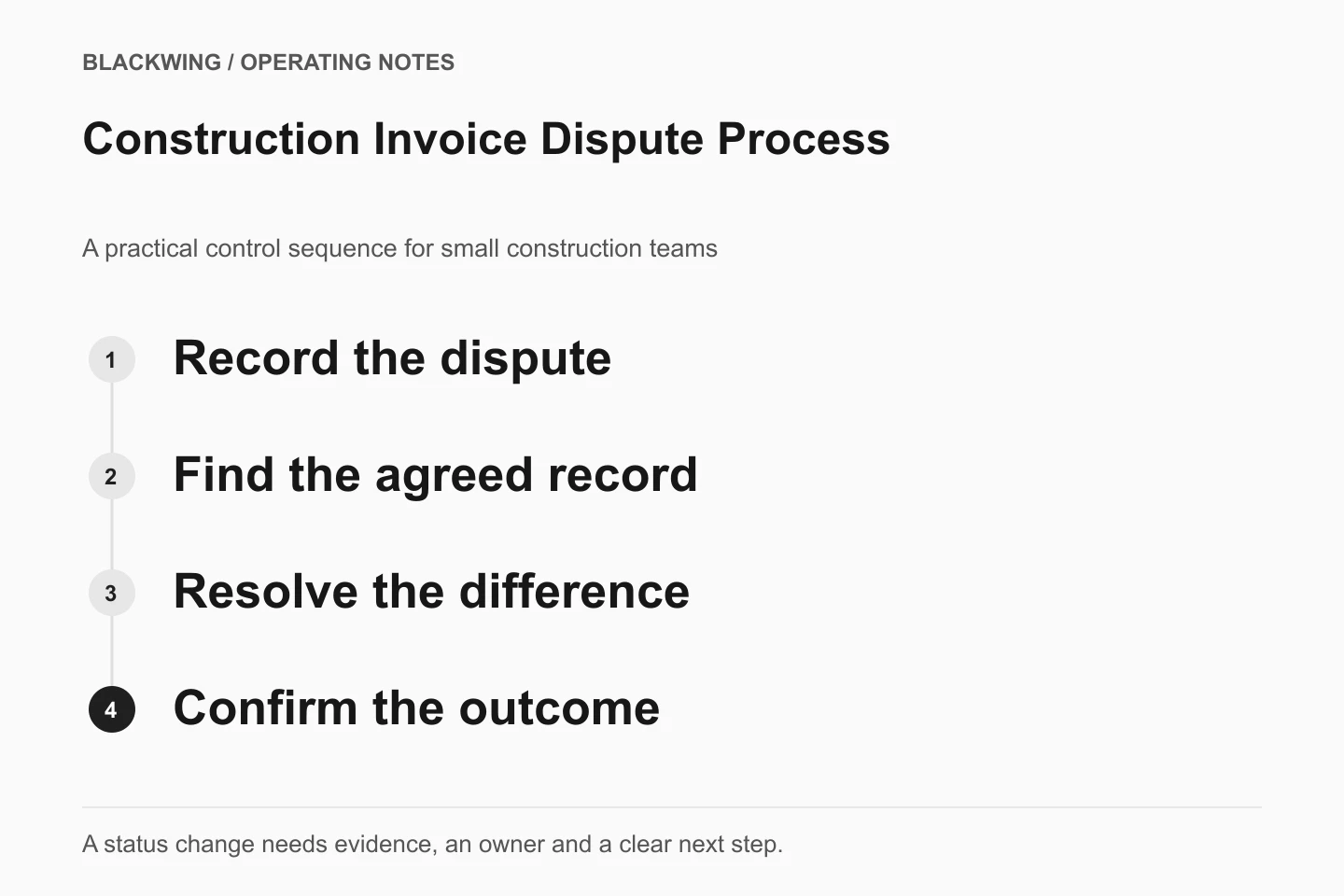
Use four sections: issue, basis, response, and disposition. These are proposed operating categories, not a prescribed contract procedure.
1. Issue: What Exactly Was Rejected?
Create one case ID linked to the project, customer, invoice number, billing period, and original submission. Preserve the invoice as sent, the transmission record, and the rejection message. Keep the date received separate from the date someone entered the case.
Record the challenged line and amount when known. If the customer only says "this is wrong," the next action is clarification, not an internal guess presented as their position. Identify who can clarify the question and who owns that request.
2. Basis: Which Records Answer the Question?
Link evidence to the challenged item rather than dropping the entire project folder into an email. A scope question may need the accepted proposal and an authorization record. A quantity question may need measurements or daily tickets. A completion question may need dated work records and the relevant acceptance evidence.
Identify the document version, date, and relevant section. Note missing evidence explicitly. A photograph may show installed work without proving its commercial authorization. A signed delivery ticket may establish receipt without establishing that a billed amount is correct.
3. Response: Who Can Decide and Reply?
The coordinator gathers the record. The project manager explains field facts. The authorized commercial owner decides the proposed response, subject to any required professional review. These can be different people even in a small team.
Before sending, check that the reply answers the stated objection, uses the correct invoice version, and does not accidentally promise a credit or settlement beyond the sender's authority. Record who approved the response and retain what was actually transmitted.
4. Disposition: What Changed?
Distinguish clarification sent, corrected invoice submitted, customer response received, amount agreed, adjustment posted, and payment reconciled. None of these statuses automatically proves the next one.
If the invoice changes, preserve the original and link its replacement. Ask the billing owner how the replacement should be identified so the customer does not process both. Record the final outcome and any unresolved balance without overwriting the history.
A Construction Invoice Dispute Register
Start with a small register and linked evidence, not a second accounting ledger.
| Field | What it should establish | Example entry |
|---|---|---|
| Case and invoice | Which submission is under review | D-014; invoice 106, version 1 |
| Rejection reason | The specific unanswered question | Customer questions extra disposal scope |
| Evidence and gap | What supports the response; what is absent | Authorization email linked; disposal receipt missing |
| Response owner | Who prepares and approves the reply | PM prepares; commercial lead reviews |
| Next action | A named action with a review date | Coordinator requests receipt |
| Version and outcome | What was sent and what followed | Version 2 submitted; response pending |
The entries above are illustrative. Your actual fields should follow the contract, accounting system, and approval responsibilities. Keep restricted commercial records in controlled storage rather than attaching them to a broadly visible dashboard.
Illustrative Example: A Questioned Disposal Charge
Consider a hypothetical remodeler whose invoice includes an extra disposal charge. The customer disputes that line because the original proposal included debris removal. This is an invented teaching example, not a Blackwing client story or a recovered-payment claim.
The coordinator opens a case and preserves the original invoice. The PM identifies an email discussing a different disposal requirement, but the file does not show whether the customer approved its price. The disposal receipt confirms a cost occurred; it does not settle the authorization question.
The next action is therefore not "resend receipt and demand payment." The commercial owner reviews the scope and authorization gap, obtains any missing records, and decides the permitted response. If a correction is approved, the billing owner issues the appropriate revised document and links it to the case.
The register remains open until the agreed disposition is recorded. Sending an explanation is a milestone, not proof that the customer accepted it.
Keep the Workflow Useful After the First Case
Choose a review rhythm that fits your billing cycle. Review cases by missing decision and next action, not just invoice age. A case waiting for a receipt needs a different intervention from one waiting for an authorized position on scope.
Track rejection categories consistently. Repeated missing attachments may justify a submission checklist. Repeated authorization gaps may point upstream to the project workflow. Do not treat the number of closed cases as success without checking whether they were resolved, withdrawn, or simply hidden.
If ownership is unclear, business process mapping can define the handoffs before software is configured. Blackwing's construction systems work connects those responsibilities to forms, project records, and review queues. Automation can remind an owner about a missing action; it should not invent acceptance or resolve a commercial disagreement.
Frequently Asked Questions
What Should a Construction Invoice Dispute File Include?
Include the invoice as submitted, proof of submission, the exact objection, relevant scope and work records, identified evidence gaps, approved responses, revisions, and disposition. The required records depend on the agreement and issue. More attachments are not necessarily better evidence.
Should We Replace the Invoice as Soon as Someone Objects?
Not automatically. First establish whether the issue needs clarification, missing documentation, or a genuine correction. Have the authorized billing owner control revisions and replacement references so the original and corrected versions cannot be mistaken for separate charges.
Does a Complete File Guarantee Payment?
No. A complete file makes the disagreement easier to review; it does not establish legal entitlement or guarantee acceptance or recovery. Contractual deadlines, remedies, and payment decisions need the appropriate authorized and professional review.