
A construction mobilization release record connects one project's initial setup status to the instructions issued to a specific crew for its first arrival. It identifies what has been arranged, what has actually been received and handed over, who authorized the dispatch, and which instruction revision the crew acknowledged.
This is a narrow coordination control for contractors running several jobs. It is not a project-wide preconstruction checklist, a safety assessment, or permission to bypass the project's established approvals. It starts after those responsibilities have been defined and makes the first-day handoff usable.
The question is straightforward: does the crew have one reliable instruction for this project, or several messages that no longer agree?
Separate the setup record from the crew calendar
The calendar tells you who is allocated and when. The mobilization record explains the first arrival: project ID, assigned crew lead, reporting contact, arrival arrangement, initial work package, current document link, and the setup items that support that arrival.
Use a separate release ID for each project and crew dispatch. If the same crew moves between two jobs, its instructions should identify the destination explicitly. Do not copy a previous project's release and leave its location, contact, or delivery assumptions inside the new one.
The August 2026 UFGS temporary-facilities guide specification separates site-plan and submittal information from execution topics such as employee parking, temporary facilities, and storage areas. It provides a current federal example of distinct setup packages, not a mandatory checklist for private construction businesses.
For an operations record, the useful distinction is planned versus delivered versus handed over. Track the responsible party's confirmation without using the record to make technical judgments about facilities or equipment.
Use a setup-to-instruction release register
Build one compact record with links to the underlying project controls. The following proposed checklist focuses on administrative evidence and first-day communication. Project-specific technical and safety decisions remain with the responsible qualified people.
| Release element | Evidence to link | What the crew instruction needs |
|---|---|---|
| Project and dispatch identity | Project ID, crew lead, date, release revision | Unambiguous destination and current version |
| Initial setup packages | Request, order, delivery, installation if applicable, and acceptance references | Which arrangements are actually handed over |
| Open setup items | Punch item, affected package, responsible owner | Any stated limitation on the first assignment |
| Close-down ownership | Named removal or return coordinator and linked plan | Who retains responsibility after initial setup |
| Arrival logistics | Confirmed access arrangement and reporting contact | Where and to whom to report |
| First work package | Approved instruction or document reference | Defined assignment and its limits |
| Shared resources | Allocation confirmation for this dispatch | Which resource belongs to this project |
| Release authority | Named authorizer and timestamp | Whether dispatch is authorized |
| Crew acknowledgment | Lead acknowledgment of the issued revision | Confirmation the instruction was received |
| Changed instruction | Superseding revision and notification record | Which earlier instruction is withdrawn |
Do not paste private access credentials into a widely shared board or public document. Point authorized recipients to the appropriate controlled channel. The release needs a usable access arrangement, not a permanent copy of every sensitive detail.
Make setup status observable
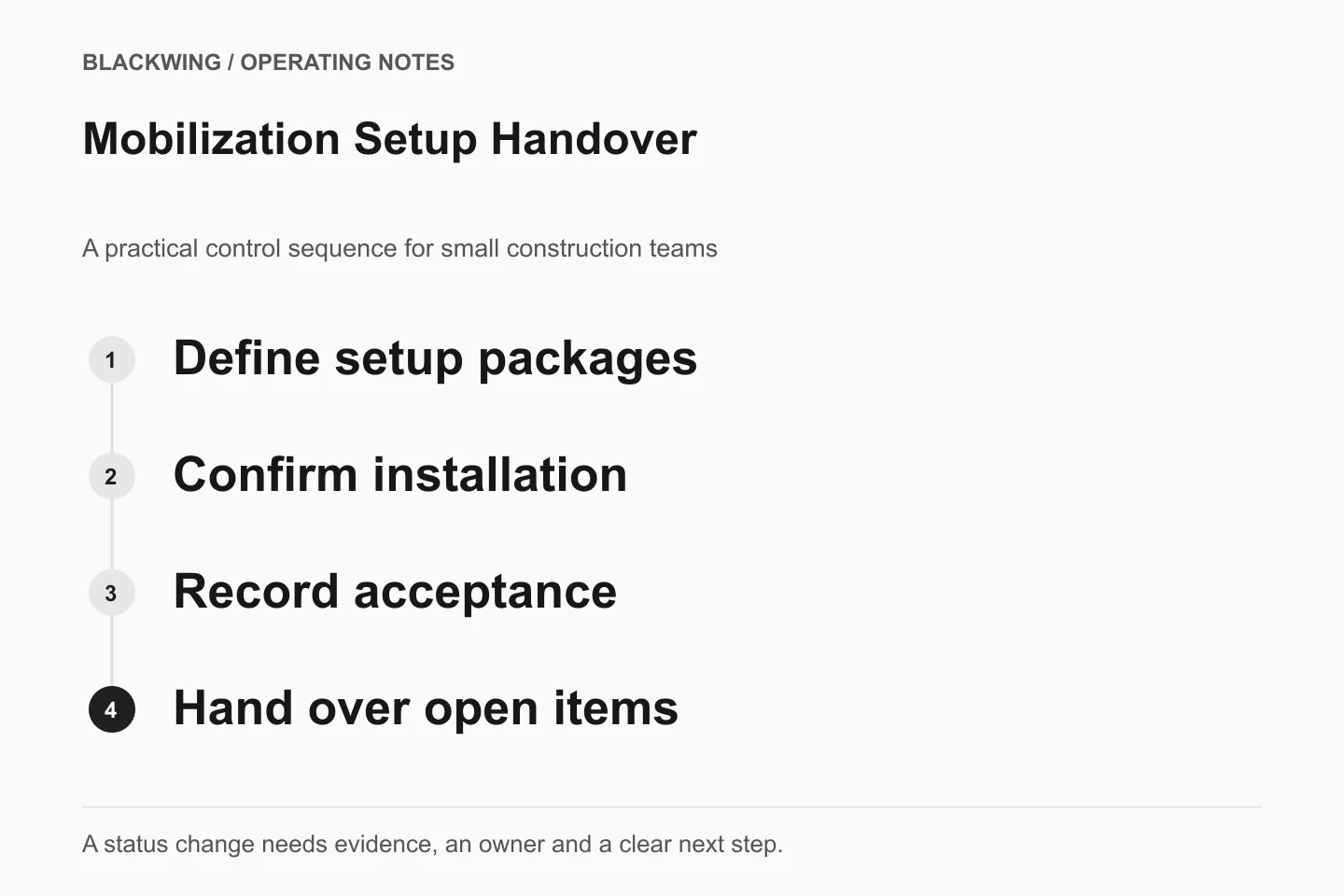
For each initial setup package, trace request, order, delivery, installation where applicable, acceptance, and handover. Record installation and acceptance as confirmations by the responsible parties, not judgments by the release coordinator. A delivery record alone does not establish that a setup package was accepted. Define the evidence required for your project rather than letting everyone interpret "ready" differently.
Retain open setup punch items with a named owner and an agreed disposition. Identify who coordinates later removal, return, or close-down, even though the first-day release does not manage that future work. This keeps a temporary setup package from losing its owner once the crew arrives.
Track exceptions at package level. If a storage delivery is delayed, identify the affected dispatch and the owner of the revised arrangement. Do not declare the whole project unready or ready based on an unrelated checkbox. The release authorizer needs the impact on this crew's first assignment.
Reference existing approvals instead of recreating the broader preconstruction review. The release coordinator checks that the required references and responsible-party confirmations are present. They do not certify design, permit, safety, or technical compliance by completing this administrative record.
Illustrative example: two Monday starts and one changed delivery
Imagine a contractor coordinating fictional Projects A and B for the same Monday. Crew A is assigned to Project A; Crew B is assigned to Project B. A shared setup delivery is initially recorded against A, but a supplier message later changes its destination to B. This is an illustrative coordination scenario, not a client story.
Without project-specific release records, the scheduler may see two staffed starts while Crew A follows an outdated group message. The missing link is not another capacity calculation. It is the connection between the changed setup arrangement and the instruction issued for A.
The coordinator updates A's setup exception, routes the revised first-day arrangement to its authorizer, and issues release revision 2 only after the relevant decision is recorded. Crew A's lead acknowledges revision 2. The earlier message is marked superseded and the change is communicated through the team's established channel.
Project B retains its own record. Receiving the delivery at B does not prove A's revised arrangement is resolved. Each release can now be checked against its own evidence instead of a general message that "Monday is sorted."
Control the last change before dispatch
Set an internal time for reviewing first-day instructions based on how your team operates. This is a communication practice, not a universal contractual deadline. Confirm the project, crew, setup exceptions, reporting contact, document revision, and authorization at that review.
If something changes afterward, identify the release it affects. Record what changed, who decided the revised arrangement, and which instruction supersedes the previous one. A message sent is not the same as an acknowledgment received. Keep any unacknowledged revision visible to the coordinator.
- Issued: the authorized first-day instruction has been sent.
- Acknowledged: the crew lead confirms the current revision was received.
- Arrival confirmed: the lead reports arrival through the agreed channel.
- Exception returned: the first-day arrangement differs and needs an authorized response.
Keep arrival confirmation bounded. It shows that a communication event occurred, not that all project work is acceptable or that the crew should improvise around an unresolved condition. Route changes and exceptions through the project's existing responsibilities.
Blackwing's construction operations services can help connect multi-project dispatch, setup records, and crew instructions. The aim is a handoff people can use without searching several chats for the latest arrangement.
Frequently asked questions
How is a mobilization release record different from a preconstruction checklist?
A preconstruction checklist covers broad project preparation. A mobilization release record documents a specific first-day dispatch: setup handover status, arrival logistics, assigned work references, authorization, and crew acknowledgment. It links to wider approvals rather than duplicating or replacing them.
Does crew acknowledgment mean approval to start every activity?
No. Acknowledgment confirms receipt of the named instruction revision. It does not replace activity-specific authorization or any required project review. Keep the first assignment and its limits explicit, and route exceptions to the responsible person.
What should change when a crew moves to another project?
Create a project-specific release with the correct destination, reporting contact, assignment references, resource allocation, and setup evidence. Retain the previous release as history. A changed calendar entry alone does not establish that the crew received the new first-day instructions.
Make the first arrival a traceable handoff
A useful construction mobilization readiness checklist ends with a current instruction and an acknowledgment, not a broad claim that the project is ready. Start with the next two dispatches. Give each its own setup-to-release record and check whether the right crew receives the right revision.