
A construction value engineering decision log records the function an option must preserve, the alternatives considered, their cost and delivery trade-offs, the authorized decision, and what changed afterward. It keeps an idea for better value separate from permission to change the work.
A shorter lead time, simpler installation sequence, or lower purchase cost may make an option worth exploring. None of those benefits answers the whole question. What changes for the customer? What additional work does the option create? Who can approve it?
The practical goal is a decision someone can trace later, without reconstructing a meeting from memory.
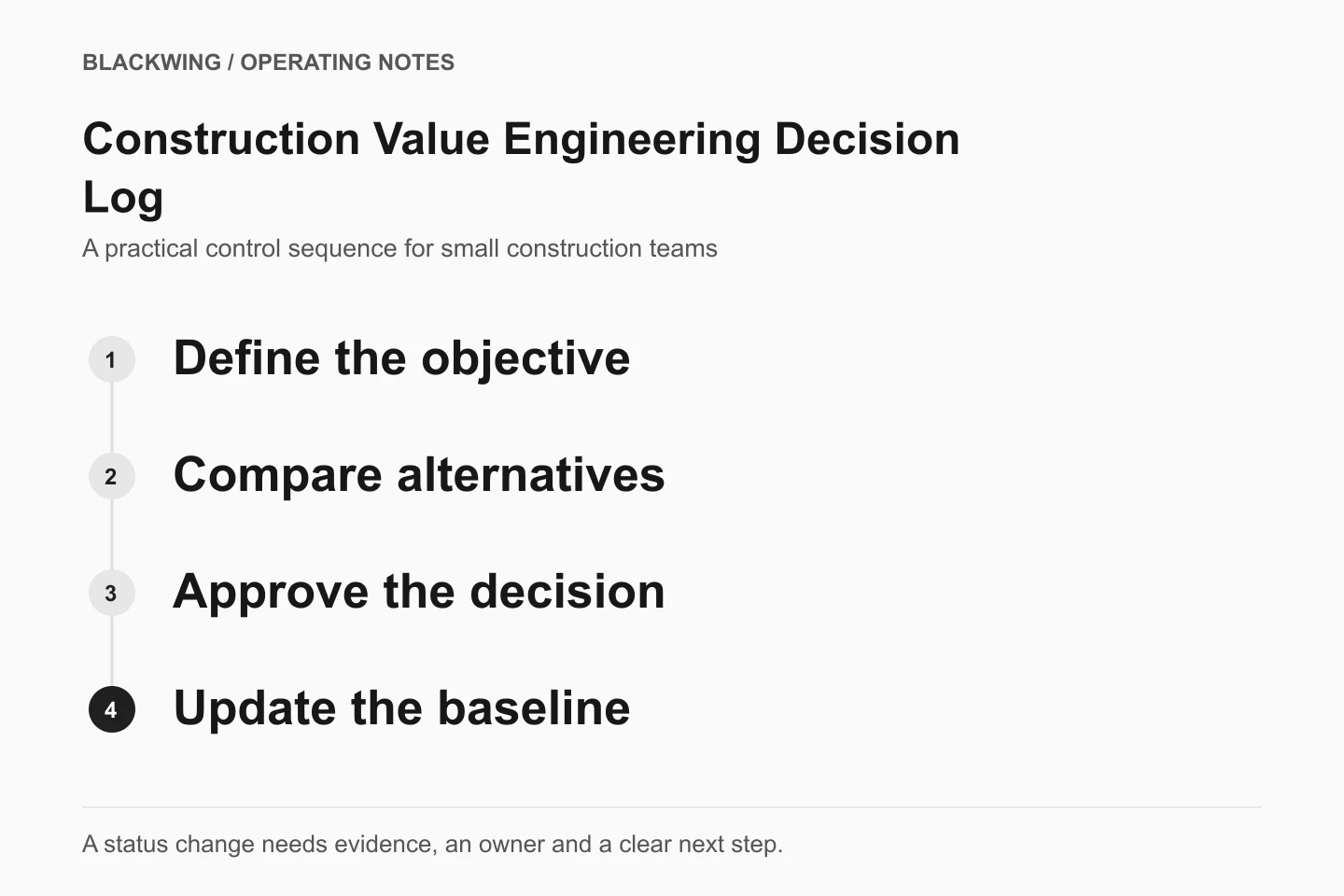
Start with the function, not the discount
The FHWA value-engineering job plan separates function analysis, alternatives, evaluation, development, presentation, and implementation. Its evaluation considers life-cycle cost as well as performance and schedule. This is a useful methodological reference, not a requirement imposed here on private remodeling projects.
Use that distinction to improve your first question. Instead of asking only how to reduce an item's price, describe the outcome the item must deliver. Keep the description understandable to the customer and the people reviewing the option.
An operations team can organize the decision without pretending to perform engineering. Route design suitability, required performance, and technical acceptance to the qualified people responsible for those matters. A green status in a project board is not technical approval.
Create an option-to-release decision record
Give every option a stable ID. Keep the current approved baseline beside the proposal so reviewers can see exactly what would change. The following log is a proposed business-process tool, not a substitute for the project's design and change-control documents.
| Record field | Question it must answer |
|---|---|
| Baseline and function | What is approved now, and what outcome must remain? |
| Proposed option | What specifically changes, and who proposed it? |
| Cost basis | Which quote, quantity, date, and exclusions support the estimate? |
| Trade-offs | What changes in appearance, maintenance, availability, or coordination? |
| Dependencies | Whose review or revised document is needed? |
| Decision | Accepted, rejected, deferred, or returned for information? |
| Authority and conditions | Who decided, when, and subject to what conditions? |
| Implementation and verification | Where was the approved change issued, and what proves it took effect? |
Attach the evidence rather than pasting unsupported conclusions. If a supplier says an option is available earlier, retain the dated quote or confirmation. If maintenance costs are unknown, record that uncertainty instead of filling the field with a hopeful estimate.
Keep rejected and deferred options in the log. Their reasoning helps the next project manager understand why an attractive suggestion was not pursued. Otherwise the same option can return in a later meeting without the limitation that ruled it out.
Compare net effects on the same basis
A lower purchase price can be offset by redesign, cancellation, additional coordination, or a different installation sequence. Separate those effects instead of displaying one unqualified savings number. Include credits and already committed costs where relevant to the actual decision.
Use three cost statuses: preliminary estimate, supported proposal, and verified outcome. Moving an option through approval does not automatically move its estimated benefit into the verified category. Close that gap after implementation with the records available for the project.
Also distinguish a possible schedule benefit from an agreed revised schedule. Earlier supplier availability may help, but other constraints may prevent the project from finishing sooner. Describe the specific milestone affected and who has confirmed the proposed change.
Illustrative example: one option, three different decisions
Imagine a fictional remodeling project comparing the current custom storage layout with a standardized module layout. The customer needs the same agreed storage capacity and appearance criteria. The alternative has a quoted purchase reduction of $4,000. These are illustrative figures, not a Blackwing client result.
The team estimates $700 for document revisions and $300 for additional coordination. The preliminary net reduction is $3,000 before any other effects. The log separately identifies an unconfirmed cancellation charge on the original order and a customer review of the changed layout.
At this point the correct status is "under review," not "$3,000 saved." The customer might accept the appearance change, the responsible reviewer might return it for revision, or the cancellation charge might remove the financial advantage. Those are different decisions with different evidence.
If the option is accepted, record the approval conditions and follow the agreement's change procedure. Then identify the updated drawing, purchasing instruction, and customer-facing record. The value-engineering log points to those controls; it does not replace them.
Use clear statuses so an idea does not become an instruction
- Proposed: an option exists, but its basis is incomplete.
- Evaluating: reviewers are comparing function, cost, and other effects.
- Decision recorded: the authorized response and conditions are captured.
- Released: required approval conditions are satisfied and controlled instructions are issued.
- Verified: implementation and the available outcome evidence have been reviewed.
Assign one coordinator to move the record between states. That person follows up with reviewers and checks evidence. They do not inherit the authority to approve a design change simply because they maintain the log.
For conditional acceptance, identify exactly what remains open. "Approved subject to revised layout acceptance" should stay visibly conditional until that acceptance is documented. Do not send an unconditional purchasing instruction because the headline status says approved.
When ownership is unclear, business process mapping can make the option review, customer decision, document revision, and release handoffs visible. Map the decisions and exceptions before choosing how to automate reminders.
Frequently asked questions
Is value engineering the same as choosing cheaper materials?
No. Value engineering considers how to provide the required function with a better overall balance of cost and other project needs. A cheaper item that changes the required outcome is not automatically a better-value option. Its trade-offs need explicit review.
Who should approve a value-engineering option?
Use the decision authority defined for the project and the type of change. Customer acceptance, technical review, and commercial authorization may belong to different people. Record each required decision separately rather than treating one general approval as permission for everything.
When can a proposed saving be reported as achieved?
Report a benefit as achieved only after the approved option is implemented and the available cost evidence supports it. Until then, label the amount as estimated or approved but unverified. Avoid counting the same benefit in more than one report.
Keep the reasoning with the change
A construction value engineering decision log should explain what the team protected, what it traded away, and what it authorized. Start with one live option. Make its baseline and unknowns visible, obtain the right decisions, and confirm the approved change reached the people doing the work.