
A subcontractor backcharge process should create a reviewable record of the issue, the applicable contract procedure, notices, responses, corrective work, costs, and authorized disposition. It should not turn a superintendent's complaint directly into an accounting deduction.
For this guide, a proposed backcharge means a proposed allocation of costs to a subcontractor because of an alleged failure to perform an obligation. "Proposed" matters. Recording a cost does not establish responsibility, recoverability, or a right to withhold payment.
The useful operational question is: can the authorized reviewer follow the record from the original issue to the final decision without relying on someone's memory?
Start With the Actual Subcontract
Before choosing a notice template or correction date, have the authorized contract reviewer identify the relevant agreement, amendments, notice route, response requirements, and decision authority. The applicable procedure may differ by issue and by contract. Applicable law may also affect the decision.
AIA's own summary of A401-2017 describes provisions concerning notification of faults or nonconformities, correction costs, and written notices. It distinguishes ordinary notice from notice of claims. This is a description of one model subcontract, not proof that your signed agreement grants the same rights or uses the same procedure.
Do not borrow an owner-to-contractor notice period and apply it to a subcontractor. Do not copy a deadline from another job. This article is a workflow guide, not legal advice or authorization to deduct, supplement labor, or undertake corrective work at another party's expense.
Use an Issue-to-Disposition Log
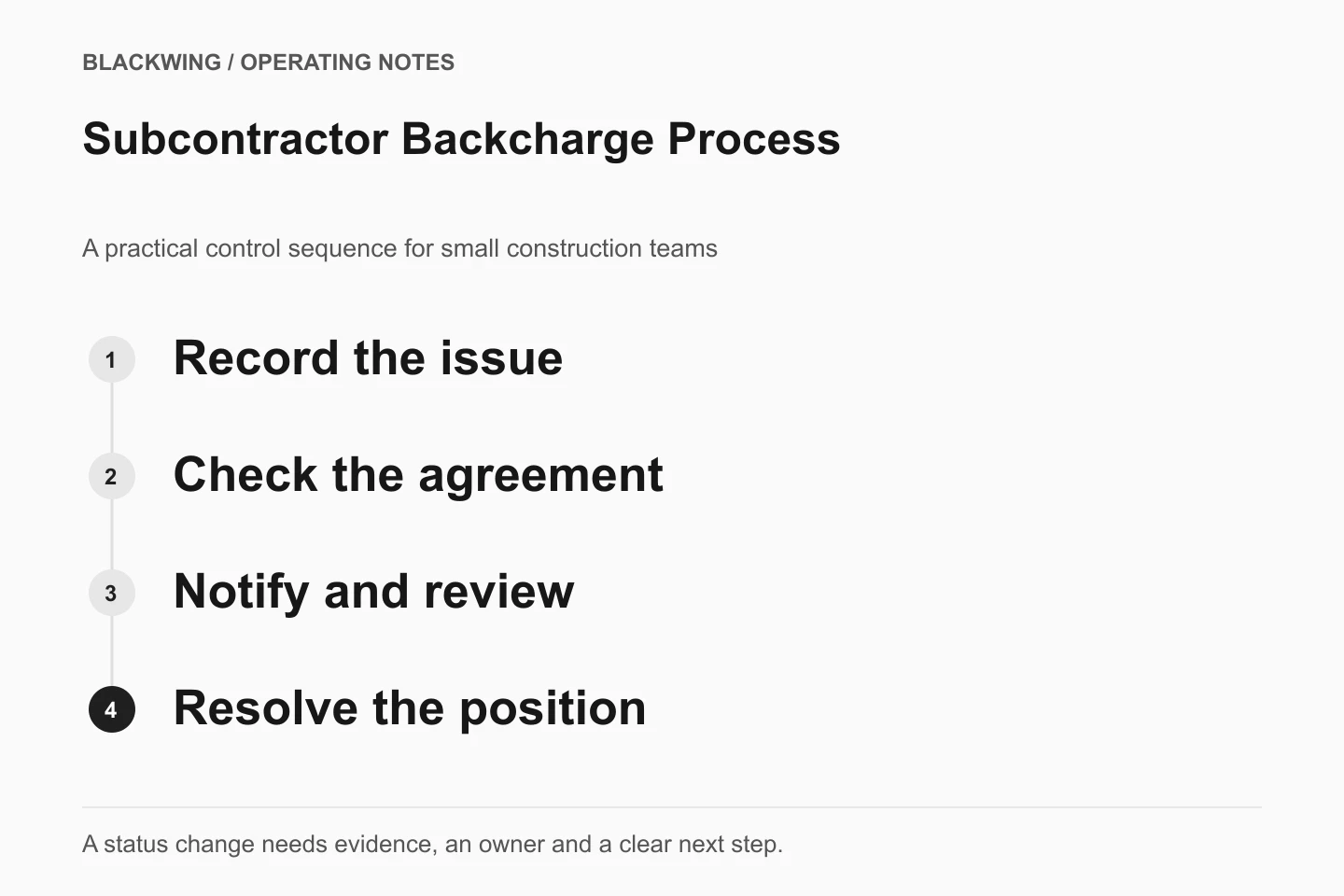
Build the record through four stages: establish the issue, confirm the procedure, document the work and cost, and authorize the disposition. Keep disputed facts visible throughout.
1. Establish What Happened
Give the issue a case ID. Record its location, date observed, relevant scope item, and the obligation believed to be affected. Capture dated photographs, inspection records, daily notes, or other evidence appropriate to the issue.
Separate observation from attribution. "Material remains in the corridor" is an observation. "This subcontractor caused the obstruction and owes all cleanup costs" is a conclusion that needs support. Record other trades present, access restrictions, and any uncertainty about who created the condition.
Identify immediate site or project needs through the responsible management process. An urgent operational response should still leave a factual record. Do not use this administrative workflow as a substitute for site safety procedures or emergency authority.
2. Confirm and Record the Required Procedure
The authorized reviewer determines what communication is required, to whom, by which channel, and on what timetable. Store that determination with its source. If the procedure is unclear, mark it unresolved and escalate rather than filling in a familiar deadline.
Keep the notice actually sent, its attachments, recipient details, transmission or delivery evidence, and the response. A draft notice in a folder is not proof of notice. A task marked "emailed" may not establish delivery by the method the agreement requires.
Capture the subcontractor's position fairly, including any challenge to scope, responsibility, access, timing, or the proposed remedy. If they undertake correction, record what was checked and whether the issue was resolved. Do not keep a proposed charge alive simply because a case was opened.
3. Document Any Authorized Work and Actual Cost
Where corrective work is authorized through the applicable process, link the instruction to its work records. Keep labor quantities, material use, equipment records, invoices, and other supporting cost evidence separate from an unsupported estimate.
Show the basis of each line. Identify shared costs and exclude unrelated work from the proposed allocation. Do not spread a general cleanup bill across trades merely because they were on site, or add a standard percentage without the appropriate basis and approval.
Retain estimates as estimates. If actual costs differ, explain the difference rather than overwriting the original forecast. The reviewer needs to see what was expected, what was done, and what amount is now proposed.
4. Authorize and Reconcile the Disposition
Route the complete file to the designated commercial decision maker and any required professional reviewer. Available workflow outcomes may include withdrawn, further evidence required, disputed, agreed adjustment, or approved action. The agreement and applicable requirements determine what actions are available.
Give accounting a specific authorized instruction, not a vague "backcharge approved" status. Record any adjustment reference and read back the posted result. If a charge remains disputed, preserve the dispute and its next action instead of labeling it accepted because a ledger entry exists.
A Review-Ready Backcharge Checklist
The following checklist is an original operating example. It does not grant a contractual remedy.
| Review question | Minimum record to locate |
|---|---|
| What obligation is allegedly affected? | Signed scope and relevant contract reference |
| What is observed, and what is disputed? | Dated issue evidence and both parties' positions |
| Which procedure applies? | Authorized review of notice, timing, recipients, and authority |
| What was actually communicated? | Sent notice, attachments, delivery evidence, response |
| What work and cost are supported? | Authorized instruction and itemized actual records |
| What decision was made? | Named decision owner, reasons, permitted action, accounting reference |
If one row is missing, show the gap explicitly. A complete-looking form should not conceal an unanswered question about responsibility or authority.
Illustrative Example: Cleanup With Mixed Responsibility
Consider a hypothetical project with packaging and offcuts left in a shared work area. A site lead proposes charging the whole cleanup invoice to one subcontractor. This example is invented to explain the workflow; it is not a client result.
The case file shows photographs but also confirms that several trades worked in the area. The subcontract reviewer checks the relevant responsibilities and notice requirements. The subcontractor provides photographs of its own cleanup and challenges the allocation.
The commercial reviewer asks for more evidence rather than treating the supplier invoice as proof of responsibility. Any supported portion, unresolved portion, and authorized disposition remain distinct. The outcome might be a revised proposal, withdrawal, or further review. The workflow does not predetermine who pays.
Keep Commercial Review Separate From Performance Scoring
A backcharge case is not a substitute for subcontractor performance management. Do not turn an unresolved allegation into a confirmed performance failure. Equally, a long-standing relationship does not remove the need for a documented commercial decision.
If your field, PM, and accounting teams interpret the same status differently, start with business process mapping and documentation. Blackwing's construction operations work can help define the record and handoffs. Contract interpretation and legal entitlement remain with the appropriate authorized professionals.
Frequently Asked Questions
Does a Backcharge Log Prove We Can Deduct the Cost?
No. The log organizes evidence and decisions. Whether a deduction, withholding, or other remedy is available depends on the actual agreement, facts, applicable requirements, and authorized review. A completed internal form does not create a right.
Is There One Standard Notice Period for Backcharges?
No universal period is supplied here. Different agreements and issues can require different procedures. Have the responsible reviewer establish the applicable requirements before relying on a date or communication method from a template or another project.
Should Estimated Costs Be Included in the File?
Yes, when clearly labeled and relevant to the review. Keep them separate from actual incurred costs and explain revisions. An estimate can inform planning, but it should not be presented as a verified final cost or automatically posted as a deduction.