
Subcontractor bid leveling is the process of comparing proposals against one defined scope so you can see what each price includes, excludes, or leaves unanswered. The output should be an award recommendation supported by clear coverage, not just a spreadsheet sorted from lowest to highest.
For a small contractor, the difficult part is often the space between trades. One proposal includes delivery but not unloading. Another includes installation but assumes someone else prepares the work area. Both prices may be accurate. They are not yet comparable.
Start with one question: if we accept this proposal, who owns every part of the package? Resolve that before negotiating the final number.
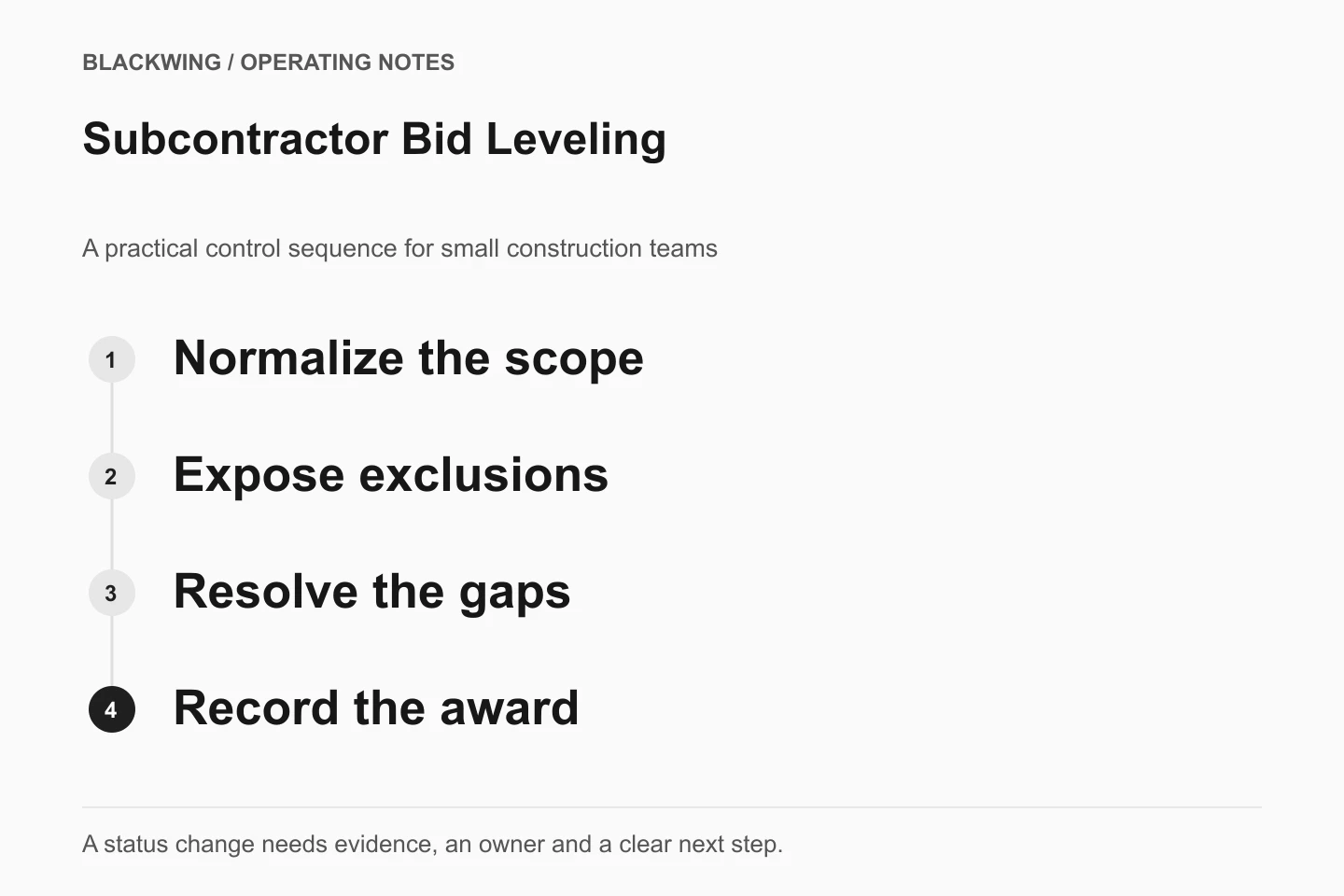
Define the comparison before opening the bids
Give the comparison a package ID and identify the drawings, specifications, scope notes, and addenda used as its baseline. Record the revision and issue date. If bidders priced different information, flag that difference before discussing their totals.
Break the package into deliverables and interfaces. A useful row describes something someone must supply, perform, coordinate, or hand over. Avoid a single line called "complete scope" that hides all the questions you need to ask.
The Procore bid-leveling instructions distinguish missing or excluded bid items, alternates, and edited comparison values. That supports an important recordkeeping distinction: the submitted bid and your evaluation adjustments should remain identifiable.
You do not need that product to apply the principle. Keep an untouched copy of each proposal and link every clarification to the comparison. A neatly typed cell is not evidence that the bidder accepted it.
Use a coverage matrix, not a price-only table
The following is a proposed working structure. Add a column for each bidder and keep the evidence reference beside the response. Use four explicit labels: included, excluded, unclear, and not applicable with a reason. A blank cell is still an unanswered question.
| Comparison row | What to establish | Evidence to retain |
|---|---|---|
| Base deliverable | Exact work, quantity basis, and limits | Proposal section and scope revision |
| Trade interface | Who supplies, installs, tests where specified, and finishes | Written responsibility clarification |
| Delivery and handling | What the quoted logistics include | Bidder response or revised proposal |
| Exclusions | Who will carry the omitted work | Coverage owner and separate price |
| Alternates | Which option is being compared | Base/alternate selection and dependency |
| Timing and validity | Availability, duration assumptions, quote expiry | Dated bidder confirmation |
| Open qualification | What prevents a reliable comparison | Question owner and response status |
For each interface, record separate supply, installation, and specified testing or verification owners. A fictional equipment package might name the equipment vendor for supply and Trade A for installation while leaving the specified testing party unclear. Keep that third cell open until the responsible parties confirm it. "By others" does not identify an owner. Attach the accepted responsibility split to the final buyout scope, without making technical judgments about how the work should be done.
Keep package coverage separate from bidder capability. Availability, relevant experience, and ability to deliver deserve review, but a strong capability score does not make an exclusion disappear. Equally, a complete proposal does not prove the subcontractor can meet the proposed start.
Separate quoted money from comparison allowances
A comparison adjustment is your estimate of the cost needed to place bids on a similar basis. It is not a revised subcontract offer. Show the original submitted total, confirmed bidder revisions, and internal evaluation adjustments separately.
Label the basis for each internal amount. It might come from another package quote or an estimator assumption. If the amount is unknown, write unknown and assign a clarification. Do not insert zero because the spreadsheet needs a number.
Also check for overlap. If both a trade package and the general conditions budget include the same handling activity, adding another allowance can double count it. Every adjustment needs a coverage owner, not just a cost code.
Illustrative example: the apparent low bid
Suppose two fictional installation proposals cover the same defined package. Bid A is $38,000 and excludes unloading and final debris removal. Bid B is $40,500 and explicitly includes both. These figures illustrate the review method; they are not market prices or a client result.
Your estimator provisionally allows $1,500 for unloading and $1,000 for debris removal against Bid A. The comparison total is now $40,500, but its confidence is different from Bid B: two amounts remain internal assumptions. Do not announce that the bids are equal without that qualification.
Ask Bid A to confirm inclusion prices or identify a separate provider. Check whether either activity already sits elsewhere in the project budget. Only then update the recommendation. The exercise may change the ranking, or it may simply explain why the initial price difference exists.
Close clarifications before the award handoff
Use one question log for the package. Each question should identify the scope row, bidder, requested answer, response date, and effect on the recommendation. A call can move the discussion forward, but confirm any material scope or price change in the agreed written format.
- Estimator: maintains the comparison baseline and adjustment basis.
- Project manager: reviews trade interfaces and execution assumptions.
- Authorized decision maker: accepts the recommendation and any identified residual uncertainty.
- Contract administrator: checks that agreed clarifications appear in the award documents.
Set a review gate: no recommendation marked ready while a material inclusion, exclusion, or interface has no stated disposition. If a decision must proceed with uncertainty, record the named owner, the assumption accepted, and the possible effect. That is an explicit business decision, not a completed clarification.
The award handoff should include the accepted proposal revision, agreed scope, selected alternates, clarification record, and unresolved items. Follow the project agreement and procurement rules for how those documents are incorporated. This matrix does not determine contractual precedence or replace qualified contract review.
Blackwing's construction operations work connects estimating decisions to purchasing and project delivery. The useful system is the one that carries confirmed scope forward without making the project manager reconstruct the bid conversation.
Frequently asked questions
What is the difference between bid leveling and negotiating a lower price?
Bid leveling establishes whether proposals cover the same work and conditions. Negotiation addresses the commercial terms of an identified offer. Clarify coverage first so a lower negotiated price does not quietly remove work you expected to receive.
Should every excluded item be added to the bid total?
No. First determine whether the item belongs in the package and whether another project budget already covers it. Add a clearly labeled comparison adjustment only where needed, and retain its basis. An internal estimate does not change the bidder's offer.
Can a spreadsheet manage subcontractor bid leveling?
Yes. A spreadsheet can work if it preserves original proposals, revision references, coverage statuses, clarification ownership, and the final recommendation. The important control is the evidence behind the comparison, not the software used to display it.
Make the award decision explainable
Good subcontractor bid leveling leaves the next person able to explain what was compared, what changed, and what was actually awarded. Start with one upcoming trade package. Build the coverage rows, close the unanswered scope questions, and only then decide which price deserves your confidence.