
A subcontractor pay application workflow manages one subcontract's progress claim for a defined billing period. It connects the submitted line amounts to evidence, records the reviewer's reasons for any difference, routes corrections back to the subcontractor, and hands over one identifiable approved version.
This is not the same as paying an ordinary vendor invoice or building the owner's schedule of values. The question is whether the progress and other amounts claimed in this period are supported under this subcontract, and whether the corrected application reflects the review.
Keep submission, review, correction, approval, and payment as separate events. A status change should not hide what happened to the money.
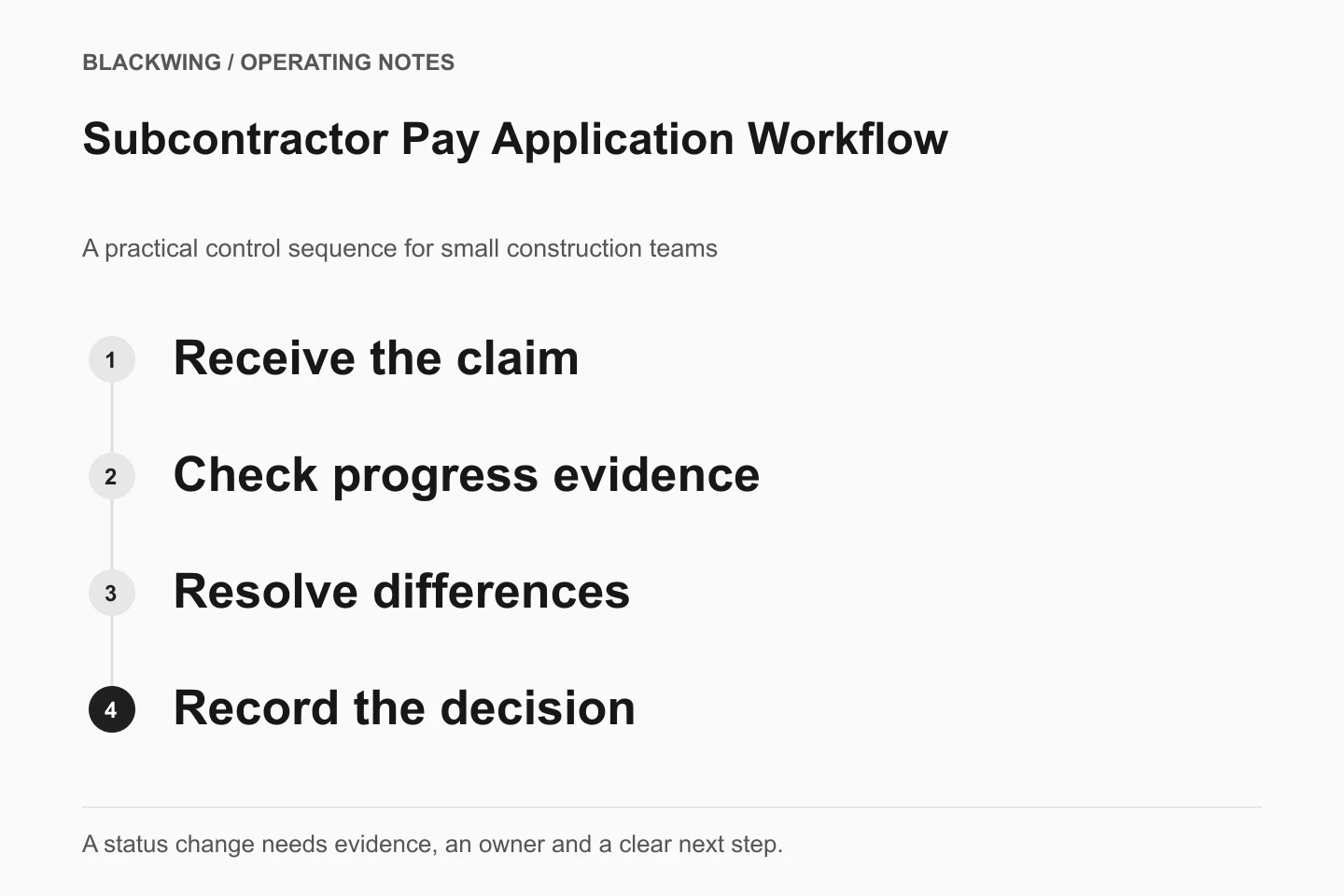
Define the billing cycle before the application arrives
Give the record a project ID, subcontract ID, billing period, application number, and revision. Confirm the submission route, required supporting records, review responsibilities, and timing from the actual agreement. Calendar reminders should support those requirements, not invent a standard deadline for every project.
The invitation or submission request should identify the current commitment reference and where to send the application. Identify who checks progress, who checks the commercial basis, and who can authorize the reviewed amount. One person may hold several roles in a small business, but the decisions still need distinct records.
The AIA G702S instructions describe subcontractor applications that summarize completed work, stored materials, retainage if applicable, previous payments, change orders, and the current request, supported by the G703S continuation sheet. These are form-specific fields, not a requirement that every subcontract use AIA forms.
Preserve the submitted claim before reviewing it
Save the application and its supporting files as received. Record the receipt date and revision. If a line is incomplete or unsupported, flag it without overwriting the subcontractor's original claim. The reviewer needs to distinguish what was requested from what was later accepted.
Check the period and previous application reference first. A plausible total can still repeat a prior claim or use a different cumulative baseline. Confirm how the selected form treats previous applications, certificates, or payments instead of treating those terms as interchangeable.
For progress lines, identify the location or work package, the amount claimed this period, the cumulative amount, and the evidence used for review. Evidence might include agreed measurement records and dated field reports. Photos alone may not establish the full quantity or commercial value being claimed.
Use a line-review and resubmission ledger
The following proposed ledger belongs to one application revision. Its purpose is to make the correction cycle visible, not create a second schedule of values.
| Review field | What to capture |
|---|---|
| Claim reference | Application, revision, period, and subcontract line |
| Submitted position | This-period and cumulative amounts as received |
| Evidence checked | Dated record, work location, and reviewer |
| Review result | Supported, clarification needed, or correction requested |
| Reason for difference | Specific quantity, period, scope, or evidence issue |
| Requested action | What must change or be supplied, and by whom |
| Resubmission | New revision, receipt date, and changed lines |
| Final disposition | Authorized amount, decision reference, and handoff status |
Avoid comments such as "wrong percentage" without a basis. State the line, the issue, and the record needed to resolve it. If a reviewer proposes another amount, preserve that proposal separately from the submitted amount until the correction and authorization are complete.
In Procore's subcontractor invoice review instructions rejecting a line does not itself change its amount. The documentation also warns that line-rejection comments are not included in the automated email to the invoice contact. This product example shows why recording a review, correcting a value, and communicating the reason need separate checks.
Illustrative example: a correction that never reached the total
Suppose a fictional subcontractor submits application 4, revision 1, with a $12,000 current-period claim on one line. The reviewer supports $9,000 based on the agreed progress evidence and requests clarification of the remaining $3,000. These figures illustrate the workflow, not a project result or a right to withhold payment.
The coordinator records the submitted $12,000, the proposed $9,000 review position, the evidence reference, and the reason for the difference. A rejected-line marker alone does not prove that the application total changed or that the subcontractor received an explanation.
The subcontractor responds with revision 2 for $9,000 and an updated summary. The reviewer checks the changed line and the rolled-up amount against the prior record. If the subcontractor instead provides evidence supporting $12,000, the reviewer assesses that evidence and records the actual decision.
Only the authorized final revision moves to the next stage. Preserve revision 1 and its review history so a later payment question does not look like the subcontractor originally asked for $9,000. Communication and version history matter as much as the corrected arithmetic.
Check special claim categories without assuming entitlement
Where stored materials are claimed, request the evidence and approval required by the subcontract. Distinguish material previously claimed as stored from material now incorporated into completed work so its value is not counted twice. Refer technical or commercial uncertainty to the responsible reviewer.
Keep pending changes identifiable. Work associated with an unresolved change should not quietly appear as approved base-scope progress. Record the applicable change reference and its current status, and follow the agreement's treatment. This article does not establish payment entitlement, withholding rights, or universal retainage rules.
If only part of an application remains unresolved, route that question through the authorized contract-specific process. Do not invent a rule that the entire application must stop, or that an undisputed portion can always proceed. The workflow should expose the issue early enough for the right person to decide.
Hand over one approved version and keep payment separate
The billing coordinator should hand over the approved revision, authorized amount, approval reference, and remaining exceptions. Accounting then records the next financial events through its established controls. An approved application is not evidence that funds were released or received.
Blackwing's workflow systems implementation can connect billing-period records, field review, correction requests, and accounting handoffs. Start by defining what each status proves before adding notifications or automated approvals.
Frequently asked questions
How is a pay application different from a basic invoice?
A pay application presents a period-specific progress claim against a subcontract, often with cumulative line amounts and supporting records. A basic invoice may request a fixed charge without that progress-review structure. Use the documents and approval requirements agreed for the project.
Does rejecting a line automatically reduce the amount payable?
No universal rule follows from a rejected-line status. In Procore's documented workflow, rejection does not change the line amount. Record the reason, communicate it, and complete the authorized correction and approval process under the subcontract before treating the reviewed figure as final.
What should be checked when an application is resubmitted?
Check the new revision against the review comments, changed lines, supporting evidence, cumulative baseline, and summary amount. Confirm which issues are resolved and which remain open. Preserve the earlier submission so the final decision remains traceable.
Make the review cycle visible
A useful subcontractor pay application workflow explains what was claimed, what was questioned, what changed, and which version was approved. Test it on one billing period. Follow every correction through resubmission and the final handoff, not just to the first review comment.