
That boundary turns AI into a document-reading assistant rather than an autonomous estimator. Its useful output is not a confident “best quote” label. It is a source-linked comparison that makes differences and unanswered questions easier to see.
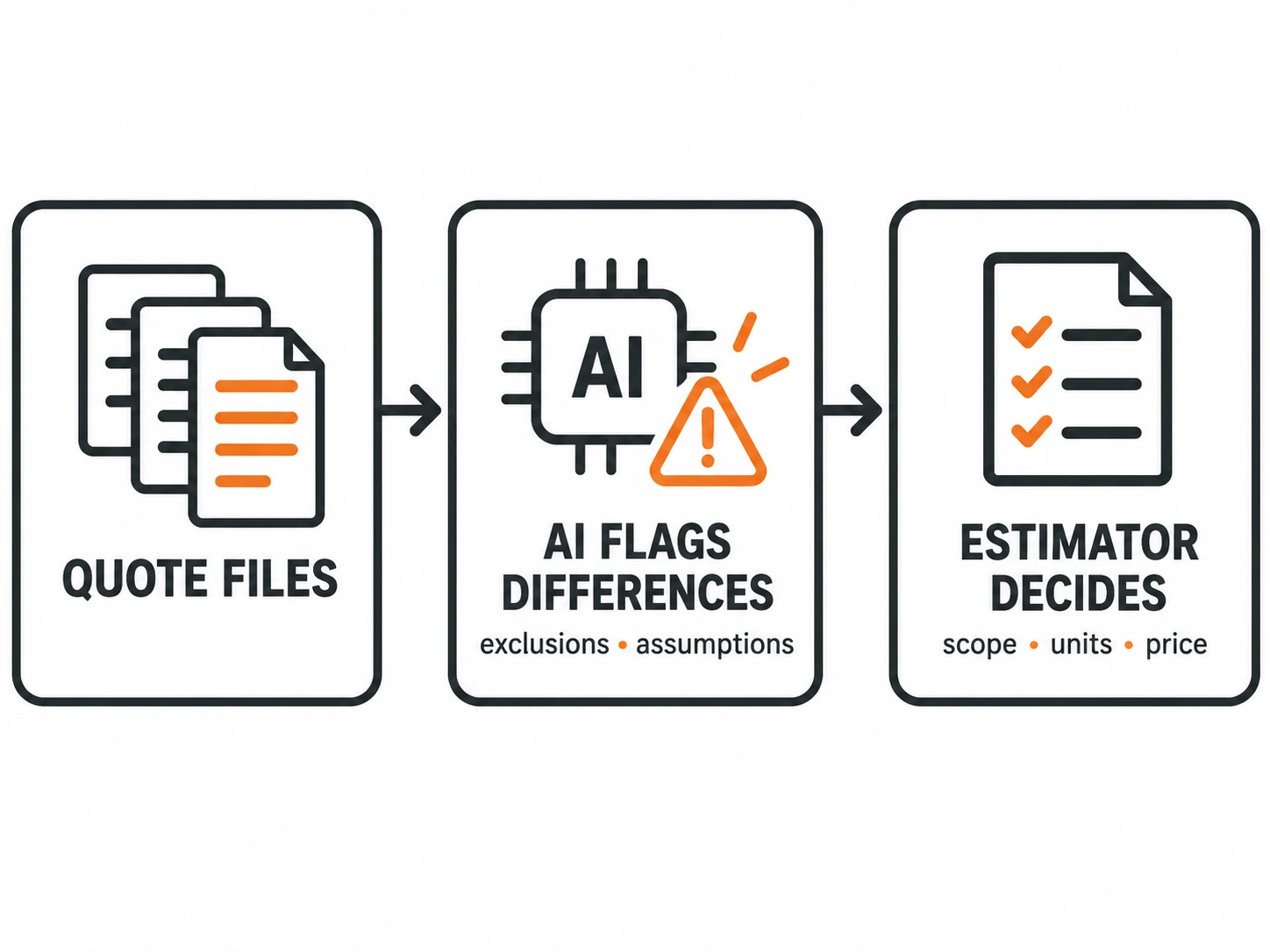
Keep quote comparison separate from procurement approval
Supplier quotes often arrive in different layouts and describe similar items with different wording. One may state a product grade and delivery window, while another leaves an assumption unstated. A model can help collect those statements into comparable fields. That is different from confirming that the quotes satisfy the project specification.
The existing supplier quote and procurement article addresses quote validity, approvals, purchase timing, supplier confirmation, and delivery. This article focuses earlier in the work: helping the estimator interpret the documents and prepare clarifying questions. The comparison should hand off into the approved estimating and purchasing process rather than replace it.
Decide which tasks need AI and which need rules
Start with deterministic checks where the rule is explicit. A script or spreadsheet can flag a missing currency, compare dates, normalize approved unit labels, detect duplicate quote identifiers, or check whether all required vendor fields are present. A rule can compare numeric values after a person confirms the units and scope are compatible.
Use AI for less structured reading. It can extract a stated product description, identify an exclusion, summarize a delivery assumption, or find a line that appears to differ from the project requirement. The estimator then checks each claim against the original page. If a quote does not state an item, the comparison should say “not stated,” not fill it in from a typical practice.
OpenAI’s file-input guide describes how supported PDFs can be processed with text and page images, and its image documentation explains supported visual input. Structured outputs can place results into a consistent comparison format. These are input and formatting capabilities. They do not validate dimensions, quantities, equivalence, or interpretation of a construction specification. OpenAI file inputs · OpenAI images and vision · OpenAI structured outputs
Worked example: surface the question, not the winner
Hypothetical example: An estimator has two supplier PDFs for a finish material and a written project requirement. The AI draft extracts the quoted product or grade, stated unit, quoted quantity, validity date, delivery assumption, and exclusions. It marks “waste allowance not stated” in one quote and “alternate grade” in the other. Beside each field, it provides the page or passage where the wording appears.
The estimator opens those pages, checks whether the units match, and asks the supplier to clarify the grade and allowance. If the alternate product needs technical review, the estimator routes that question to the authorized person. Only after scope equivalence is established should a numeric comparison be treated as meaningful. The model did not calculate a takeoff or select a winner.
This is also where a comparison can uncover a process defect. If every quote omits a required delivery assumption, the response may be a better supplier request template, not a more elaborate model prompt.
Make evidence and uncertainty visible
Build a comparison table around the decision the estimator needs to make. Useful columns may include vendor, stated product, unit, quantity, quoted amount, validity, delivery assumption, exclusions, source location, and open clarification. Use “not stated,” “unclear,” and “requires estimator review” as distinct states. Do not collapse them into a blank cell or a guessed value.
Keep the original file available from every extracted item. A reviewer should be able to move from a proposed value to the quote page without searching an inbox. If an AI passage is paraphrased, preserve enough of the original wording to make its meaning checkable. For scanned or low-quality pages, show that extraction needs attention rather than quietly presenting a clean result.
Do not compare total prices until the estimator confirms that the offers cover a comparable scope and unit basis. Tax, freight, handling, alternates, exclusions, and validity may affect the decision. The business’s approved estimating policy controls how those items are handled.
Test it as an estimating aid
Run a pilot alongside the existing comparison method. For each comparison, keep the AI draft, original quote pages, estimator’s final table, and any clarification exchanged. Measure preparation time to a verified comparison, edits by field, unsupported or missed exclusions, and questions that the estimator says were useful. Review missed differences as carefully as correctly flagged ones.
Before the pilot, agree who reviews the results and what would make the feature unacceptable. A shorter first draft can still increase total effort if the estimator must recheck every field. Compare like-for-like cases and keep the current process as a baseline. Do not present the result as a savings percentage unless the business measures it with a clear period and method.
Use a sample from more than one supplier format if those formats are part of ordinary work. If the pilot only uses clean, searchable PDFs, describe that boundary. Continue using rules for normalized values and explicit comparisons, and reserve AI for reading inconsistent wording. A human estimator remains responsible for every bid decision.
For the broader construction context, Blackwing’s construction operations page describes process and system work across estimating, purchasing, and project information. A 30-minute Operations Review is a relevant next step when quote handoffs or repeated clarification work are creating operating friction.
Frequently asked questions
Can AI create a construction takeoff from supplier quotes?
This workflow does not ask it to. It organizes what a quote states and flags differences for review. The estimator owns quantities, units, specification interpretation, and the bid.
Can AI tell whether two products are equivalent?
It can highlight wording that appears different and point to the source. A qualified estimator or other authorized reviewer must determine whether the products meet the project requirement.
What should the comparison show when a quote omits a detail?
Mark the field “not stated” or “unclear” and prepare a clarification question. Do not use a typical value or assume that another quote’s terms apply.
What should a pilot measure?
Track time to a verified comparison, field-level corrections, missed or unsupported differences, and useful clarification questions. Compare the results with the existing process before drawing conclusions.