
Otherwise a perfectly reasonable price sits in someone's inbox until it expires. Materials marked "ordered" have no confirmed delivery. The crew discovers a substitution after the supplier has already dispatched it.
You cannot control every supplier price or lead time. You can control how quickly your business makes a decision, what it has actually committed to, and which information the site receives.
That is where a small contractor should focus before buying a larger procurement system.
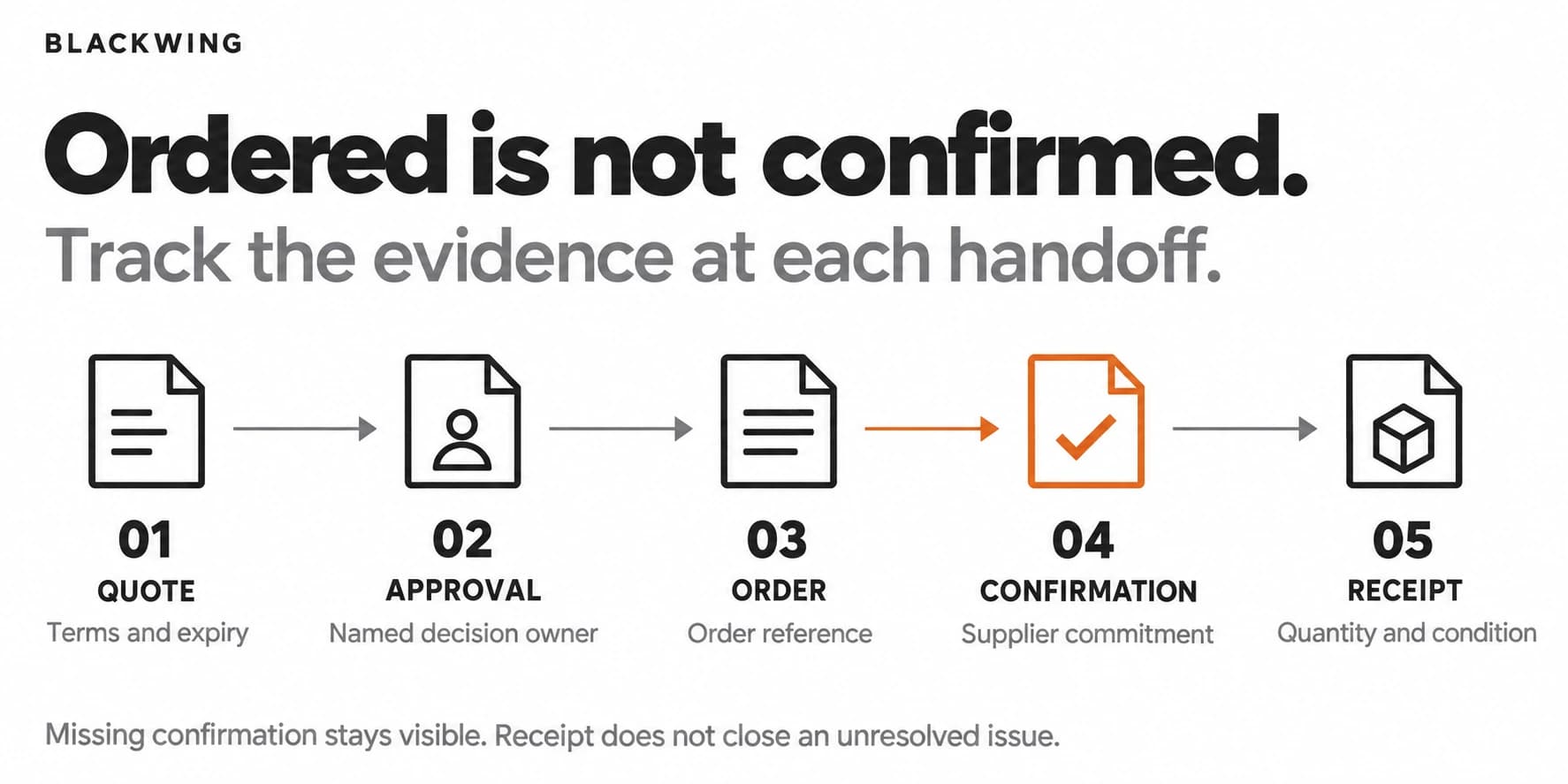
Price volatility exposes process delays
AGC's September 2026 input-cost release describes rising construction input costs and project disruption associated with trade and geopolitical uncertainty. That is external context, not a forecast for your next supplier quote.
Inside a contractor's business, the practical questions are more immediate. Which quotes expire soon? Which purchases are waiting for approval? What must arrive before the crew starts? Who follows up when a supplier has not confirmed?
If those answers depend on opening several inboxes, construction purchasing is relying on memory. The risk is not only paying more. It is discovering the problem too late to make a useful decision.
Track the dates that change the decision
A purchase needs more than a delivery date. Use distinct fields for quote expiry, approval deadline, order-by date, supplier-confirmed delivery, and site need-by date.
These dates answer different questions. Keep them in the same purchasing record:
| Date | What it establishes | Next check |
|---|---|---|
| Quote expiry | End of the offered validity period | Purchasing reconfirms stale terms |
| Approval deadline | When the internal decision is needed | Approver decides or uses the escalation route |
| Order-by | Planned order timing based on lead time | Purchasing checks readiness to commit |
| Confirmed delivery | Supplier's recorded delivery commitment | Project manager checks it against the plan |
| Site need-by | When the project requires the material | Site owner confirms sequence and readiness |
Label estimates as estimates. Do not silently turn a supplier's indicative lead time into a confirmed commitment.
Where practical, build in appropriate handling time for receiving, checking, and resolving issues before installation. The allowance depends on the material and project. There is no universal buffer that makes every order safe.
Build one purchasing record per requirement
A basic construction material tracking register can contain the project, item or specification reference, quantity, supplier, current quote, relevant dates, owner, approval status, order reference, delivery confirmation, and receipt status.
Give each requirement a stable reference so emails and documents can point to the same record. Keep quote revisions attached rather than overwriting the history.
Make the status language meaningful. Requested is not approved. Approved is not ordered. Ordered is not delivery-confirmed. Delivered is not necessarily accepted for use.
The record can live in a spreadsheet or a work-management tool. What matters is that the project manager, purchasing owner, and site team understand the same state.
Construction job costing should use the appropriate commitments and costs, but it is not a substitute for tracking whether the required material will arrive. One is a financial view; the other is an operating dependency.
Route approval before the quote becomes stale
Agree who can approve a routine purchase and which conditions need escalation. Use company-approved spending and risk boundaries, not an amount copied from somebody else's business.
Make the approval request complete: specification, quantity, current quote, expiry, project requirement, budget context, and any relevant alternatives. If the decision is waiting, the purchasing owner should know when to follow up and who can act if the usual approver is unavailable.
Do not resolve a delay by assuming silence means approval. The route needs an explicit decision or an approved delegation.
If the quote expires before approval, reconfirm terms before ordering. A stale attachment does not establish what the supplier will charge today.
An example of the handoffs
Imagine a small remodeler ordering a finish product for an upcoming installation. This is an illustrative example, not a real project result.
The quote expires Friday. Installation is planned for a later date, and the supplier has given an estimated lead time. The purchasing owner records the expiry, works backward from the site need, and identifies when approval must be completed.
The approver sees the current specification, price, and timing together. Once approved, the purchasing owner submits the order and obtains the supplier's confirmation. The project manager checks whether the confirmed delivery still supports the installation plan.
If it does not, the team now has a visible exception. They can consider a resequenced task or an approved alternative. They are not discovering on installation morning that "ordered" meant "someone meant to send it."
Treat substitutions as decisions, not shortcuts
A proposed substitution can affect dimensions, performance, appearance, warranties, installation method, price, or contractual requirements. Purchasing should not decide that an alternative is equivalent simply because it is available.
Record the proposed product, reason, differences, cost and timing impact, and responsible reviewer. Obtain the required technical, project, and customer approvals before commitment or use. Those requirements vary by project and contract.
Where scope or price changes affect the customer agreement, connect the decision to the change-order process. Keep purchasing status and formal change approval distinct.
At receipt, check the item, quantity, condition, and relevant documentation. Record shortages or damage and tell the scheduling owner if work readiness has changed. A delivery receipt should not close an unresolved issue.
Fix the queue you can influence
Review purchases that are unapproved, nearing quote expiry, unconfirmed by the supplier, or at risk of missing the site requirement. Track causes rather than treating every delay as a supplier problem.
Useful measures include approval waiting time, expired quotes requiring rework, orders without confirmations, and material-related changes to planned starts. They show whether the process is improving without promising that it can overcome external market conditions.
Blackwing helps businesses connect process mapping with practical operating systems. Book an operations review if purchases keep getting stuck between the site, the office, and the owner's inbox.
Frequently Asked Questions
What should a construction procurement log include?
A construction procurement log should include the project, specification, quantity, supplier, current quote, quote expiry, approval deadline, order-by date, confirmed delivery, site need-by date, responsible owner, and status. Attach order and receipt references, and keep unresolved substitutions or shortages visible.
How do contractors manage quotes that expire quickly?
Record the expiry and decision deadline, give the approver complete information, and establish an escalation route. Reconfirm the supplier's terms if approval occurs after expiry. Do not assume an old quote remains valid.
Is a purchase order the same as confirmed delivery?
No. A purchase order records the buyer's order or commitment, depending on the agreed terms. Delivery confirmation records the supplier's response and expected fulfillment. Track both rather than assuming an order guarantees a date.
Can a better purchasing process prevent material price increases?
No. It can reduce avoidable internal delays and make commercial choices visible earlier, but supplier pricing and availability remain external constraints. Measure process reliability separately from market movements.