
The most useful question is often not “What date does AI predict?” It is “What information is missing before we can trust this plan?” A review assistant can organize the evidence. Deterministic schedule logic calculates dates from defined relationships. The project manager confirms whether the inputs still match the work.
Keep schedule review separate from crew scheduling
This article focuses on a project-level plan: recorded activities, their relationships, status updates, and unresolved inputs. The existing construction crew scheduling article addresses labor allocation and cross-job capacity. Weather disruption and preconstruction readiness have their own workflows. A schedule review assistant should connect relevant updates without turning into a general tutorial or a replacement for those processes.
Autodesk Build documentation describes construction scheduling and workplan features, including schedule versions and field updates. Its documented functions are not evidence that an AI forecast is reliable. If a contractor uses another scheduler, verify the actual product’s capabilities, permissions, and current configuration before designing an integration. Autodesk Build: About Schedule and Workplan
Assign each part to the right tool
Use the schedule system or deterministic logic for dependency calculations, calendars, working days, and date changes. If task B depends on task A, the schedule engine should apply the configured relationship and calendar. A model should not recreate those calculations from a prose description when the controlled schedule already contains them.
Use rules to catch missing predecessor links, blank owners, overdue updates, or a delivery date that has not been confirmed. These checks are only as sound as the project’s agreed definitions and data. An alert should state which field is missing and who should resolve it.
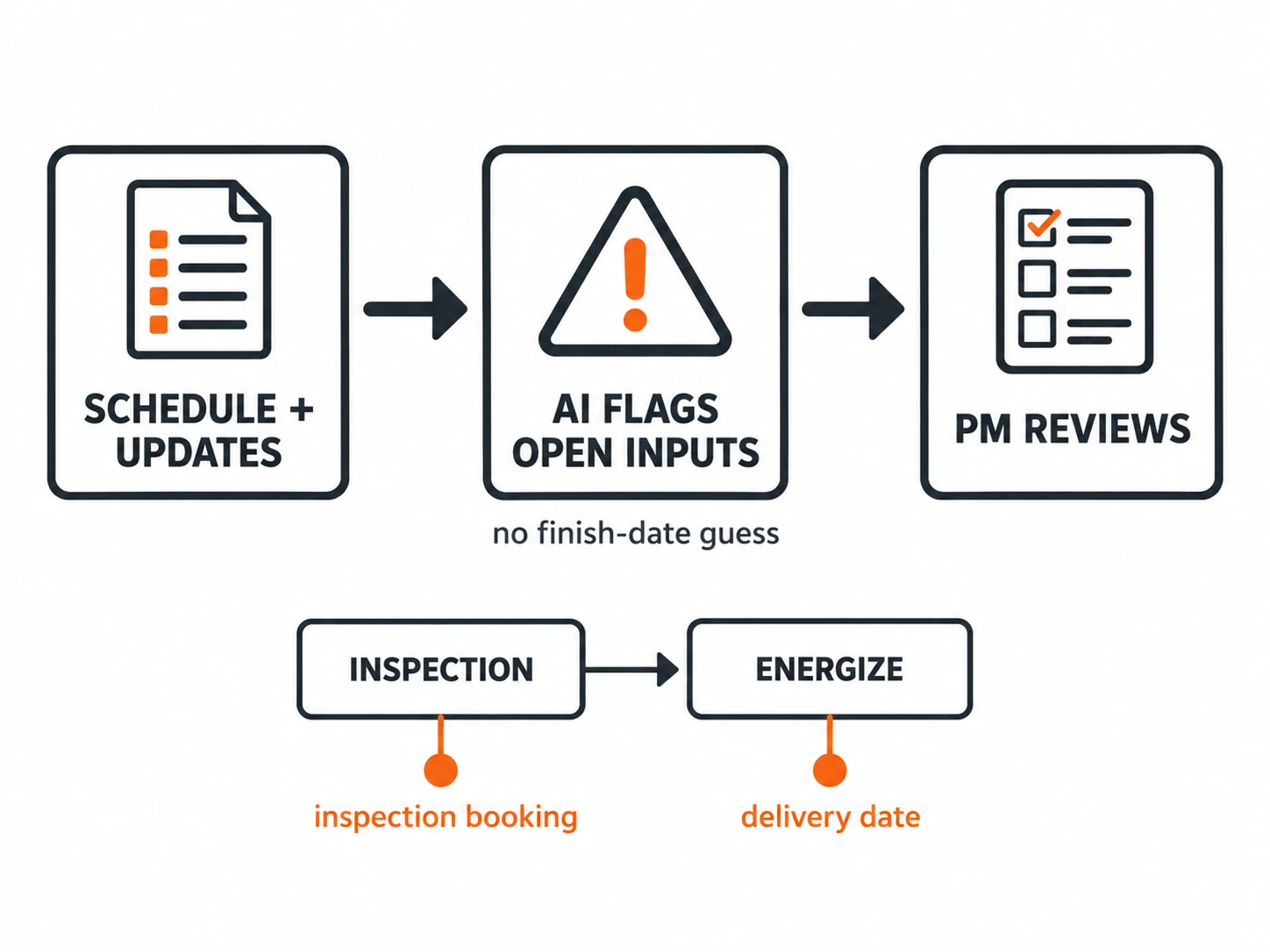
Use AI to read varied status notes and prepare a concise review list. It might connect “inspection not booked” to a recorded inspection activity or point out that a supplier update says a delivery date is still pending. It can also summarize which records changed. It should preserve the source and uncertainty, and it should not forecast a completion date unless a separately validated, authorized process supports that use.
The project manager reviews actual progress, calendars, resource availability, scope changes, delivery commitments, and any field constraints. Safety decisions remain with the people and procedures authorized to make them. The AI assistant has no authority to approve sequence changes or promise dates to a client.
Worked example: report the missing inputs
Hypothetical example: The current schedule shows an inspection before energization. A project update says the inspection is not booked. A procurement log says the switchgear delivery date is pending. The assistant’s review note says: “Two unresolved inputs affect the recorded energization sequence. Confirm who owns inspection booking and when the supplier will confirm delivery. No revised finish date proposed.”
The project manager checks that the schedule contains the correct dependency and that the two updates refer to the same work package. They contact the owners, update the controlled system when information is confirmed, and decide whether the sequence or client commitment needs to change. The assistant has identified a review need, not predicted when energization will happen.
If the schedule lacks the inspection dependency, the assistant should not assume one from general construction knowledge. It can flag the missing relationship for review, but the PM or qualified scheduler determines whether the dependency belongs in the plan.
Make the review easy to audit
Show the task, source update, source date, schedule version, owner, and unresolved question in one view. Separate “reported complete” from “verified complete.” If two updates conflict, show both and name the person who must reconcile them. Preserve the prior schedule version and the person who approved any controlled update.
Avoid status language that overstates certainty. “Supplier date pending” is different from “delivery delayed.” “Inspection request submitted” is different from “inspection booked.” The tool should preserve the wording and the source record. A concise review can still be precise.
Build human review into the handoff. The PM should be able to accept a question, correct a summary, assign a follow-up, or leave the issue unresolved. Do not auto-edit the schedule or notify a client from a generated summary. Use the company’s normal approval path for external commitments and schedule changes.
Measure a bounded pilot
Compare the current schedule review meeting or update process with an AI-assisted review on a defined set of ordinary project updates. Track time spent preparing the review, missing inputs found before the meeting, incorrect or unsupported flags, issues missed by the assistant, and how often the PM changes the draft. Check the assistant’s source links and schedule version, not just whether the summary sounds plausible.
Set the review criteria with project managers and schedulers before the pilot. Include cases with contradictory updates and missing dependencies. Keep schedule calculations in the approved scheduling system. If rules catch the relevant missing data reliably, use the rules. Add AI only where interpreting free-text updates saves review effort without obscuring responsibility.
Construction businesses can review Blackwing’s construction operations page for its process and system context. If schedule updates, delivery confirmations, and field handoffs are making dates difficult to manage, a 30-minute Operations Review can help identify where the planning process needs attention before a new tool is chosen.
Frequently asked questions
Can AI predict a reliable construction completion date?
This workflow does not make a date prediction. It highlights unresolved inputs and recorded dependencies for a project manager to review. A date commitment requires verified information and the company’s normal approval process.
Should AI calculate schedule dependencies?
Use the project’s controlled scheduling system and configured logic for date calculations. AI can point to missing or conflicting information, while the PM or scheduler determines whether the relationship is valid.
What if field updates conflict with the schedule?
Show both sources and route the discrepancy to the owner. The project manager checks the current schedule version and resolves the record before a commitment is changed.
What should a scheduling pilot measure?
Track preparation time, missing inputs caught, unsupported flags, missed issues, source correctness, and PM corrections. Include contradictory updates and keep the approved schedule system as the calculation baseline.