
It gets difficult when several jobs need the same people and every project manager has a reasonable explanation for why their job comes first.
The calendar can look full while the work is not ready. A crew arrives before materials. Someone gets moved without the foreman knowing. A specialist is booked on two jobs because each schedule was built separately.
Hiring can increase capacity, but it does not fix those coordination problems. A useful crew schedule matches available skills to work that is genuinely ready, then makes changes visible to everyone affected.
For a small contractor, that is a more practical goal than finding the perfect scheduling application.
Separate labor shortages from scheduling waste
The workforce constraint is real. The AGC and NCCER September 2026 workforce survey reported continuing hiring difficulties and project delays linked to workforce shortages.
Better construction labor planning cannot manufacture qualified people. It can help you distinguish a shortage from time lost to missing materials, unclear priorities, unfinished predecessor work, and repeated reassignment.
Those problems need different responses. If a trade has more committed work than available capacity, you need a capacity decision. If capacity exists but the job is not ready, you need to remove a constraint or change the sequence.
Calling both problems "we need more people" hides the part you can actually improve.
Build one view across active jobs
Project schedules explain what each job needs. A shared crew schedule explains what the business can commit.
For the next planning window, use a crew-planning record like this:
| Record field | What to capture | Why it matters |
|---|---|---|
| Work and timing | Job, work package, intended start, duration | Defines the actual commitment |
| Skills and availability | Named crew, required qualifications, absences | Exposes conflicts across jobs |
| Readiness | Materials, access, predecessor work, inspections | Separates ready work from hoped-for starts |
| Decision and follow-up | Allocation owner, constraint owner, next check | Makes changes and unresolved work accountable |
This does not require a complicated system. A maintained spreadsheet or simple board can be enough to start. The important part is one current version that the office and field team both recognize.
Do not treat everyone as interchangeable. A count of available people does not tell you whether the required supervision, qualifications, experience, or trade skills are available. Safety and working-time requirements remain boundaries, not scheduling variables to work around.
Use a work-ready gate before making a promise
A requested start date is not a confirmed allocation. Put a readiness check between them.
For each work package, ask whether the scope is clear, predecessor work is complete, materials are confirmed, the site is accessible, and necessary decisions have been made. Add any project-specific permits, inspections, equipment, or qualified personnel required.
Use simple statuses: Requested is not checked; Constrained has an unresolved dependency; Ready can proceed; Committed has an authorized allocation; Complete has confirmed work finished. "Almost ready" is not a status a crew can act on.
Constrained work needs an owner and a next check. Without those, the schedule becomes a list of dates that someone hopes will happen.
Do not hide uncertain durations behind precise dates. Record the assumption and agree when it will be confirmed. A scheduling tool can display certainty beautifully even when the underlying work has none.
What this looks like with two competing jobs
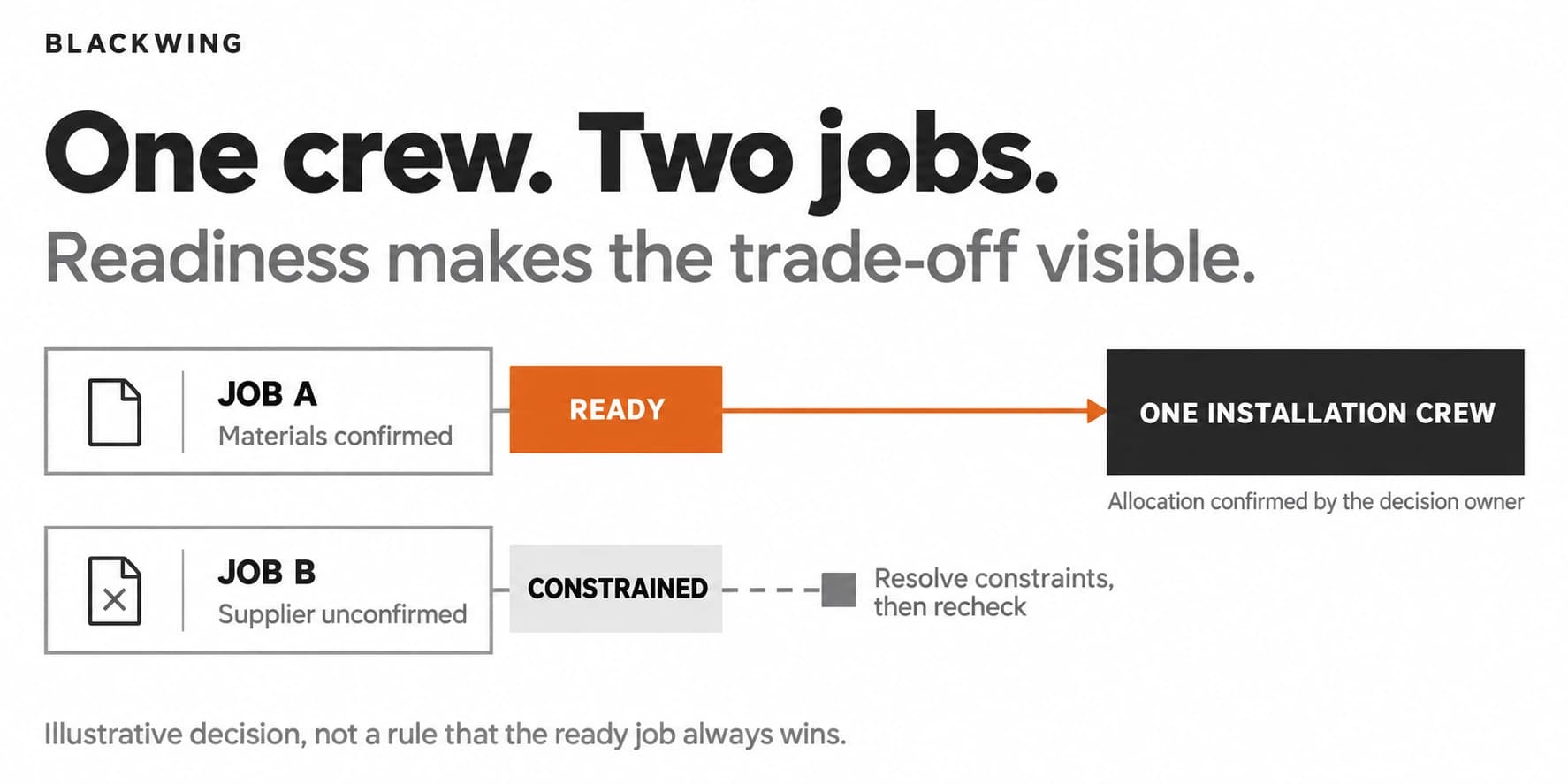
Consider an illustrative contractor with one installation crew and two jobs requesting the same Monday start. Both customers are expecting progress.
Job A has confirmed materials and completed preparation. Job B is waiting for a supplier confirmation and the finish selection is still unresolved.
Assigning half the crew to each job might feel fair. It could also create two under-resourced sites and more travel without resolving Job B's constraints.
The scheduling owner checks commitments and readiness with both project managers. They confirm Job A's allocation, assign named owners to Job B's missing decisions, and agree when Job B will be reviewed again. Any customer date change is communicated by the responsible project manager, not guessed by the crew.
This is not a universal rule that the ready job always wins. A contractual milestone or a different risk may change the decision. The point is that the trade-off becomes explicit rather than being settled by whoever calls last.
Make schedule changes a controlled handoff
Schedules will change. The process should make the change understandable, not pretend it can prevent every disruption.
For each proposed move, record the reason, affected jobs, impact on commitments, new allocation, and decision owner. Check equipment and subcontractor dependencies before confirming it.
Then communicate the approved version to the foreman, office coordinator, and affected project managers. Require acknowledgment through a practical channel. A schedule updated in the office is not a schedule received in the field.
Urgent changes can use a phone call, but the current record still needs to be updated. Otherwise tomorrow's plan is based on yesterday's information.
Keep daily field reports connected to this process. Reports tell you what happened; crew scheduling decides what happens next. Neither should quietly substitute for the other.
Review capacity before accepting another start
A regular look-ahead review should examine committed work, constrained work, and likely demand. Choose a horizon that fits your job lengths and lead times rather than adopting a fixed number because another contractor uses it.
Review actual duration against the estimate and record why work moved. Was it a scope change, supplier delay, incomplete preparation, absence, or an unrealistic labor assumption?
That record helps the business improve future commitments. It also prevents blaming the crew for delays created before anyone arrived on site.
Track a few useful measures: starts moved because work was not ready, conflicting crew assignments, unplanned transfers, and whether changes reached the field before work began. Avoid turning this into individual productivity surveillance. The first question is whether the operating process gives people a workable plan.
A schedule is a commitment system
Good contractor scheduling makes capacity, readiness, and decision ownership visible. It will not remove a workforce shortage. It can stop your business from wasting the capacity it already has or promising the same capacity twice.
Blackwing's workflow systems implementation work connects those rules to a system teams can maintain. Book an operations review if your crew plan lives across separate calendars, calls, and last-minute messages.
Frequently Asked Questions
What is construction crew scheduling?
Construction crew scheduling assigns available people and skills to project work over a defined period. A useful schedule considers work readiness, dependencies, duration, existing commitments, and who can authorize changes across jobs.
What should a construction crew scheduling template include?
Include the job, work package, required skills, available crew, intended start, estimated duration, readiness, confirmed allocation, and decision owner. Record constraints and the next check. A shared spreadsheet can work if the office and field use one maintained version with agreed change rules.
Should crews be assigned before materials are confirmed?
Treat the allocation as provisional when required materials remain uncertain. Confirm it only after checking whether the work can proceed, or explicitly document the approved contingency. A date alone does not establish readiness.
Can better scheduling solve construction labor shortages?
No. Scheduling can reduce avoidable conflicts and readiness-related waste, but it cannot replace missing skills or create additional labor capacity. Separate resource shortages from coordination problems so the business can address each appropriately.