
The decision should consider scope fit, delivery capacity, available information, commercial conditions, and the reason the company could win. Unknowns should stay unknown until clarified. They should not become positive assumptions because everyone wants the job.
The goal is not to decline more work. It is to spend estimating effort on work the business can responsibly pursue and deliver.
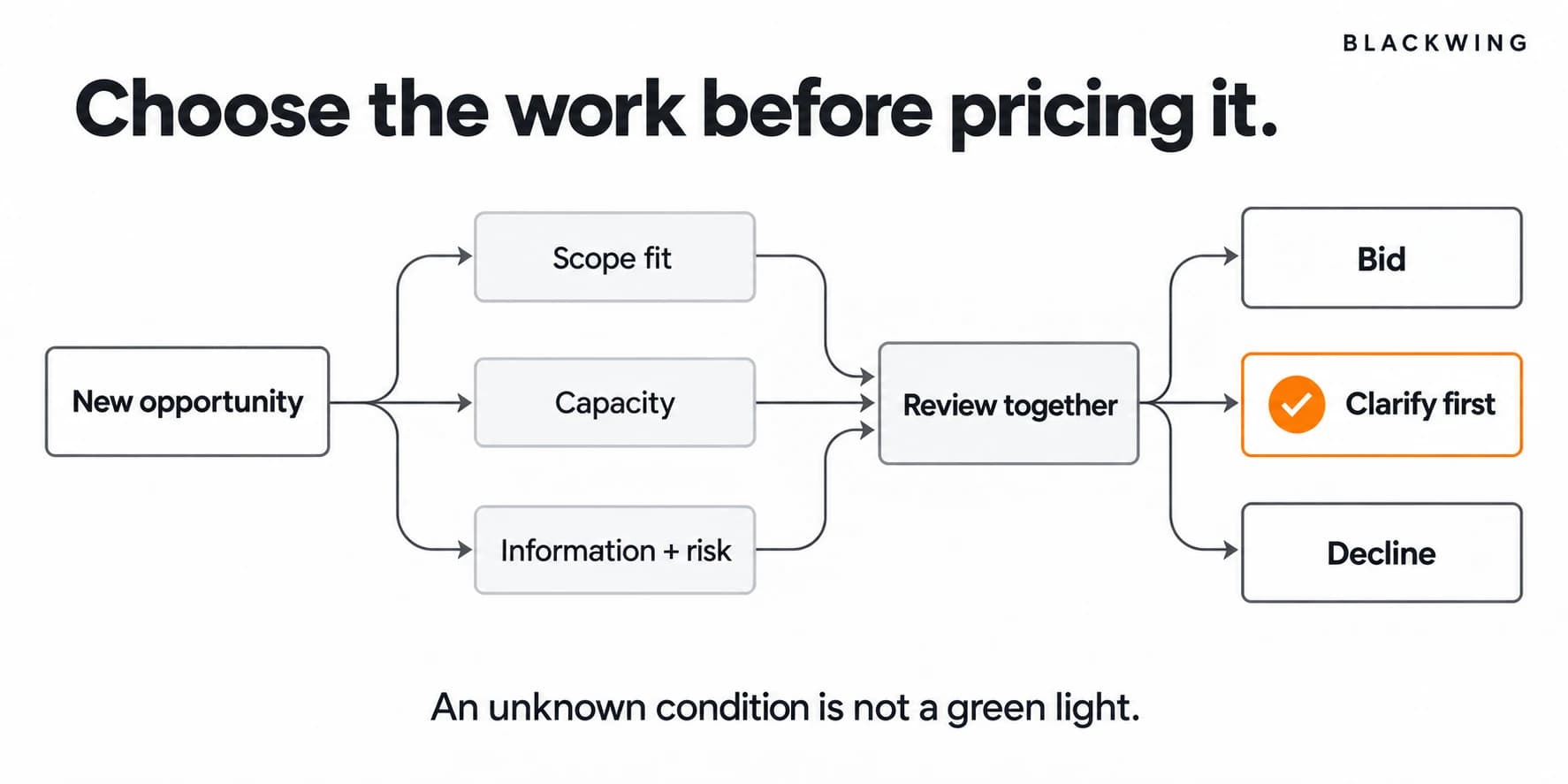
What Is a Bid or No-Bid Decision?
A bid or no-bid decision is the internal choice to price an opportunity, seek clarification first, or decline it. It happens before committing significant estimating resources.
Procore's bid-selection guidance discusses project fit, resources, location, and other considerations. Those categories are useful prompts, not a universal scoring model or a guarantee of profitable work.
Your process should reflect your company's actual capabilities and approved risk limits. Contract, financial, or specialist concerns need the appropriate review.
Separate Opportunity Intake From Estimating
An invitation arriving in the inbox should create an intake record, not automatically a full estimating assignment.
Capture the customer, project type, location, proposed scope, procurement route, submission deadline, likely delivery period, available documents, and responsible contact. Identify who will make the pursue decision and when it must be made.
If basic information is missing, assign a clarification action. Do not make the estimator discover every gap while trying to produce a price under an artificial deadline.
Use Five Questions Before Pricing
1. Is this work within our capability?
Check the actual scope, delivery method, technical needs, and required qualifications. Similar-looking projects can have very different interfaces or demands.
Do not count an unconfirmed subcontractor, unfamiliar method, or hoped-for hire as established capability. If a capability gap may be resolved, give it an owner and decision date before treating it as solved.
2. Can we deliver in the likely period?
Review the existing workload, leadership attention, crews, and critical equipment or supplier dependencies. Capacity is more than the number of people on payroll.
Link this check to your construction crew scheduling process. A project can fit the company's skill set and still conflict with commitments already made.
3. Is the information sufficient for a responsible bid?
Identify missing scope, unclear documents, access constraints, and assumptions that could materially change the estimate. Record the clarification route and submission conditions.
Some opportunities can proceed with clearly permitted qualifications or allowances. Others cannot. Follow the actual bid rules and have the appropriate person review the approach rather than inventing a standard exception.
4. Do the commercial conditions fit our boundaries?
Review relevant payment, contractual, insurance, bonding, and other conditions through the company's authorized process. Do not reduce them to a salesperson's gut feeling.
This article does not recommend accepting specific terms or calculate project profitability. It recommends making the review visible before the bid consumes the team's time.
5. Why are we a credible choice?
Name the fit: relevant capability, a workable delivery approach, an established relationship, or a clearly understood customer problem. Avoid assuming that the lowest price is the only route to an award.
If there is no credible reason to pursue the opportunity, investigate that before asking the estimator to compensate with another late night.
A Decision Record That a Small Team Can Use
| Review area | Record the evidence | Possible next action |
|---|---|---|
| Scope fit | Relevant capability and identified gaps | Confirm specialist input |
| Capacity | Delivery period and existing commitments | Check resource conflict |
| Information | Available documents and material unknowns | Request clarification |
| Commercial conditions | Authorized review and unresolved concerns | Refer to the right adviser |
| Pursuit reason | Clear fit with the customer and project | Confirm bid strategy |
Finish the record with one outcome: bid, clarify first, or decline. Include the decision owner, reason, and date. If the outcome is conditional, write the condition and next check rather than marking it approved prematurely.
Do Not Let a Score Hide a Serious Gap
A scoring matrix can help a team compare opportunities. It can also give false confidence when several positive scores cancel out one unacceptable condition.
Separate hard boundaries from preferences. An unresolved mandatory qualification should not be averaged away by a convenient location and a familiar customer.
If you use numbers, define what each score means and test them against actual decisions. Do not present invented thresholds as construction-industry benchmarks.
An Illustrative Capacity Conflict
Imagine a specialty contractor receiving two invitations in the same week. Both match its trade. One has a clear package and a likely start after current commitments. The other needs immediate pricing but has an uncertain scope and a delivery period that overlaps two active jobs.
The owner initially asks for both estimates. A short intake review shows that the second opportunity needs scope and timing clarification first.
The estimator is not being asked to stop selling. The company is deciding where estimating effort can produce a responsible proposal. This is an illustrative example, not a claimed business result.
Learn From Decisions After the Bid
Record whether a submitted bid was awarded, declined, withdrawn, or remains unanswered. Preserve the original pursue reason and compare it with what happened.
When a project is delivered, feed relevant lessons back into future selection: difficult interfaces, underestimated coordination, or a scope the business handled well. Do not confuse a bid win rate with a complete measure of project quality or profitability.
Keep the handoff after award separate. Our article on estimate-to-project handover covers transferring the accepted work into delivery.
Conclusion: Estimating Starts With a Decision
A construction bid or no-bid process protects scarce attention by making project selection deliberate. Start with a short intake review, explicit boundaries, and a recorded outcome. Expand the process only when the added detail improves the decision.
Blackwing helps construction businesses connect sales qualification, estimating, and delivery capacity. Book an operations review to examine why every opportunity becomes an urgent estimate.
Frequently Asked Questions
What is a construction bid or no-bid process?
It is an internal process for deciding whether to price a project, clarify it first, or decline it. It checks project fit, capacity, information, commercial boundaries, and the reason to pursue before significant estimating effort is committed.
Who should make the bid or no-bid decision?
The company should designate an authorized decision-maker using input from estimating, operations, and relevant specialist advisers. In a small contractor, one person may hold several roles, but the required checks should remain explicit.
Should every opportunity receive a full estimate?
Not automatically. A short intake review can identify missing information, capacity conflicts, or unsuitable conditions before a full estimate begins. The company should decide based on its capabilities and approved pursuit criteria.
Is bid win rate enough to judge project selection?
No. Bid win rate shows awards relative to bids under a defined calculation, but not delivery difficulty, customer fit, estimating effort, or project profitability. Review the quality of pursued and delivered work as well as awards.