
Nothing happened to the building. The business still lost an essential capability.
A construction business continuity plan should address the functions that must keep working during a disruption, including an unexpected absence. The SBA's continuity guidance emphasizes identifying critical functions and recovery strategies. The useful question for a small contractor is which decisions currently depend on one person being reachable.
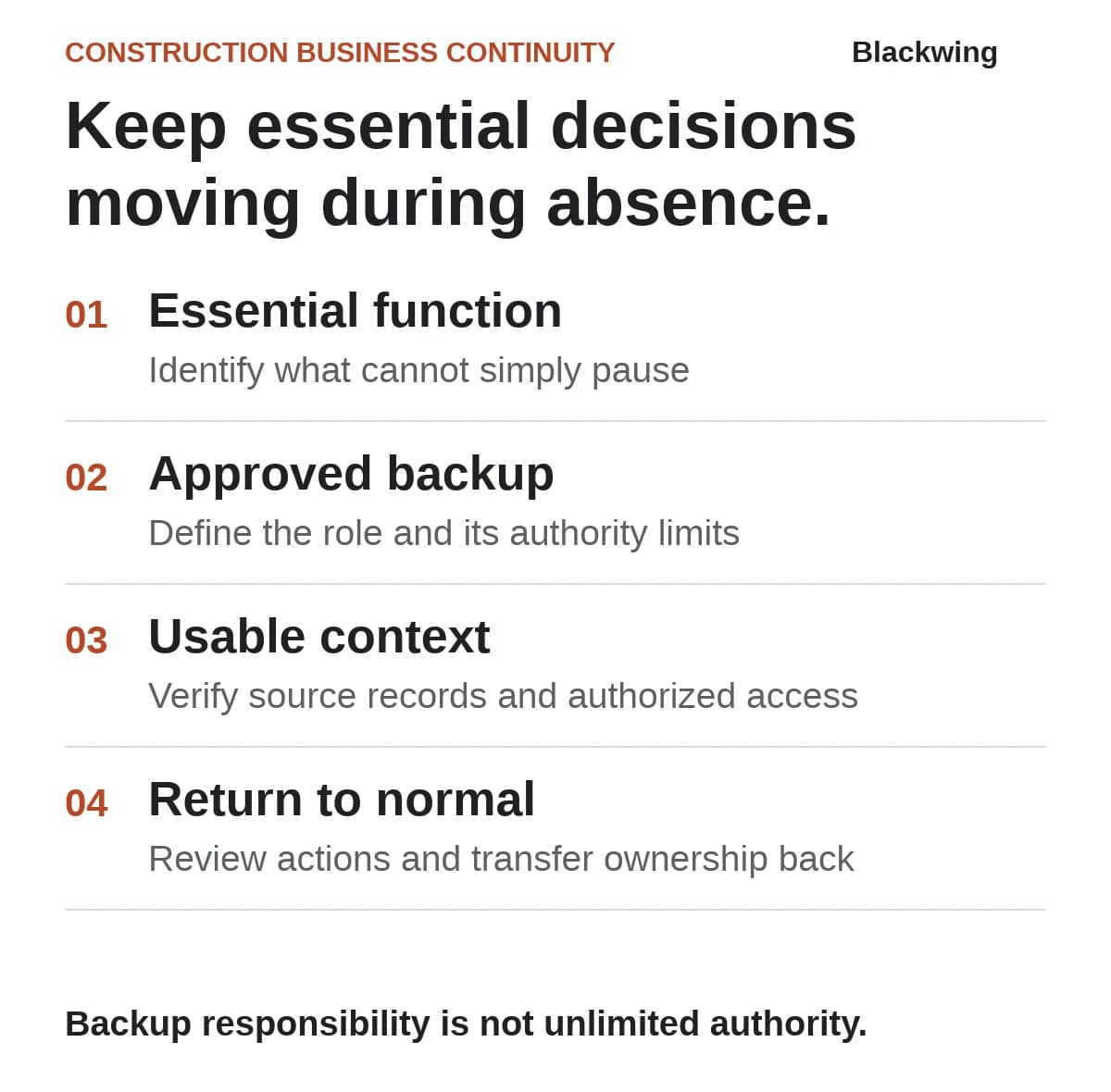
Identify functions rather than job titles
Start with the work that cannot simply pause. This might include customer communication, project coordination, approved purchasing or access to current operating records.
Describe the required outcome and the consequence of interruption. Not every routine task needs the same recovery priority. The company should decide what can wait and what needs an approved temporary route.
Keep safety and emergency response procedures separate and under the appropriate qualified owners. An office continuity checklist is not an evacuation plan, a technical safety assessment or a guarantee that the work can continue safely.
The economic resilience process deals with changing demand and backlog. Continuity deals with the business's ability to operate when a required function is disrupted.
Define backup responsibility before the absence
For each essential function, identify the normal owner, approved backup, escalation route and limits of authority.
Being the backup does not automatically confer permission to sign contracts, release payments or grant access. Decide which actions the person can take and which need another authorized reviewer.
The backup should understand what evidence is required to make the permitted decision. A contact list and a forwarded inbox do not explain which commitments are current or what the company already approved.
Where no safe backup route exists, record the limitation and the decision the owner needs to make. Do not solve it by describing everyone as temporarily authorized to do everything.
Maintain the information needed to act
Keep current project responsibilities, approved commitments, pending decisions and important communication arrangements in controlled records.
The continuity packet should point to those sources. It should not become another workbook with copied values that no one updates during normal operations.
Make the access route practical. The responsible administrator should verify that the approved backup can open the required systems under their own authorized identity. Do not store passwords in the packet or transfer a personal account as a shortcut.
Protect private staff, customer and commercial information. A backup may need specific records for a function without needing unrestricted access to every file in the business.
Choose when temporary continuity mode begins
Define the condition that activates the temporary arrangement, who makes that decision and how the team will be informed.
An owner working from another location may remain responsible for some approvals. A person who cannot be contacted creates a different situation. The plan should distinguish those conditions rather than assume every absence requires the same response.
Tell the relevant team which responsibilities have moved and which remain unchanged. Keep customer messages accurate. Do not make broad promises about service or delivery that the temporary team cannot support.
The aim is a controlled temporary arrangement, not a permanent expansion of authority during a stressful period.
Test one ordinary disruption
Use a hypothetical exercise before a real interruption. For example, assume the office coordinator is unavailable while an active job needs a supplier confirmation and a client update.
Ask the backup to locate the current order, identify the unresolved question and find the authorized response route. Then ask them to prepare the client update from the maintained project record.
Observe where the exercise depends on a private chat, personal recollection or inaccessible file. Those are improvement items. Do not conceal them to declare the drill successful.
An exercise does not authorize a live purchase, account change or message. Use reviewed scenarios or otherwise approved test methods so the exercise does not create accidental external commitments.
Keep capacity and recovery limits visible
A backup often carries other responsibilities. Moving a task does not create more available time.
Review what can realistically continue, what should be deferred and which decisions need escalation. The capacity-planning workflow can help explain those trade-offs without promising that every function will operate normally.
Technology recovery also needs its own responsible process. A named backup person cannot restore a system merely because the continuity document says the data is backed up. Recovery arrangements must be tested by the appropriate technical owner.
Insurance, employment and legal questions require the relevant advisers. This article focuses on operating continuity and does not prescribe those treatments.
Return ownership deliberately
When the normal owner returns, review actions taken, unresolved issues and any temporary arrangements still active. Transfer ownership back through the agreed process.
Preserve the decision history. Do not remove the temporary record because normal operations resumed. It can explain why a commitment changed or where the backup needed more support.
Keep permission removal and access changes with the authorized administrator. The return to normal should be clear enough that two people do not continue believing the other is responsible.
Blackwing helps reduce dependence on memory and informal availability through connected records and approved workflows. An operations review can start with one essential decision the team cannot currently make without calling the same person.
Frequently asked questions
What should a construction business continuity plan cover?
Cover essential functions, disruption triggers, approved backup roles, required information, authority limits and return-to-normal arrangements. Keep emergency safety, technical recovery and insurance planning connected but distinct, with the relevant qualified owners responsible for them.
Is continuity planning only for major disasters?
No. A business can lose an essential capability through an ordinary absence or system interruption. Consider the disruptions that are relevant to the company's operations rather than preparing only for events that damage the physical office.
Can the backup use the absent person's account?
Do not make shared or transferred personal credentials the continuity method. Arrange individually authorized access with the responsible administrator, limited to the duties needed. The backup's role should not silently expand financial, contractual or security-sensitive authority.
How should a small contractor test the plan?
Use a bounded exercise involving one essential function and an approved scenario. Check whether the backup can find current evidence, identify the next decision and use the authorized route. Record limitations without creating unapproved purchases, messages or account changes.