
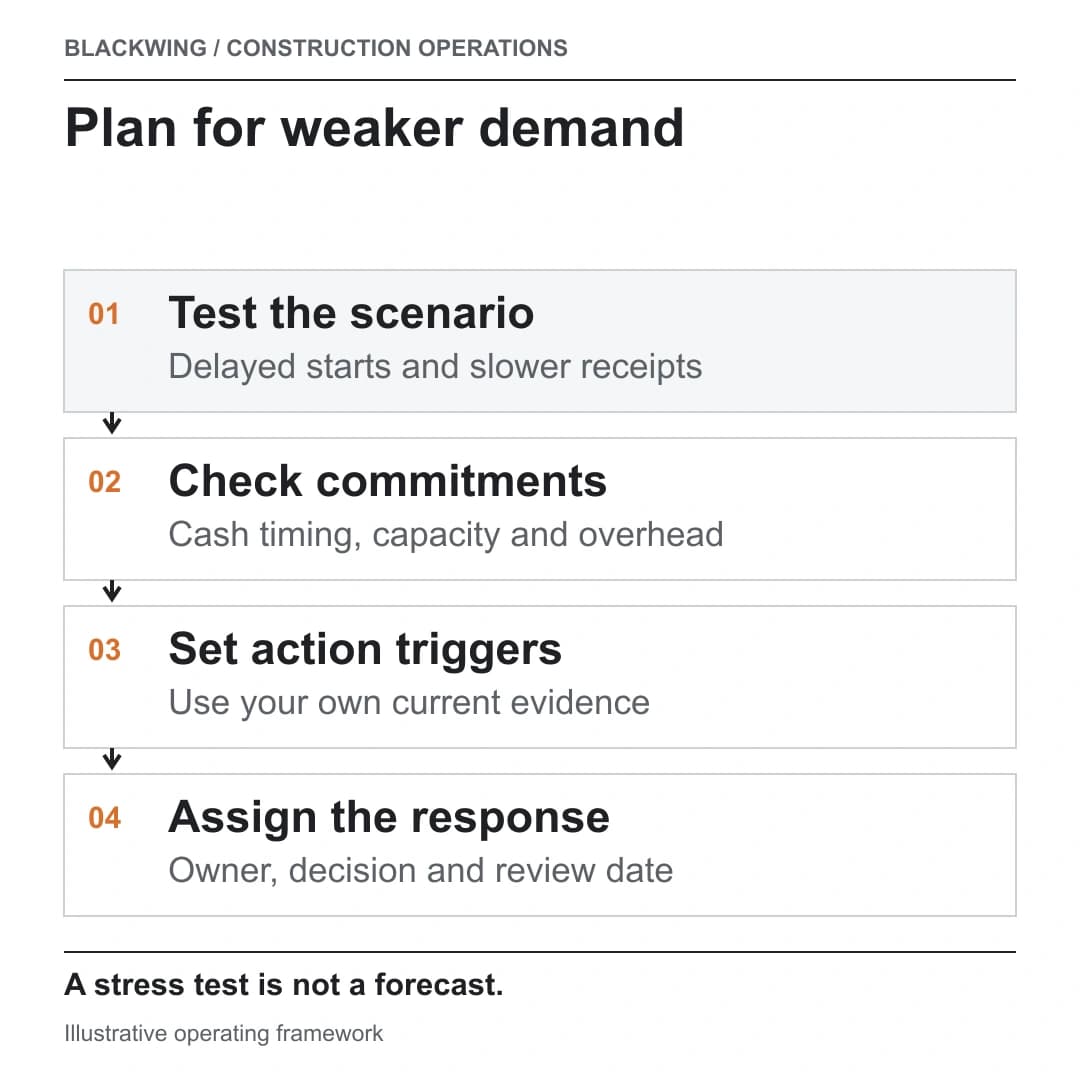
Start with a scenario, not a headline
A national construction indicator can provide context, but it cannot tell an individual contractor whether its own backlog will convert, when a project will start, or when an invoice will be paid. For example, the Associated General Contractors of America reported that U.S. construction spending rose in August 2026 from July but remained below August 2025, with different patterns across segments. The National Association of Home Builders reported a third-quarter remodeling sentiment index of 62, one point above the previous quarter. These measures describe different parts of the U.S. market; together they do not establish a universal downturn or an outlook for your company. (AGC, October 1, 2026; NAHB, October 8, 2026)
Use external data as a prompt to examine your own records. A stress test is a conditional question: if starts slip, awards slow, or payment timing changes, which decisions become urgent? It is not a claim that the scenario will happen.
Grade the backlog by evidence
Put every opportunity in a category that describes its current evidence. The labels below are a practical organizing method, not a probability scale. Keep the underlying evidence visible so a reader can challenge the classification.
| Work status | Evidence to record | How to treat it in a scenario |
|---|---|---|
| Signed | Executed agreement, scope and current start assumptions | Committed work, subject to the actual terms and dependencies |
| Awarded | Award notice or documented selection; agreement still pending | High confidence only to the extent the remaining steps are clear |
| Likely | Customer signal, estimate or procurement activity without award | A prospect, not contracted backlog |
| Speculative | Early conversation, unqualified lead or unconfirmed timing | Exclude from base commitments; track separately |
Then attach dates and assumptions. “Signed” does not answer whether site access, permits, materials, or a customer decision are ready. “Likely” does not mean a start date is available. Include who last verified each fact and when.
Map timing and fixed commitments together
For each major job, put expected start, progress billing or collection milestones, material commitments, subcontractor commitments and internal capacity on one timeline. The purpose is to find dependencies, not to rebuild a detailed cash-flow forecast. For that deeper billing and receipt process, see construction cash-flow management.
Now list business commitments that continue when work shifts: payroll plans, leases, financing payments, insurance, software, equipment, and supplier or partner obligations. Use the actual records and owners. A list of costs alone can mislead if it ignores a delayed start, an uncommitted purchase, or a payment that depends on approval.
Hypothetical example
Suppose a contractor has one signed project whose start depends on a customer selection, one awarded project awaiting final paperwork, and several estimates that have not been accepted. A supplier requests confirmation for an order tied to the first project. The resilience question is not “Should the company cut overhead?” yet. It is whether the selection has an accountable decision date, whether the order can wait under the supplier’s terms, what other work can use the capacity, and which authorized person will make the commitment decision.
That short review prevents a prospect from being treated as guaranteed workload and prevents a purchase decision from being made on an unverified start assumption.
Agree triggers before pressure rises
Choose a small number of observable signals tied to actions. Examples might include a signed start moving beyond a named date, a required customer decision remaining open past its dependency date, a collection milestone being disputed, or a critical supplier confirming a changed lead time. These are prompts to review; they do not automatically justify cancelling work, changing terms, or reducing staff.
For each trigger, record the source, threshold or condition, decision owner, first action and review date. “Watch cash” is not operational. “If the start date changes, the project lead updates committed purchases and the owner reviews capacity before approving new commitments” gives people a next step. Use a weekly construction operations dashboard to monitor the agreed triggers and follow up on assigned actions. A number on the dashboard is useful only when someone knows what to do about it.
Make the review usable
Run the review at a cadence that matches how quickly commitments change. A company with pending starts may need a shorter interval than one with stable, long-duration work. No universal refresh interval fits every contractor. Also refresh when a material event occurs: award, cancellation, delayed access, major scope change, or a changed payment assumption.
Keep three columns distinct: confirmed facts, management judgments, and open questions. That makes uncertainty visible. Give one person ownership of every open question and set a next check date. If a decision depends on contract interpretation, financing, employment rules, or tax treatment, route it to the appropriate professional rather than turning an operating scenario into generic advice.
Four questions owners often ask
What belongs in a construction backlog review?
Include work status and evidence, start and payment assumptions, dependencies, committed purchases and partner capacity. Separate signed work from awards, prospects and speculative leads.
How often should we refresh the review?
Choose a cadence based on decision lead time and how quickly your backlog changes. Refresh sooner when a start, award, collection assumption, or major commitment changes.
What should trigger a response?
Agree observable conditions in advance, such as a delayed start or an unresolved dependency. Name the owner and first review action; a trigger is a reason to assess, not an automatic instruction to cut or cancel.
Does a national spending decline mean my business is in a downturn?
No. National U.S. data describes an aggregate measure. Compare it with your own signed work, segment, customers, project dates and payment evidence.
Turn uncertainty into assigned decisions
The practical value of a resilience review is that it shows what is committed, what still depends on someone else, and what the company will do if an assumption changes. Make the scenario visible, keep judgments separate from facts, and assign each trigger to a decision owner. If your team needs help mapping the handoffs and records behind that review, request an operations review.
Written with the help of Laura, Ahmed Fahmy’s AI assistant, based on his ideas and under his supervision.