
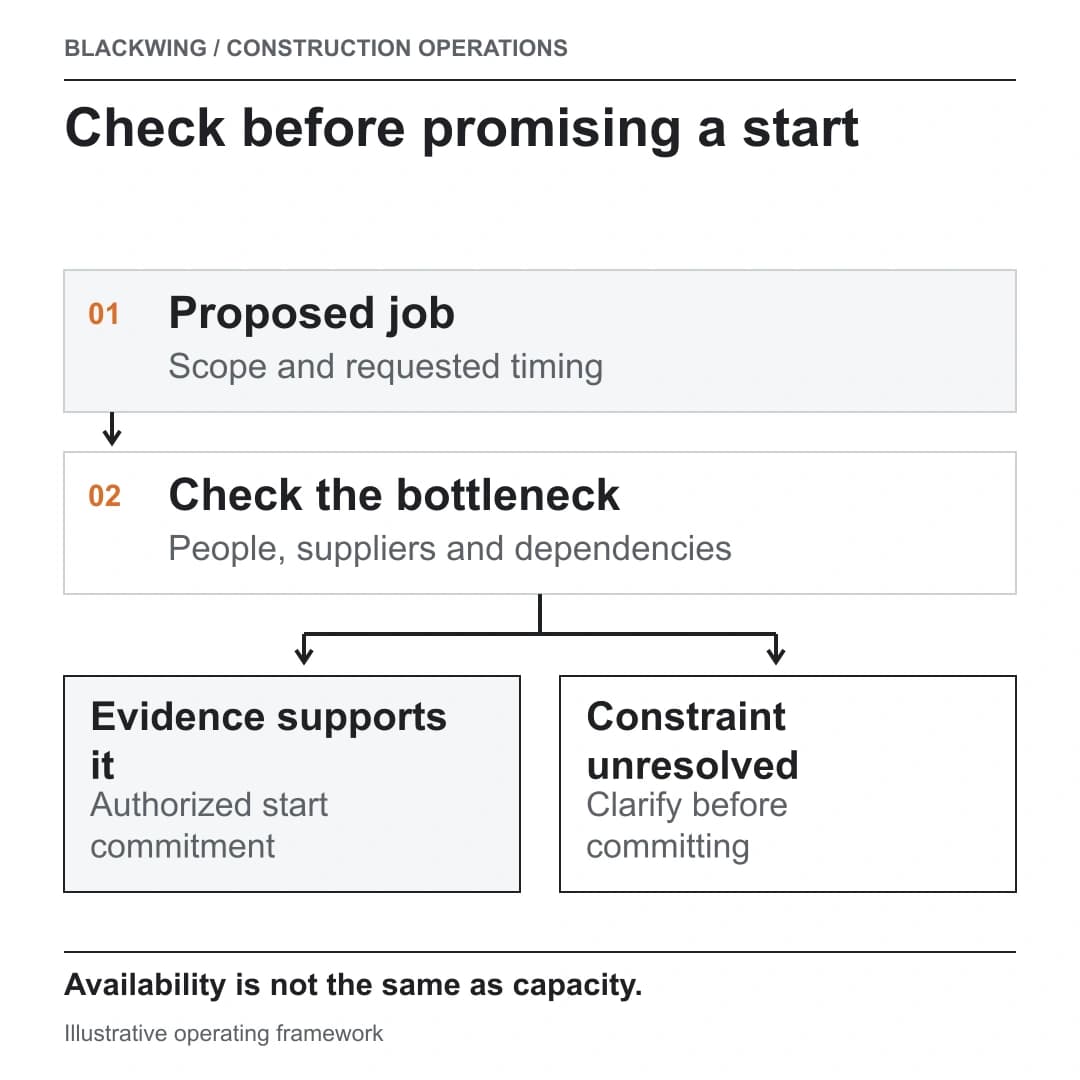
Look for the bottleneck, not just available headcount
A company can have people available and still lack capacity for the next job. A qualified specialist may be booked, a subcontractor may not have confirmed, equipment may be committed elsewhere, or a long-lead item may not arrive in time. Capacity is bounded by the resources and dependencies that govern the sequence, not by a broad utilization percentage.
Start with actual workload: signed projects, current dates, remaining scope, critical milestones and known changes. Separate contracted commitments from tentative starts and prospects. Then check the resource or dependency most likely to constrain the proposed work. Procore’s resource-planning guide discusses aligning schedule, workload and resource availability; it is vendor guidance, not a validated forecasting method for every contractor. (Procore resource planning)
Build a commitment review
For each prospective start, assemble a short evidence packet:
- Scope and timing: What work is included, and what requested start and sequence are under consideration?
- Confirmed workload: Which existing jobs, milestones and commitments compete for the same resources?
- Critical capacity: Which roles, subcontract packages, equipment or materials could constrain the work?
- Dependencies: What access, customer decisions, approvals or predecessor activities must happen first?
- Decision owner: Who may confirm the start, and which unresolved items must be cleared first?
Mark each input confirmed, provisional, or unknown. Do not turn unknown subcontractor availability into an assumed yes. Record the evidence source and date because capacity changes as jobs move.
Hypothetical example
A contractor is asked to start a new project while an existing job still needs the same specialist trade. The proposed start appears possible on a high-level calendar, but the trade partner has not confirmed dates and a required material lead time is still being checked. The operations lead records both constraints, asks the existing project manager to confirm the remaining sequence, and obtains current partner and supplier information. The owner can then make a conditional proposal or defer commitment under the company’s authorized process.
The point is not that every uncertainty requires rejecting the work. It is that a date should reflect evidence and conditions, not an unverified assumption embedded in a calendar.
Separate company-level commitments from weekly assignment
This review happens before a company promises acceptance or a start. Weekly crew scheduling then allocates confirmed work to people and dates. A bid/no-bid process decides whether an opportunity is worth pursuing; an AI schedule review checks an existing schedule. These are related but different decisions. See crew scheduling for small contractors, the construction bid/no-bid process, and AI construction scheduling review for those workflows.
Avoid universal planning horizons or utilization targets. The useful horizon depends on lead times, project type, commitments and how quickly inputs change. Revisit capacity when a start shifts, a partner declines, a delivery moves, or scope changes materially.
Record the date and source of each important availability check. A partner’s confirmation from an earlier estimate may not apply to the requested period. A supplier lead time may refer to a different product or delivery location. If evidence is stale or scope changed, treat the input as provisional and request current confirmation before commitment.
Capacity is not only a resource count. Consider whether the company has the management attention, supervision and information flow required for concurrent work. A project can fit on the calendar and still overload the person coordinating approvals, estimating changes or field quality reviews. Ask people closest to the work to identify such constraints rather than converting them into an arbitrary utilization ratio.
If the evidence supports a conditional start, state the condition plainly and identify who will clear it. The proposed date may depend on confirmed site access or a named partner’s availability. The authorized decision-maker should decide whether and how to communicate that condition. Keep it in the record so the team revisits the commitment if unresolved.
Four questions about construction capacity
What is construction capacity planning?
It is matching confirmed workload and proposed work against the resources and dependencies needed to deliver it, before making an authorized commitment.
What should be checked before promising a start?
Review current workload, bottleneck roles, partner and equipment availability, material lead times, access and other project dependencies.
Is capacity planning the same as crew scheduling?
No. Capacity planning supports a company-level acceptance and start decision. Crew scheduling assigns people to work after commitments are clearer.
How should uncertain availability be handled?
Label it provisional or unknown, identify who will verify it, and make any commitment conditional on that evidence through the authorized process.
Commit only when the constraints are visible
A compact review is enough when it answers what is already promised, what resource could constrain the next job, which facts remain unverified, and who can make the commitment. Keep the review connected to current project records and refresh it when assumptions change. For help linking capacity decisions to operational handoffs, request an operations review.
Written with the help of Laura, Ahmed Fahmy’s AI assistant, based on his ideas and under his supervision.