
The document-capture process happened once. The evidence-review process did not continue.
Construction certificate of insurance tracking should connect relevant documents to the active relationship, required qualified reviews and renewal follow-up. A certificate is not a substitute for the underlying policy or professional judgment about whether a particular requirement is satisfied.
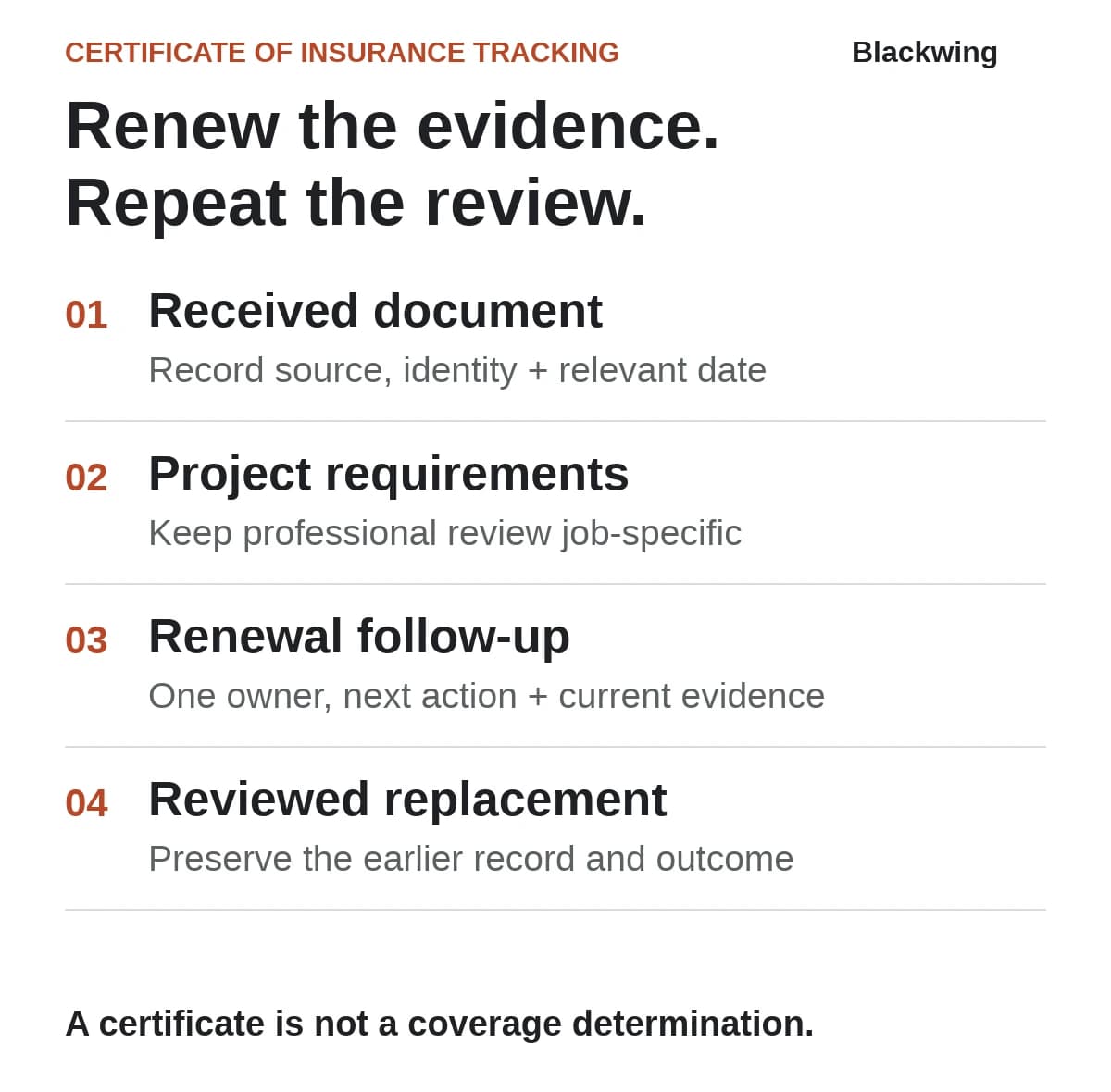
Keep the certificate's role clear
The Texas Department of Insurance explains limitations on certificates, including that they cannot alter the referenced coverage. That is jurisdiction-specific guidance, not a statement that every rule in Texas applies nationwide.
For the contractor's operating process, the important principle is to avoid treating a document label as a coverage decision. A certificate received, a document reviewed and a project requirement accepted are different statuses.
Have the appropriate insurance professional and contract or legal owner define the required evidence for the actual work. This article does not determine coverage, required limits, endorsement wording or legal compliance.
The coordinator's job is to maintain the records and route the review. They should not infer a professional conclusion from an unqualified checklist.
Connect evidence to both the company and the project
Keep a stable subcontractor or supplier identity. Attach the relevant evidence with its source, document date, recorded policy period and review state.
Then connect that evidence to the projects and requirements for which it has been reviewed. A document suitable for one relationship should not automatically satisfy every future job.
Requirements may differ. The responsible reviewers should identify those differences rather than asking the administrator to reconcile them informally.
The subcontractor onboarding workflow establishes the initial record. The renewal process maintains the relevant evidence while the relationship remains active. Initial intake is not a permanent approval for every circumstance.
Separate dates from professional acceptance
An expiry date is useful for routing follow-up. It is not, by itself, proof of current coverage or of every requirement the company needs to evaluate.
Record where the date came from and distinguish an extraction from a reviewed value. If software reads the document, a responsible person should check material fields before reminders or statuses depend on them.
Keep uncertainty visible. If the policy identity is unclear or the supplied document is inconsistent, route the question instead of selecting the date that makes the record look complete.
Do not turn an approaching date into an automatic legal conclusion or work stoppage. The appropriate owners must define the action route and authority for the particular agreement and circumstance.
Give renewals a responsible owner
Create a practical follow-up queue based on the reviewed requirements and timing. Each item needs an owner, the evidence being requested and the next action.
Keep the request and response history. A reminder sent is not a renewal received. A new certificate received is not necessarily reviewed evidence accepted for the relevant project.
When replacement evidence arrives, preserve its relationship to the earlier record. Avoid replacing the old file without a trace of the period or review it supported.
Close the renewal item when its defined evidence and review outcome exist. Where the response is incomplete, keep the exception active and identify the responsible professional or decision owner.
Review changes that matter to active work
An active project may introduce a new requirement, a changed contractual relationship or a question that the earlier review did not cover. The process should have a route to obtain the appropriate re-review.
For example, consider a hypothetical subcontractor whose document renewal arrives while they are assigned to two projects. One project's reviewed requirements are unchanged. The other has a newly identified question about the evidence needed.
The record should preserve the separate review outcomes. Marking the company globally approved would hide the unresolved project question. Marking every relationship rejected would also erase the distinctions.
Connect this review to the subcontractor-management process so the responsible team can see the approved status and remaining decisions for its own work.
Protect the documents and the boundaries
Limit access to people who need the information. A project status may be relevant to field coordination without requiring the full private document set to be shared with every user.
Do not upload evidence to an unapproved AI or document service. If a tool helps identify fields or approaching dates, keep extraction, professional review and authorized action distinct.
The register should explain its limitations. It does not prove that a policy remains unchanged, that a claim will be covered or that all contractual and legal requirements have been met. Those are matters for the relevant professionals and actual evidence.
Measure whether follow-up reaches a reviewed outcome
Track renewals waiting on a response, new documents waiting on review and project-specific exceptions lacking an owner. Review recurring delays and improve the handoff that causes them.
The purpose is a maintained evidence process, not a dashboard that makes every company look permanently compliant.
Blackwing can help connect document intake, renewal reminders and qualified review in the existing systems. An operations review can trace one certificate from receipt through its relevant project reviews and replacement evidence.
Frequently asked questions
What is construction COI tracking?
It is the operating process for maintaining certificate-of-insurance records, relevant dates, project relationships, review states and renewal follow-up. It should support qualified review rather than claim to determine coverage or compliance from a document alone.
Does a certificate change the insurance coverage?
Do not treat the certificate as a substitute for the policy or as authority to alter coverage. Consult the appropriate insurance professional and relevant jurisdictional rules. A status in the contractor's system is not a coverage determination.
Is one certificate enough for every project?
Not automatically. Keep the evidence connected to the specific requirements and reviews for each relevant relationship. The responsible professionals should determine what applies, including whether a changed project or agreement needs additional evidence or review.
Can reminders approve renewed evidence automatically?
Reminders can support follow-up, but a response received and a professional review completed are different events. Define the required checks and authority before automation updates a status that people rely on for active work decisions.