
You have agreed a date. The trade says it is available. Someone adds the name to the schedule.
Then the first morning becomes a series of preventable questions: Which drawing? Who opens the site? What is excluded? Who signs off? Where do updates go?
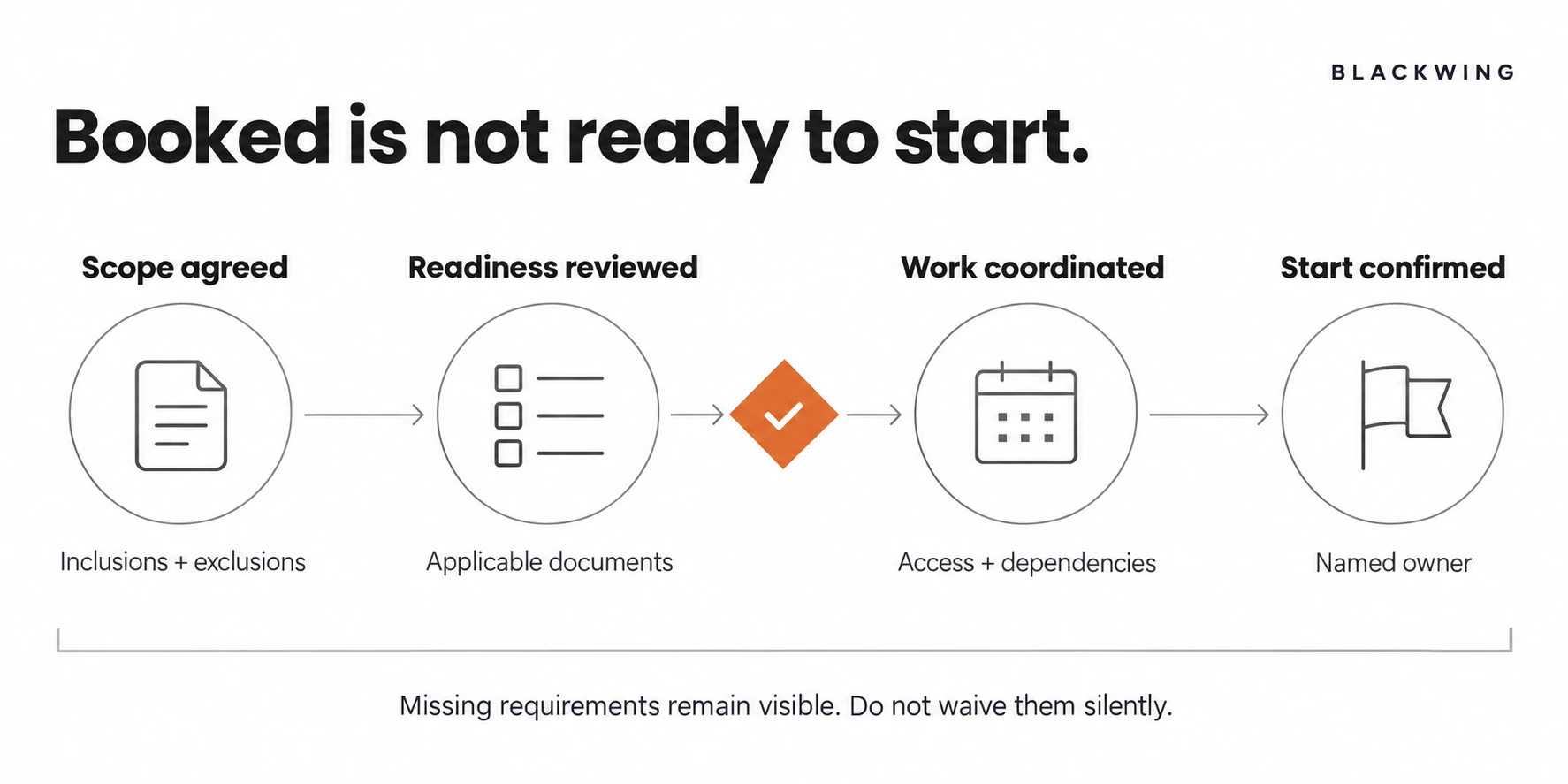
Booked is not the same as ready to start.
Selection and Onboarding Are Different Decisions
Selection asks whether a subcontractor is suitable for the work. Onboarding turns that decision into an executable working arrangement.
Procore's subcontractor hiring guidance emphasizes scope clarity and coordinated project information. Your onboarding process should build on the approved selection, not substitute for capability checks or contractual review.
Requirements vary by trade, project, jurisdiction, and agreement. Have the appropriate adviser or responsible professional determine applicable licensing, insurance, tax, safety, and other requirements. This checklist is an operational framework, not a universal legal or safety-compliance list.
Build a Readiness Checklist Around the Work
Scope and boundaries
Link the agreed scope, inclusions, exclusions, and applicable drawings or specifications. Identify interfaces with other trades and who provides materials, equipment, or temporary access where relevant.
Do not rely on "same as last time." Reusing a subcontractor does not make this project's boundaries identical to the previous one.
Record how scope questions and proposed changes should be raised. Make clear that a site conversation is not automatically an approved variation.
Applicable document review
List the documents actually required for this engagement and identify the person authorized to review them. Track received, under review, accepted for the stated purpose, and needs correction separately.
An uploaded document is not a verified document. Nor does a coordinator's tick replace specialist review when one is needed.
Sensitive personal, commercial, and banking information should be stored with appropriate access controls, not copied into an open project board for convenience.
People and communication
Record the subcontractor's lead contact, site lead, office contact, and escalation route. Explain who gives instructions and who can authorize decisions.
Give the trade a usable route for RFIs, daily coordination, changes, and completion evidence. Avoid asking it to monitor five different places with no explanation of which one contains the official direction.
Site and work readiness
Confirm the planned work area, predecessor activity, access arrangements, required project induction, and other applicable start conditions with the responsible project person.
A date in the calendar does not prove those conditions are met. If a dependency is unresolved, keep it visible with an owner and next check.
System access and handoff
Provide only the access needed for the role. Check that the intended user can find current information and submit the required updates.
An invitation sent is not access tested. A screenshot of the board does not demonstrate that the subcontractor can open the controlled drawing on its own device.
A Minimum Subcontractor Onboarding Checklist
| Readiness area | Evidence to check | Responsible owner |
|---|---|---|
| Agreed scope | Current scope and exclusions linked | Project decision-maker |
| Applicable requirements | Required records reviewed by the right person | Designated reviewer |
| Working contacts | Lead, office contact, and escalation route confirmed | Coordinator |
| Project information | Current references and instruction route understood | Project coordinator |
| Start conditions | Work area, dependencies, and access checked | Responsible site lead |
| Digital access | Required user can open and update permitted records | System owner |
Add project-specific requirements rather than assuming this short table covers every obligation.
Make Exceptions Visible
Small businesses often solve missing information with a verbal exception. Sometimes an authorized exception is possible. Sometimes the missing requirement cannot be waived. Your system must not make that decision silently.
Record what is missing, its consequence, who can decide, and the actual decision. If no authorized route exists, keep the start condition unresolved and escalate through the proper project process.
"Owner is aware" is not a complete record. A useful exception identifies what the owner has actually authorized and what remains outside that authority.
An Illustrative First-Day Problem
Imagine a small general contractor coordinating a finishing trade. The dates are agreed and the company has used the trade before, so nobody runs an onboarding check. On arrival, the lead has an older scope summary and does not know which contact handles clarification.
The revised process does not require a large procurement department. The office coordinator links the current scope, checks applicable documents with the designated reviewer, confirms the lead contact, and runs a short readiness handoff with the site lead.
The point is not more paperwork. It is fewer decisions left to improvisation at the site gate. This example is illustrative, not a reported client outcome.
Keep Onboarding Connected to Scheduling
Your construction crew scheduling process should distinguish a requested start from a readiness-confirmed allocation. Link the onboarding state to that distinction.
Do not use the checklist as a substitute for ongoing coordination. Scope, access, personnel, or project requirements may change after the first day. Assign an owner to review relevant changes rather than treating onboarding as permanently complete.
Conclusion: Prepare the Relationship Before the Start
A subcontractor onboarding checklist works when it makes responsibilities and unresolved conditions visible. Keep it short, project-specific, and tied to evidence. Test it with one trade before rolling it across every job.
Blackwing helps construction businesses design practical onboarding, coordination, and accountability systems. Book an operations review to replace owner-dependent chasing with a clear readiness process.
Frequently Asked Questions
What should a subcontractor onboarding checklist include?
Include the agreed scope, applicable requirement review, working contacts, current project information, communication and escalation routes, site start conditions, and tested system access. Determine legal, safety, insurance, and licensing requirements for the specific engagement with appropriate advisers.
Is onboarding required for a subcontractor we already know?
An established relationship does not confirm readiness for a new project. Recheck the current scope, applicable documents, contacts, site conditions, and access. Reuse verified information where appropriate, but do not assume project-specific requirements are unchanged.
Who should own subcontractor onboarding in a small company?
One coordinator can maintain the checklist, but technical, contractual, compliance, and start decisions remain with the authorized people. Separate coordination ownership from specialist approval authority, even when a small team holds several roles.
Can a subcontractor start with missing documents?
That depends on the missing requirement and the applicable project, contract, and law. Do not waive it through an administrative status. Identify the authorized reviewer, record the decision where an exception is permitted, and keep unresolved conditions visible.