
The folder contains several files called final. The person who negotiated the agreement is unavailable.
Construction contract management needs more than document storage. A practical contract register connects the controlled agreement to reviewed obligations, responsible owners and its change history. It helps the team find the right decision route without asking an administrator to become the company's lawyer.
Establish the agreement's identity
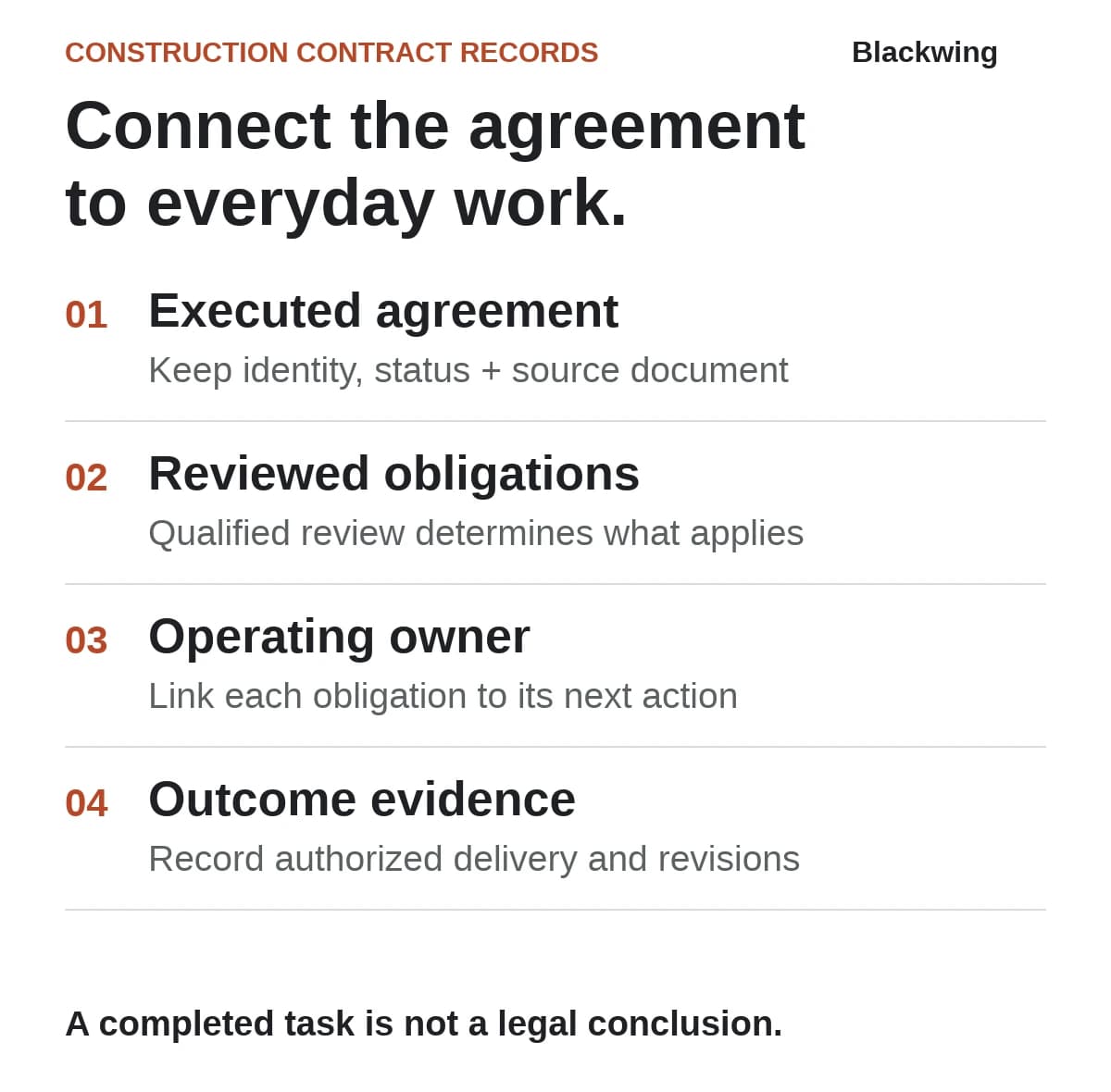
Give each agreement a stable reference. Record the project, parties, document location, execution status and the person responsible for maintaining the record.
Keep a draft separate from an executed agreement. A returned signed copy should be checked through the company's authorized process before being labelled the operative record. Do not assume a file named final is the document everyone accepted.
Link amendments and related documents with their reviewed status and effective relationship. Preserve the original instead of replacing it with a reconstructed version whose changes are difficult to trace.
The document-control workflow provides revision control. The contract register adds the operational context: which relationship the document governs and who owns the relevant decisions.
Extract obligations through qualified review
The company needs a usable summary of recurring duties and decision requirements. It does not need a spreadsheet that invents legal interpretation from fragments of clauses.
Have the appropriate contract or legal reviewer identify the obligations the operating team must track. Keep the source reference and any conditions attached to the summary.
Examples might include required submissions, review routes, notice procedures or evidence associated with a defined milestone. The actual agreement determines what applies. There is no universal notice period or required wording in this article.
If the meaning is uncertain, mark it for clarification. An administrator should not resolve ambiguity by selecting the interpretation that creates the tidiest task list.
Assign an operating owner to each reviewed obligation
A legal reviewer can explain a requirement without becoming the person who gathers every project document. Assign the operating action separately.
Record the responsible owner, required outcome, relevant date or trigger and the source evidence. Where several people contribute, one person should coordinate the result.
Keep approval authority separate from task ownership. The coordinator may prepare a submission while a different person approves or sends it. A task completed in project software should not silently imply that the company has made a contractual commitment.
Use an escalation route for unresolved questions. A reminder can tell the owner that a reviewed deadline is approaching; it cannot decide whether the company's proposed response satisfies the agreement.
Connect changes without erasing the baseline
When an amendment or authorized change affects the agreement, update the register through a controlled review. Identify which obligations or references are affected and preserve the earlier state.
Do not make the team search every later email to discover whether an original requirement still applies. Equally, do not treat a proposed amendment as though it has already changed the agreement.
The construction change-order process handles individual scope or commercial changes through the relevant authority. The contract register explains how the resulting accepted record relates to the wider agreement.
Automation can surface a potentially affected obligation. The appropriate reviewer should determine the effect and approve the update before the operating team relies on it.
Keep the action record and formal communication distinct
A task saying "notify client" is not the notification itself. Preserve the authorized communication, recipient or required route and evidence of the relevant delivery step.
The exact procedure depends on the agreement and applicable requirements. A comment in a shared board, an ordinary progress email and a formal notice may not be interchangeable.
Where evidence is missing, describe the gap. Do not mark the obligation satisfied because the team remembers discussing it.
Also control who can see the underlying documents. Confidential commercial terms and private contact details should not be published broadly because the action summary is useful to the field.
Test one obligation from source to completion
Consider a hypothetical small contractor with a reviewed submission requirement tied to a milestone. The contract owner identifies the relevant provision. The project coordinator prepares the packet. A designated reviewer checks it, and the authorized sender uses the specified route.
The register links those steps to the agreement and records the actual outcome. If the reviewer requests a correction, the obligation remains open until the required result is achieved.
This does not determine legal sufficiency. It makes the operating evidence available to the people who can evaluate it. That is a much stronger starting point than an unqualified green status.
Make the register part of project management
Review upcoming triggers, unclear obligations and records waiting on authority. Keep the active list short enough for the team to use, with the wider history available when needed.
Useful process measures include obligations without owners, missing source references and repeat corrections. Do not present task completion as proof of full contractual compliance or absence of legal exposure.
Blackwing can help connect reviewed obligations to practical workflows and the right records. An operations review can examine one recurring requirement that keeps getting lost between the contract folder and the project board.
Frequently asked questions
What is a construction contract register?
It is a controlled index of agreements, their reviewed status, source documents, related amendments and operational ownership. It should help the team locate the relevant agreement and action route without replacing legal interpretation or the original document.
Is storing signed contracts enough?
Storage preserves documents but does not automatically assign responsibility for the reviewed obligations. Connect the record to owners, triggers, required evidence and the appropriate decision authority so the operating team can act on what applies.
Can AI extract contractual obligations?
AI can assist a draft from permitted documents, but a qualified reviewer must check the interpretation, references and conditions. It should not independently define notice requirements, change contract status or authorize a legally significant communication.
Does a completed task prove contractual compliance?
No. A task status is an operating signal. The underlying requirement, authorized action and relevant evidence still need the appropriate review. Keep those records available rather than treating a green checkbox as a legal conclusion.