
Then somebody opens a job and finds that the document revisions are missing, the changes have lost their links and the contact attached to the project is the wrong branch of the customer.
Construction data migration is not just moving rows. It is transferring usable project records, their relationships and the evidence people need to understand them. The acceptance test should prove those connections, not only count the imported items.
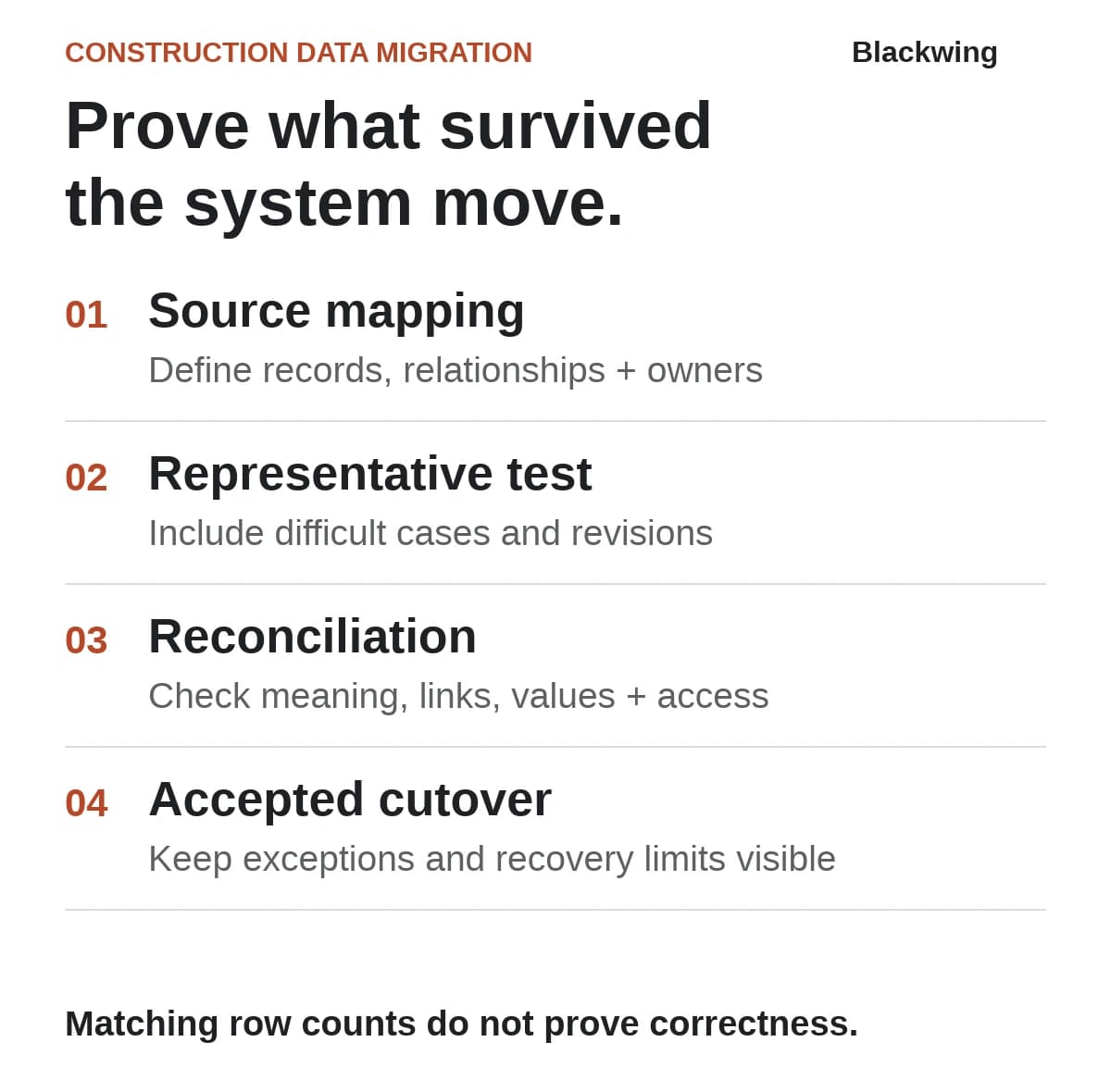
Decide what is moving and why
Define the record types in scope before exporting anything. Projects, contacts, companies, commitments, changes, documents and activities may have different sources and owners.
State what will remain in an archive, what will move into active use and what needs a decision before either happens. Do not treat all historical records as equally useful, but do not delete them simply to make the import easier.
Retention, privacy and access decisions belong to the appropriate owners and qualified advisers. The migration team should record the requirements rather than invent a universal period or publish confidential records to a convenient shared folder.
The broader security work should align with the company's approach. NIST's small-business guide is a useful starting reference for discussing cybersecurity risk, not a certification of the migration.
Map identities and relationships explicitly
Give each source record a stable reference in the mapping. Document how it will relate to the target record and how connected records will follow it.
A customer contact, a company and a project are not the same object. A project with several changes should retain the correct change relationships. A document should keep the identity and revision context the team needs.
For contact-specific issues, the construction CRM guide explains why relationships matter. Migration should preserve them rather than collapse them into a single customer status.
If duplicate or ambiguous records appear, assign the identity decision to a responsible reviewer. Do not choose a match only because two names look similar.
Test representative records before a full import
Choose examples that include the difficult cases, not just clean demonstration data. An active job, a closed job, a partial commitment and a project with several document revisions can reveal different weaknesses.
For each example, define what the target must preserve. Check important fields, linked records, documents, status meaning and access from the actual role that will use them.
Do not confuse a successful import response with a usable result. The system may accept a field while interpreting its units, date or status differently.
Keep errors and transformation decisions documented. A field intentionally left out is different from a field lost without explanation.
Reconcile more than row counts
Counts help detect omissions. They are not enough to establish semantic correctness.
Compare selected values and relationships on the agreed basis. Where totals are relevant, explain what is included so a count or amount from one system is comparable to the other. Check how dates and time zones are represented.
Document control deserves specific attention. The construction document-control process should still distinguish current, superseded and reviewed records after the move. Fifteen uploaded files do not prove that the accepted revision remained identifiable.
Keep the reconciliation evidence and unresolved exceptions. A clean dashboard should not conceal a known mismatch that still needs review.
Plan the cutoff and changes during the transition
Decide when the source stops being edited for the migration scope, how late changes are handled and which system owns new work during the transition.
Without this rule, the import can be accurate at export time and outdated before the team starts using it. Two systems then become competing versions of the job.
Record the cutoff and any final reconciliation. Tell users what is in scope and where they should work. Avoid retiring the source until the relevant business and technical owners accept the migration and its remaining limitations.
This article proposes a workflow. It does not authorize a live cutover, deletion, new access grant or change to a real company's systems.
Prove the fallback rather than naming it
A backup checkbox is not evidence that the team can recover the required records. Define what the fallback must restore and test it through the responsible technical process.
Likewise, an exported archive may preserve some data while omitting relationships or files. State those limits rather than calling it a complete recovery solution.
In a hypothetical migration, an active project imports correctly but its approved change documents fail to attach. The acceptance gate should keep that exception open. The company can decide whether to correct it before cutover or approve a bounded alternative, with the source evidence still accessible under controlled permissions.
Accept the system as a working record
Ask the intended users to complete a few real information-retrieval and update tasks in the reviewed target. Can they find the current document, trace a change and understand who owns the next decision?
Track unresolved mismatches and the conditions under which the source can be retired. A migration is complete when the agreed scope and acceptance criteria are met, not when the upload bar reaches the end.
Blackwing helps define mappings, review gates and usable system handoffs. An operations review can start with the records that would be hardest to reconstruct if their relationships disappeared.
Frequently asked questions
What is construction data migration?
It is the controlled transfer of construction-business records into another system or storage environment. The scope should include relevant relationships, document context, access and acceptance checks, not just importing the same number of rows.
What should be checked after importing project data?
Check important fields, units, dates, statuses, linked objects, document revisions and role access. Use representative difficult records and compare them to the source. Counts are useful but do not establish that the target preserves the meaning of the data.
Should the old system be deleted immediately?
No automatic deletion should follow an import. The responsible owners must review acceptance, retention obligations, unresolved exceptions and a tested fallback. Retirement is a separate authorized decision, not evidence that the migration itself succeeded.
Does an export prove that a migration can be reversed?
No. An export may omit relationships, files or configuration needed for recovery. Define what restoration must achieve and test it with the appropriate technical owner. Describe any limits rather than claiming a complete rollback from an untested archive.