
The booking worked. The readiness process did not.
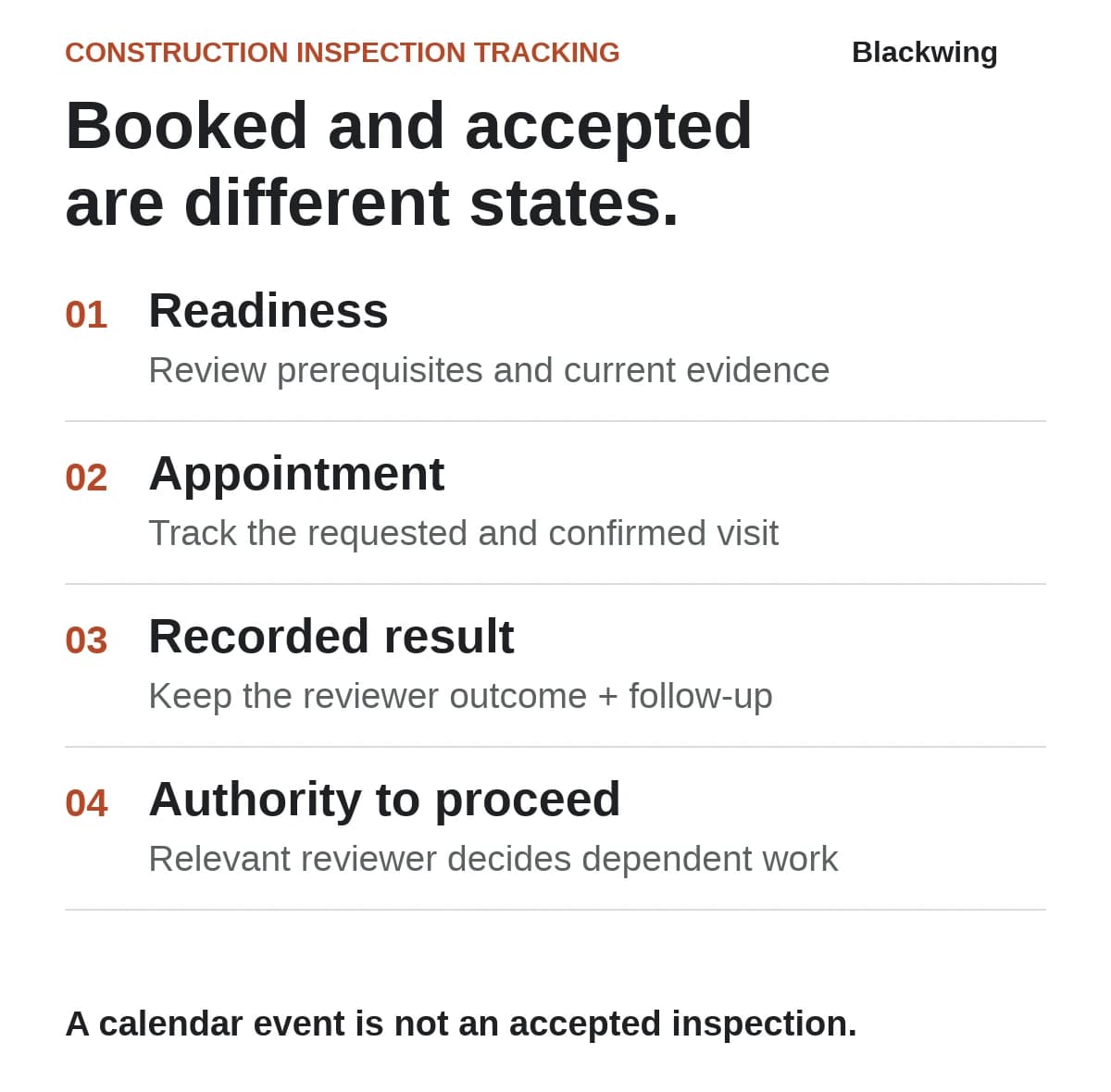
Construction inspection tracking should distinguish the required review, the visit arrangement, the recorded outcome and any authority to proceed. Those are separate events. A date in a calendar proves none of the others.
Build the register from reviewed requirements
Identify the inspections or reviews relevant to the specific project with the qualified professionals and authorities responsible for them. Requirements vary by work, agreement and jurisdiction.
Record the scope or location, responsible reviewer, relevant prerequisites and the activity that depends on the result. Keep the source of the requirement available rather than relying on a copied checklist from another job.
This is an operating register, not a technical inspection standard or a safety assessment. The process coordinator should know who must decide a requirement, not assume authority to define one.
Connect permit-related requirements to the permit-tracking workflow. An issued permit and an accepted inspection result are not interchangeable statuses.
Make readiness a step before the appointment
Define who checks that the relevant work, access, information and required participants are ready before requesting or confirming the visit.
Use the technical prerequisites provided by the appropriate reviewers. Do not turn a generic readiness checkbox into a claim that the work complies.
Keep missing prerequisites visible with an owner and next action. If the planned inspection cannot proceed, route the scheduling decision through the responsible person. Avoid waiting until the appointment simply because it appears on the calendar.
The readiness check should be usable at the work location. If the team needs a current approved detail, make that reference accessible through the controlled document system rather than asking someone to locate it from an old email.
Give the appointment its own record
Track the request, confirmed arrangement, location, relevant contact and any changes to timing. State what is actually confirmed and who confirmed it.
An application submitted for a slot is not always a booked appointment. A proposed date is not the same as a confirmed one. Keep cancellation and rescheduling history when it matters to the project record.
Tell the people who need to prepare, provide access or hold dependent work. A calendar invitation sent only to the coordinator can leave the field unaware of the plan.
Do not make promises on behalf of an authority or independent reviewer. The contractor's tracker should record their actual response, not infer availability from a desired date.
Record the result rather than a verbal summary
After the visit, connect the outcome to the inspection record and the relevant evidence or report. Identify unresolved items, required follow-up and the person responsible for the next step.
Use the terminology the responsible authority or reviewer supplies. If the result is unclear, ask for clarification rather than translating it into "passed" because the visit occurred.
Keep an informal observation separate from a formal result. A team member reporting that the visit looked positive is not necessarily the evidence needed to release dependent work.
The appropriate technical reviewer determines whether work can proceed. A software status should represent that decision where needed, not create it automatically.
Track corrections without losing the original result
Consider a hypothetical contractor arranging a review before the next work package. The appointment happens, but a required record is missing. The reviewer requests follow-up before providing the necessary acceptance.
The tracker should show the visit as completed and the acceptance as unresolved. Assign the missing record, connect the response and capture the subsequent decision.
If a new visit is required, link it to the earlier result rather than replacing the history. The team then understands why the next activity remained held and what closed the issue.
For work-verification controls beyond appointment coordination, see the construction rework-prevention process. Inspection tracking supports that record but does not replace qualified quality or safety review.
Review the queue by dependencies
The useful review is not just a list of upcoming appointments. Look for inspections whose prerequisite owners have not responded, results awaiting clarification and dependent activities still lacking a reviewed release decision.
Assign the next action rather than moving the date repeatedly. Where the requirement or sequence changes, keep the reason and authorization visible.
Track avoidable rescheduling, missing result records and dependencies incorrectly marked ready. These are process-quality signals. They should not be presented as a measure of technical compliance or proof that all inspection obligations have been satisfied.
Keep the tool in its proper role
A small team can maintain this workflow in a simple register or its existing project system. Automation can send reminders, connect records and surface overdue actions.
It should not independently determine inspection requirements, certify the work or authorize concealment and continuation. Those decisions belong to the relevant qualified people and authorities.
Blackwing helps make the coordination visible so the field and office work from the same status. An operations review can follow one inspection from requirement to result and the next permitted activity.
Frequently asked questions
What should construction inspection tracking include?
Include the reviewed requirement, work or location, prerequisites, responsible people, requested and confirmed appointment, recorded result and follow-up. Link the evidence needed for the relevant authorized decision about dependent work.
Is a booked inspection the same as an accepted result?
No. Booking confirms an arrangement, subject to its actual terms. The result comes from the inspection or review. Required acceptance and permission to proceed must be established through the appropriate authority, not inferred from the calendar.
Who decides which inspections are required?
The relevant authorities, contracts and qualified professionals determine the applicable requirements. A contractor's coordinator records and routes them. A generic article, software template or copied checklist should not be treated as a complete project-specific determination.
Can inspection software release the next task automatically?
Only within carefully approved rules that represent a verified authorized decision. A generic "visit completed" event is insufficient. Preserve technical and regulatory authority, required evidence and unresolved conditions before marking dependent work ready.