
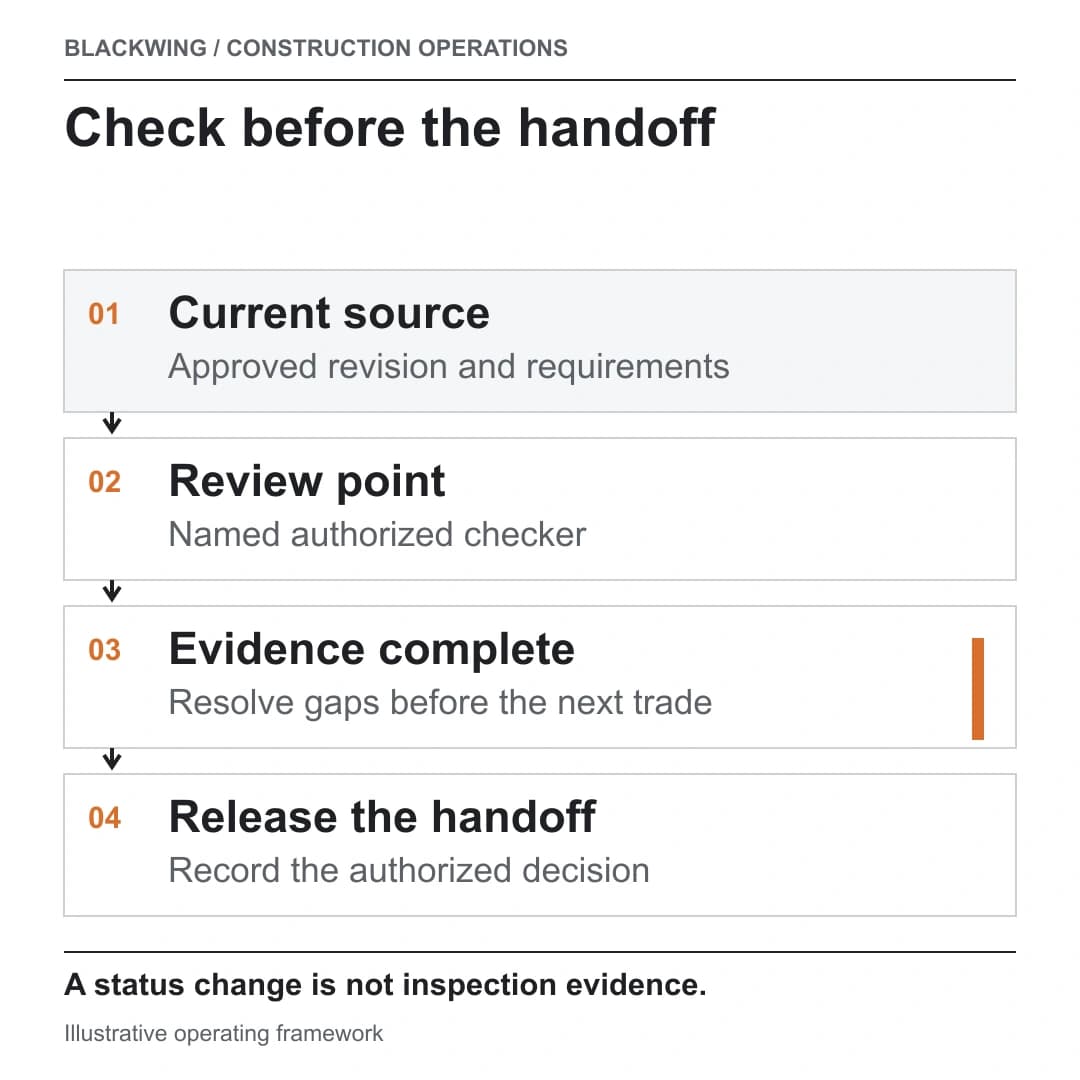
Put the check where visibility changes
Some work becomes harder to inspect after another activity covers, encloses, connects to, or relies on it. The project team should identify those transitions from its actual drawings, specifications, inspection plan and contract requirements. This article does not prescribe trade-specific technical criteria or safety steps. Those belong to qualified project personnel and governing project documents.
An in-process check is a planned observation before a dependent activity proceeds. It differs from a punch list, which generally records incomplete or deficient items identified during completion and closeout. A construction punch-list process helps manage that later work; it does not replace earlier checks.
Build a simple control around each check
For each planned review point, record five things:
- The condition and timing. Identify the work to review and the activity that would reduce visibility or make correction more disruptive.
- The current reference. Link the applicable approved drawing, specification, submittal, inspection plan or other controlled record, including its revision.
- The authorized checker. Name the role responsible for the observation and any role that must witness or approve it under the project requirements.
- The evidence. Capture the date, location or work area, reference used, observation, and any photographs or test records the project requires.
- The disposition. Record whether the work is accepted for the next handoff, requires correction, or remains open for an authorized decision.
The Procore overview of construction quality control describes inspection, documentation of non-conforming work and correction as parts of quality control. That vendor educational page is context, not a substitute for a project’s contractual inspection requirements.
Make an exception visible
If the review finds a gap, keep the affected handoff in a clear status such as open, correction required, or awaiting authorized review. Record who owns the next action and when it is due. Avoid a vague “checked” tick that does not show what was reviewed, against which current source, or what happened to an exception.
Hypothetical example
Before a wall is closed, the project’s approved inspection plan calls for an authorized reviewer to confirm a defined condition. The field lead sees that the drawing on site appears older than the project’s current revision. The right response is not to improvise a technical judgment from this article. The lead records the mismatch, identifies the current controlled document through the project’s document process, and routes the check to the designated authority. The dependent handoff proceeds only when the person authorized by the project records the disposition.
This example illustrates a control path, not a specification or universal hold-point rule. Project documents determine who inspects, what evidence is required, and who can release work.
Keep records connected to the work
Use a consistent identifier that connects the check to the project, area, activity and relevant source document. Store the evidence where the project team can find it later, and make corrections traceable. If a check is repeated, retain the original finding and the follow-up disposition rather than replacing the record with a green status.
Good document control matters because a technically sound observation against an obsolete reference can still create confusion. See construction document control for small contractors for the related process. Keep roles practical: the person who performs the work may provide evidence, while the authorized reviewer makes the decision defined by the project.
Plan the check in the sequence, not only in a quality form. The responsible lead should know when work is expected to reach the review point, how much notice the checker needs, what access must be available, and what happens if the checker cannot attend. A late request can encourage people to treat review as a formality. Tie the reminder to the work package and define an escalation route for missed reviews.
At shift handoff, review open checks with the next shift or trade lead. Confirm whether the work remains exposed, whether access affects the review, and whether an authorized release exists. Do not create a duplicate form if the project already has an approved inspection record. Ensure the existing record captures the source, result, exceptions and disposition so the team can retrieve one authoritative history.
Four questions about in-process checks
What is an in-process construction check?
It is a planned review while relevant work remains visible and before a dependent activity proceeds. The project’s requirements define the check and responsible roles.
Who releases a hold point?
The role specified by project documents and delegated authority. A generic article or software status cannot grant release authority.
What evidence should be retained?
Keep the current reference and revision, date and location, reviewer, observation, any required supporting record, and the recorded correction or release disposition.
Is this the same as a punch list?
No. In-process checks happen during work to resolve issues before dependent work. Punch lists generally organize completion-stage items and closeout.
Design the handoff before work reaches it
Choose review points from the project’s real sequence, make the current reference easy to find, and define what an exception does to the next handoff. When teams can see the evidence and the authorized decision in one place, they have a clearer basis for proceeding or correcting the work. Blackwing helps contractors map those operating controls and supporting systems; request an operations review.
Written with the help of Laura, Ahmed Fahmy’s AI assistant, based on his ideas and under his supervision.