
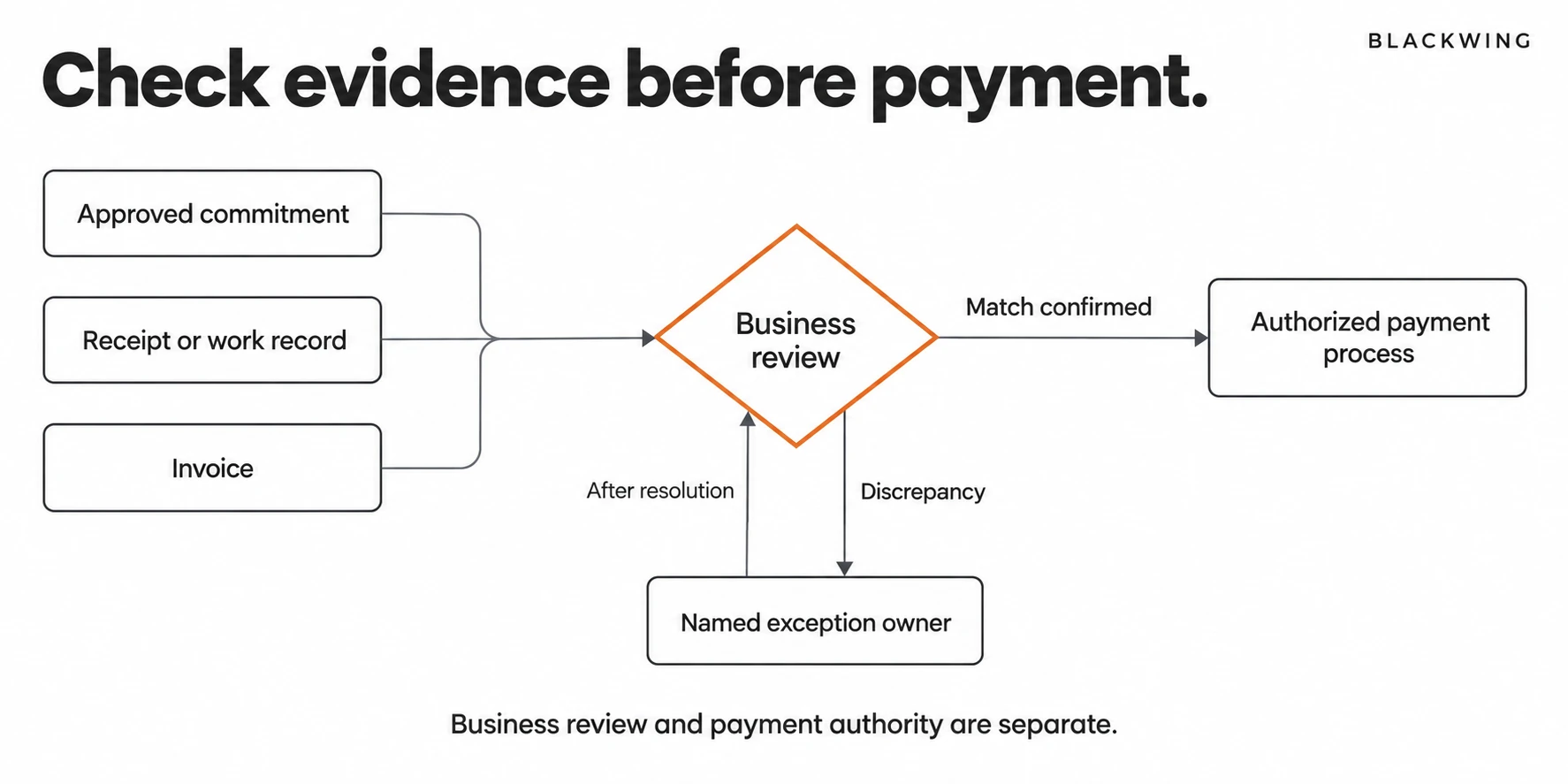
A construction invoice approval workflow connects the invoice to the authorized commitment and evidence of goods or services received, routes discrepancies to a named owner, and keeps payment authority separate. For a small contractor, this is about making the decision traceable, not adding an accounting department's worth of administration.
A familiar supplier is not evidence that this invoice is correct. A purchase approval is not evidence that the billed work was received.
What Is Invoice Approval in Construction?
Invoice approval is the business review of a supplier or subcontractor's invoice before the authorized accounting and payment process proceeds. Checks depend on the transaction, agreement, and company controls.
For goods purchased against an order, comparing the invoice, purchase order, and receipt record can be useful. Microsoft's invoice-matching documentation explains this distinction between two-way and three-way matching. The appropriate approach and tolerances must be defined for the company, not copied blindly from a software example.
Service invoices, progress claims, tax treatment, retention, and contractual payment requirements may need different evidence or specialist review. This is an operational framework, not accounting, legal, or tax advice.
Start With One Invoice Record
Give the invoice a controlled intake route and record its supplier, invoice number, date, project, amount, supporting reference, and received date. Check for a potential duplicate before the same bill becomes two approval tasks.
Use one record to track the decision. If the document arrives through a project manager and accounting inbox, link both to the same item rather than creating parallel queues.
Protect banking and sensitive commercial data. A public project board is not the right place for unrestricted payment details.
Separate Four Checks
1. What was authorized?
Link the applicable order, subcontract, service agreement, or other approved commitment. Confirm the version and any authorized changes relevant to the invoice.
If the commitment cannot be found, name the person responsible for clarifying it. Do not create retrospective approval by quietly labeling the invoice "Matched."
2. What was received or accepted?
For goods, locate the receipt information and identify quantity or condition exceptions. For services or work, use the evidence and review route required by the agreement and project.
A delivery photograph can support a record. It does not necessarily prove quantity, condition, or contractual acceptance. The responsible receiving or project person should record what was actually checked.
3. Does the invoice align with the evidence?
Check relevant quantities, prices, references, and other company-defined fields. Route tax or accounting questions to the appropriate professional rather than expecting the site lead to decide them.
Where approved tolerances apply, make them explicit. Where a mismatch needs review, record the issue and owner. An unresolved difference should not vanish behind a generic approved status.
4. Who authorizes the next step?
The person confirming project evidence may not have payment authority. Keep the business review, accounting processing, and payment authorization distinct under the company's controls.
If several roles are held by one person, preserve the separate decision records and checks. The process should remain understandable when that person is unavailable.
A Practical Invoice Review Table
| Check | Evidence | Exception owner |
|---|---|---|
| Commitment | Approved order or agreement | Purchasing or project owner |
| Receipt or work | Appropriate receiving or completion record | Responsible field or project reviewer |
| Invoice alignment | Comparison against applicable records | Designated business or finance reviewer |
| Accounting treatment | Required accounting and tax checks | Qualified accounting owner |
| Payment authorization | Company-approved payment decision | Authorized payment approver |
These are responsibilities, not a mandatory organization chart. Adapt them to your business and agreements with professional input.
Manage Discrepancies as a Queue
Classify issues so the next person knows what to do: missing commitment, missing receipt, quantity discrepancy, price discrepancy, possible duplicate, or specialist review needed.
For every issue, record the owner, next action, relevant due date, and last update. Consider applicable payment obligations when setting the review route; an internal queue does not override them.
Keep the actual status visible. "Waiting for site quantity confirmation" is useful. "Finance has it" tells the team very little.
An Illustrative Partial Delivery
Imagine a contractor ordering ten units of a material. The site records eight received and two outstanding. An invoice arrives for ten.
The office does not have to decide from memory. It links the order, receipt exception, and invoice, then routes the difference to the designated owner for resolution under the applicable agreement. The payment decision follows the authorized process.
This example illustrates an evidence handoff. It is not a universal instruction to withhold, split, or release payment in that situation.
Connect Purchasing to the Receiving Record
An invoice workflow depends on the record created earlier. If the construction procurement process never captured an order reference or receiving exception, accounting inherits an investigation instead of a check.
Fix the upstream handoff. Give the field a simple way to report receipt information and exceptions, and make sure it reaches the same project record used for invoice review.
Job-cost allocation is another related but separate responsibility. Our construction job costing guide addresses visibility of project costs, not payment authorization.
Conclusion: Make Approval Evidence-Based
A construction invoice approval workflow should explain what was checked, what remains unresolved, and who can authorize the next step. Start with one transaction type, define its evidence, and test a normal invoice and a discrepancy.
Blackwing helps construction teams connect purchasing, field records, and finance handoffs without confusing their authority. Book an operations review to examine where invoices become owner-dependent investigations.
Frequently Asked Questions
What should a construction invoice approval workflow check?
It should check the applicable authorized commitment, goods or work evidence, invoice alignment, duplicate risk, required accounting review, and payment authority. The specific checks depend on the agreement, transaction, and company controls.
What is three-way matching?
Three-way matching compares a purchase-order-based invoice with the corresponding order and receipt information. It can help identify quantity or price discrepancies. It is not suitable as a complete review method for every service invoice or progress claim.
Does invoice approval authorize payment?
Not necessarily. Business verification, accounting processing, and payment authorization can be separate decisions. Follow the company's approved authority rules and applicable contractual or legal requirements.
How should invoice discrepancies be tracked?
Record the specific discrepancy, linked evidence, responsible owner, next action, relevant due date, and resolution. Keep the issue visible until it is addressed through the authorized process rather than repeatedly resetting a generic pending status.