
The drawing is still under review. Access depends on another trade. A client choice has not been made. The crew is available, but the activity is not ready.
Those are different problems, and putting a date beside the activity does not solve them.
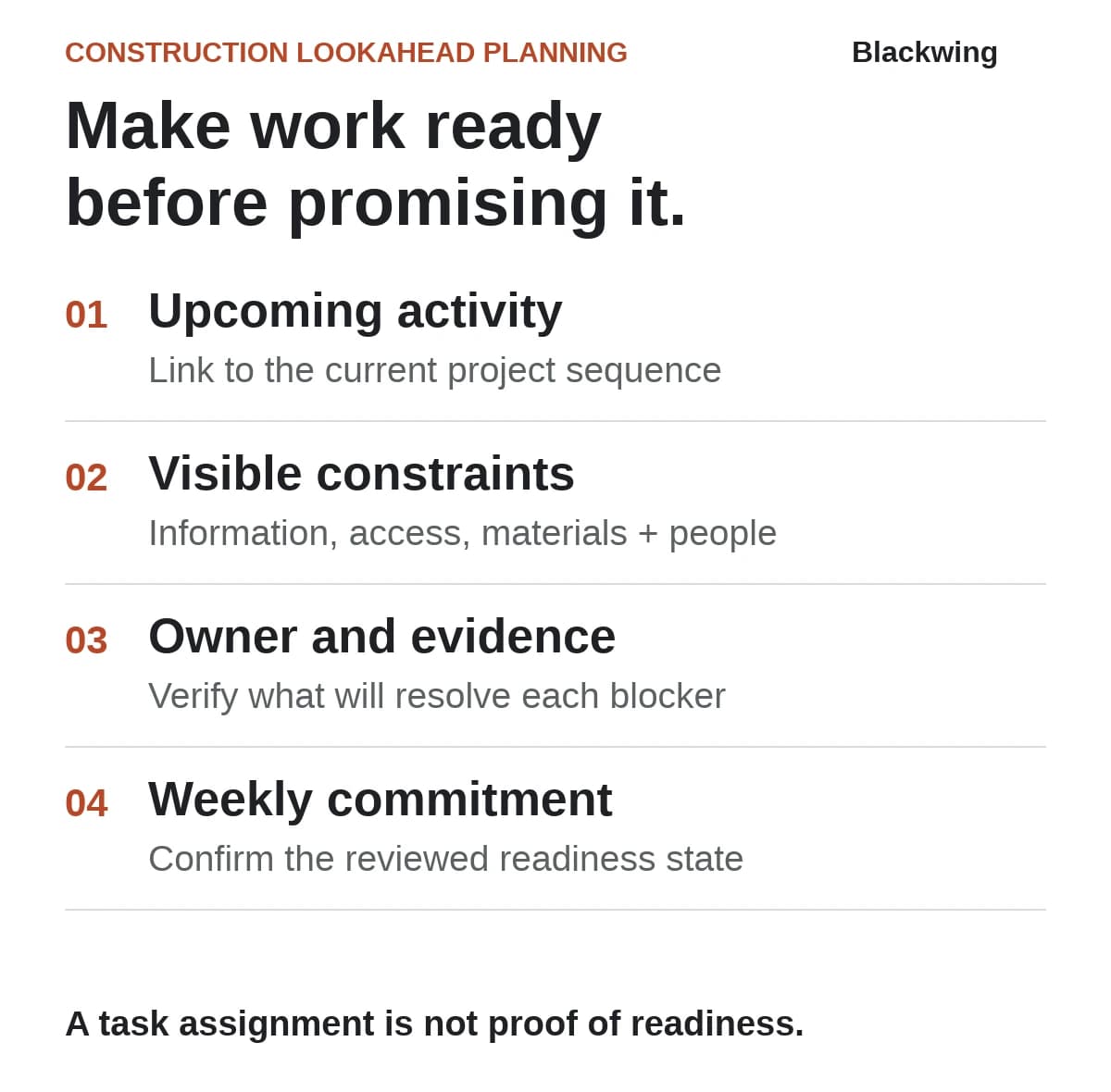
The Lean Construction Institute describes lookahead planning as making upcoming work ready. This article applies that principle to a practical small-team workflow. It is not a complete Last Planner System implementation or a certification claim.
Separate the plan from a weekly promise
The master schedule describes the wider sequence and milestones. The lookahead examines upcoming activities and their constraints. The weekly commitment identifies work that responsible people can realistically promise to complete.
Keep those roles distinct. If every activity in the lookahead is treated as an unconditional promise, the team will either overcommit or hide uncertainty.
Choose a rolling horizon that gives enough time to resolve the actual dependencies. Some decisions need longer lead times than others. The right horizon should follow the project and the team's ability to act, not a fixed number copied from an article.
The existing crew-scheduling process addresses who is available. Lookahead planning asks whether the work itself can be made ready for them.
Turn vague blockers into specific constraints
"Waiting on information" is an observation, not a useful constraint record.
Identify what information is missing, who can supply or approve it, when it is needed and which activity depends on it. Give the constraint a stable reference so it can be tracked across planning meetings.
Useful categories can include design information, approvals, preceding work, materials, access, resources and client decisions. Use the categories that help the team route an action. Do not build a taxonomy that takes longer to understand than the problem.
Keep safety, technical acceptance and regulatory permission with the qualified people responsible for those decisions. A planning coordinator can record that a decision is needed. They cannot create the missing authority by changing a status.
Use readiness evidence rather than optimistic labels
Define what will demonstrate that each constraint is resolved. For a required reviewed document, that may be the current accepted revision. For access, it may be a confirmed arrangement with the responsible party.
An email saying "should be fine" may deserve follow-up. It is not necessarily the evidence the activity needs.
Use statuses that the team can apply consistently. For example: identified, action assigned, response received, verification needed and resolved. Separate a received response from a completed review when they mean different things.
Do not mark an activity ready because the problem has been assigned. Assignment is progress in managing the constraint, not proof that the constraint is gone.
Review one hypothetical activity
Imagine a remodeler planning cabinet installation for the following week. The crew slot is available. Three dependencies remain: an accepted layout revision, completed preceding work and confirmation that the correct units will be at the receiving point.
The planner records each dependency with an owner and required decision date. One owner reports that the document is available, but the team verifies that it is the superseded revision. The constraint remains open.
The point of the review is not to punish the owner for an update. It is to prevent a weak signal from becoming a field commitment. The team can then revise the sequence or work on another ready activity through the normal planning authority.
Connect the constraint log to the meeting
The lookahead meeting should concentrate on changes, unresolved dependencies and decisions. It should not require everyone to recite every activity already visible in the record.
Review what moved into the horizon, what is approaching its required date and what changed since the last review. Confirm the next action for each important constraint. Keep the reason for a changed commitment rather than replacing the date without explanation.
At the project start, the preconstruction checklist provides a broader readiness gate. The rolling lookahead maintains readiness as active work progresses. Starting well does not mean every later dependency is resolved.
Learn from missed commitments carefully
Record whether committed work was completed using a definition the team understands. When it was not, investigate the reason with the people doing the work.
An activity may be interrupted by a new condition, an unresolved dependency or an unrealistic assignment. A completion percentage alone does not prove that the overall project is healthy or that someone performed poorly.
Use the information to improve the planning process. Are constraints identified early enough? Are decision dates meaningful? Does "resolved" consistently mean the work is ready? These questions are more useful than making the board greener.
Blackwing can help connect constraint records, decisions and weekly work commitments in the team's existing tools. An operations review can examine the last activity that was scheduled but could not start.
Frequently asked questions
What is a construction lookahead schedule?
A construction lookahead schedule examines upcoming work within a rolling horizon and identifies what must be resolved to make it ready. It connects the wider sequence to practical preparation before the team makes short-term work commitments.
Is lookahead planning the same as crew scheduling?
No. Crew scheduling addresses resource availability and assignment. Lookahead planning also considers information, approvals, materials, access and preceding work. An available crew does not make an activity ready when another necessary dependency remains unresolved.
How many weeks should a lookahead cover?
Choose a horizon that gives the team time to resolve the project's actual dependencies. Review it as a rolling view. A fixed number is not automatically appropriate for every contractor, activity or approval lead time.
When should a constraint be marked resolved?
When the responsible reviewer has the defined evidence that the dependency is satisfied. A message received, action assigned or expected delivery date is not always sufficient. The closure rule should match the type of constraint and the relevant decision authority.