
The point is not to add paperwork for its own sake. It is to make readiness observable. A checklist should identify what has been checked, who confirmed it, what remains unresolved, and what action will close each gap. It should also distinguish a genuine blocker from an item that can safely proceed in parallel under an agreed plan.
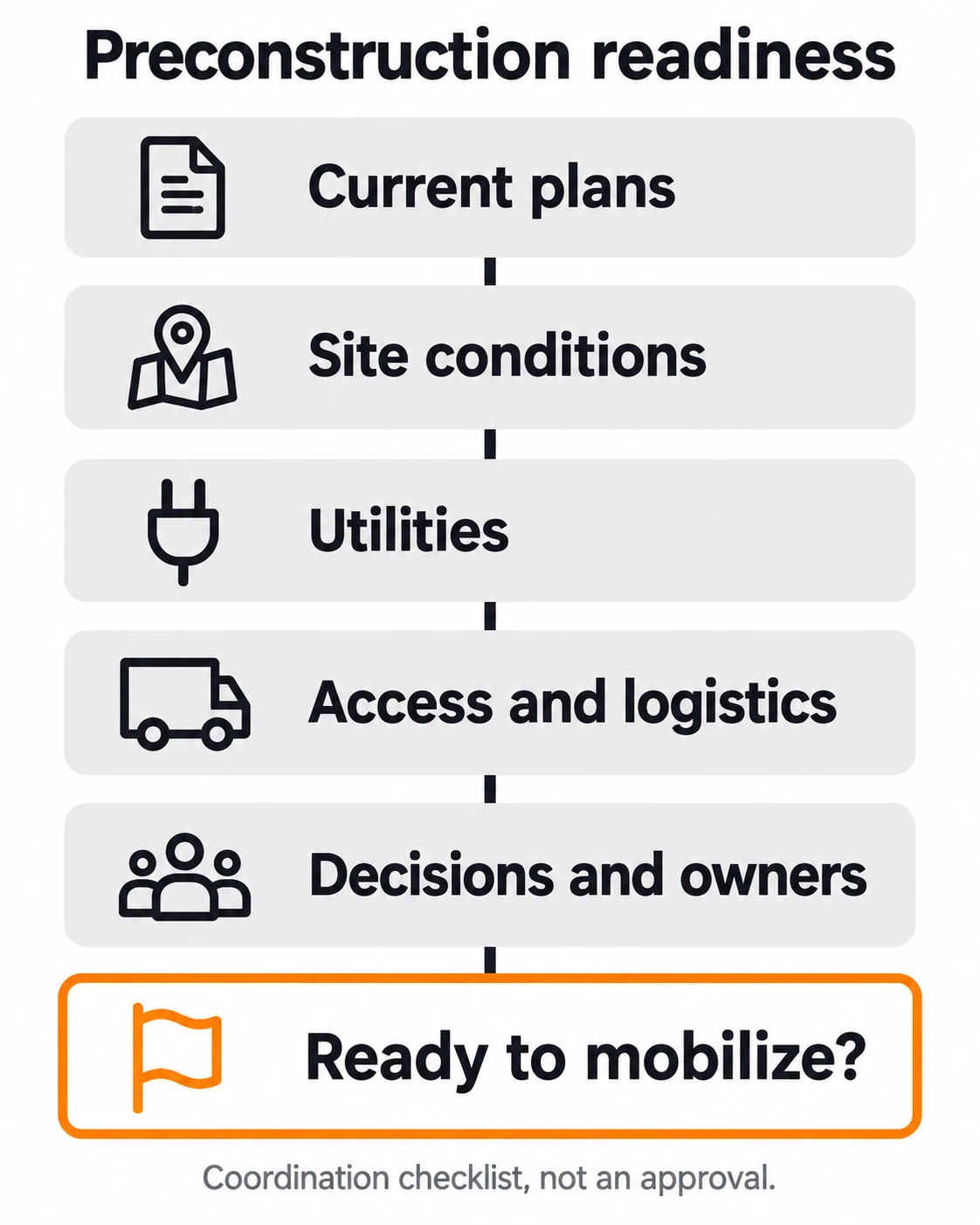
Start with the current basis
First, identify the documents and assumptions the team is using. Record the current plan or drawing revision, relevant specifications, scope boundaries, and the date of the latest site walk or condition check. If different participants are relying on different versions, resolve that before asking them to confirm readiness.
Then compare the plan with what is actually known about the site. The review may include existing conditions, dimensions that affect the work, access routes, staging constraints, adjacent operations, and visible conflicts. The right questions depend on the project and the people qualified to answer them. A checklist should prompt a field confirmation where one is needed; it should not imply that a desk review can verify a physical condition.
For example, OSHA’s job hazard analysis resource describes breaking a job into steps and examining hazards and controls at each step. That is a U.S. workplace-safety resource with a specific purpose, not a universal construction readiness standard. It illustrates a useful planning discipline: review actual work steps and conditions instead of assuming that a completed drawing answers every field question. OSHA Job Hazard Analysis Resource Guide
Make access and interfaces explicit
“Access is arranged” is too vague to support a start decision. Record which route applies, what it is intended to accommodate, any time or coordination constraints, and who has confirmed the arrangement. The checklist might ask whether deliveries, workers, equipment, and emergency contacts have been considered, but the project team must determine the relevant requirements for its site.
Interfaces deserve the same treatment. List the other trades, owners, property representatives, or operations teams whose work or decisions affect the next phase. For every dependency, record a contact, the required input, the needed date, and the consequence if it is late. A named owner is more useful than “coordinate with vendor.” If a dependency changes, update the record instead of relying on an old meeting note.
Some official guidance is deliberately narrow. OSHA’s steel-erection site-preparation material addresses preparation for steel erection, including access roads and storage in that context. It can help a team remember that physical preparation matters, but it should not be generalized into a complete checklist for every project or interpreted as advice on a particular site. OSHA Steel Erection: Site Preparation
Track utilities, decisions, and owners
Utility questions are often split across drawings, emails, and field conversations. Bring them into one place: what connection or service is relevant, what information is confirmed, who is responsible for the next check, and whether that item blocks the planned work. Avoid writing “utilities complete” unless the responsible party has defined what complete means for this scope.
The same discipline applies to decisions. A decision log can include the question, options under review, decision owner, consulted participants, date needed, status, and final answer. Attach or link the relevant record so later readers can understand what was decided. Where a change affects scope, schedule, or another party, route it through the project’s agreed change process rather than treating a checklist comment as authorization.
Keep status labels simple. “Open,” “in progress,” “confirmed,” and “not applicable” are usually enough, provided people use them consistently. Add a short explanation when an item is not applicable. Avoid a green check that hides an unresolved assumption: if confirmation is pending, say so plainly and identify the next action.
Set a real start gate
A readiness review should end in a decision, not just a collection of checked boxes. The decision might be “ready,” “ready with listed conditions,” or “hold pending named items.” Record who made the call, when it was made, which phase or work area it covers, and what would cause the decision to be revisited.
This is also where the team separates administrative completeness from field readiness. A package may contain every expected document while still leaving a physical conflict unresolved. Conversely, a noncritical administrative item might remain open without preventing a specific phase, if the responsible decision-maker agrees and records the boundary. Do not let a status label make that judgment on its own.
Illustrative example: A renovation team has a current drawing set and a planned start date. During its walk-through, it finds that the proposed delivery path is shared with another operation. The checklist records the route, the other operation’s contact, the needed coordination date, and the person responsible for confirming a workable arrangement. The start review then names the affected delivery activity as a condition, instead of marking the entire project “ready” based only on approved plans. This is an example of record design, not a claim about any particular project.
Keep the checklist useful after kickoff
Readiness is not a one-time ceremony. When site conditions, scope, access, or timing change, update the affected entries and notify the relevant owners. Preserve the prior decision or revision history so the team can tell what changed. A short, current record is more useful than a long form nobody maintains.
Begin with the smallest set of prompts that prevents recurring confusion. If the same question appears repeatedly, clarify the prompt or ownership. If people check boxes without evidence, add a confirmation field or link. If a prompt produces no decisions or actions, remove it. The checklist should reflect the organization’s actual work and approved procedures, not turn one person’s preference into policy.
Teams that need to clarify owners, exceptions, and handoffs across a recurring process can use Business Process Mapping & Documentation as a starting point for the operating workflow. For a focused discussion of a delay, rework, quality, or management-effort problem, book a 30-minute Operations Review. The conversation is intended to identify the operating issue and a practical next step; it is not a substitute for project-specific technical review.
Frequently asked questions
Does an approved plan set mean the project is ready to start?
No. Approval confirms a defined review milestone, while readiness also depends on current conditions, access, dependencies, responsibilities, and open decisions relevant to the upcoming work. The project team should define its start gate and record who makes the decision.
Who should own a preconstruction checklist?
Assign one coordinator to keep the record current, while each responsible discipline confirms its own information. The coordinator should not be treated as the technical approver for every item. Make the decision authority and escalation route visible.
How often should readiness be checked?
Review it before the relevant phase begins and whenever a meaningful change affects an assumption, dependency, or site condition. The right cadence depends on the project. A record that is not updated after a material change can create false confidence.
What should happen when an item is still open?
Record the issue, owner, next action, needed date, and whether it blocks the specific work under review. The authorized decision-maker can then hold the work or document a bounded condition. Do not silently convert an unresolved item into a completed check.