
Two days later, the crew discovers that part of the order is missing and another part is the wrong item. Nobody is sure whether the signature meant a quantity check, a condition check or simply that someone was present when the truck arrived.
Construction material receiving is the process of recording what physically arrived and routing differences for review. It should give purchasing, the field and accounting a shared record without turning a delivery acknowledgement into a technical or contractual acceptance decision.
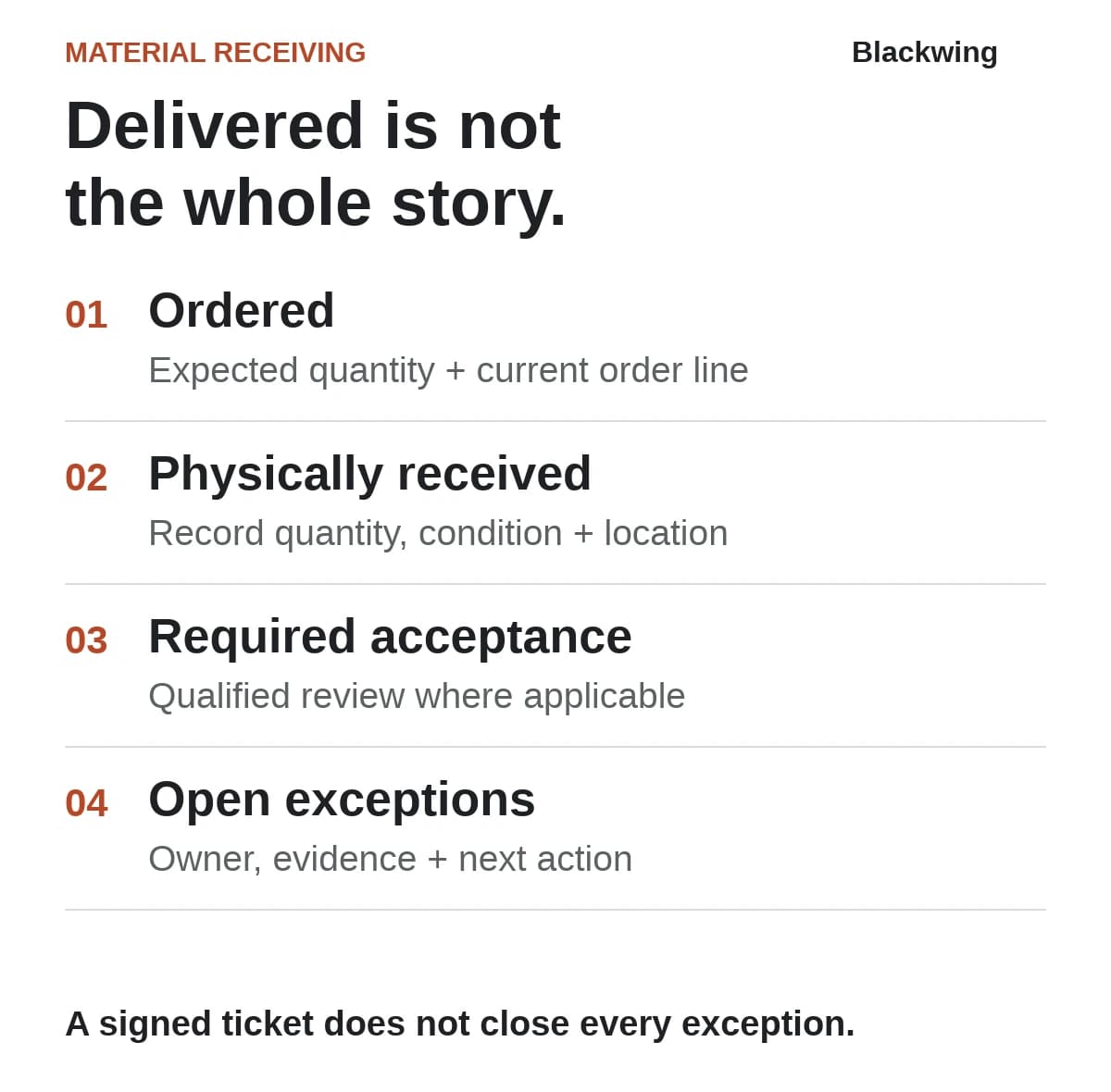
Decide what the receiver is actually confirming
Make the receiving responsibility explicit. A person accepting a delivery may be able to count packages and record visible condition without being qualified to approve a technical substitution.
Separate physical receipt, quantity verification and any required technical acceptance. Those events may occur at different times and involve different people.
The project's contract and responsible professionals should determine the relevant acceptance requirements. Do not assume that signing a supplier ticket proves compliance with the specification or waives a concern.
This distinction is particularly useful for small contractors, where the person available at the gate may not be the person who ordered the material. The system should tell them what to record and whom to call, not ask them to improvise commercial authority.
Connect the delivery to a specific order line
A supplier name and project name are not enough when several open orders look similar.
Give the receiver the order reference and expected lines. Record delivered quantities with their units, the date, relevant evidence and the storage location. Keep the delivery ticket connected to that record.
If the supplier arrives without a usable order reference, create an exception for purchasing to resolve. Do not quietly attach it to whichever open order has a similar description.
Procore's receipt documentation illustrates the connection between orders and receiving records. You do not need that particular product to maintain the relationship. A well-controlled register can be an appropriate starting point for a small team.
Keep partial receipts and condition issues separate
Use quantities that describe the physical event, not the state the team wishes the order were in.
Suppose, in a hypothetical example, ten units were ordered. Six arrive, five appear usable at the initial check and one has a visible condition issue. The remaining four have not arrived.
The receiving record should preserve those distinctions. It should not report ten accepted units because the supplier says the balance will come tomorrow. Nor should it remove the damaged unit from the record as though it never arrived.
Link the condition evidence to the item and route it to the person responsible for assessment. Photographs can document an observation; they do not automatically establish the cause of damage, technical suitability or contractual responsibility.
Give each exception a next action
A shortage, a wrong item and an uncertain specification can require different responses. Record them separately when they need different decisions.
For each exception, capture the affected line, observed difference, evidence, owner and next action. Add the supplier's response when it arrives. Keep replacements, returns and credits linked to the original receipt rather than creating unrelated records.
The owner should know what will close the issue. A promised replacement is not the same as a received and reviewed replacement. A requested credit is not a posted credit.
Check contractual notice requirements with the responsible reviewer. A comment in the receiving app may not satisfy the formal route or timing required for the particular transaction.
Tell the people whose work depends on the material
Purchasing needs to chase the difference. Accounting needs the relevant evidence for its invoice decision. The field needs to know whether the planned work can proceed with what is actually available.
Make that handoff part of the receiving workflow. Otherwise, the exception stays inside a delivery record while the schedule continues to assume a full order.
For purchasing coordination, connect to the procurement process. For disposal, transfers and returns, keep the material-waste workflow linked without treating every shortage as waste.
A receiving record is a source of evidence. It should not automatically release payment, approve a substitution or decide technical readiness beyond the receiver's defined authority.
Test the process at a real receiving point
Before building a long checklist, watch an ordinary delivery. Is the order visible on a phone? Can the receiver identify the correct line? Where do they put the evidence when the connection is poor? Who receives the exception?
These practical details determine whether the record will exist. A perfect form completed two days later from memory is not a good receiving process.
Review unmatched receipts, unresolved shortages and repeat corrections. Separate failures of data capture from failures of supply. Better documentation cannot guarantee a supplier's delivery, but it can make the business's response more coherent.
Blackwing helps design the connections between field receipt, purchasing follow-up and office review. An operations review can start with one delivery that looked complete in the system but was not usable on site.
Frequently asked questions
What is construction material receiving?
It is the process of recording materials physically delivered, connecting them to the relevant order and routing quantity, condition or specification differences for review. Physical receipt should remain distinct from technical acceptance and the accounting decision to approve an invoice.
What belongs in a material receiving checklist?
Include the project and order reference, expected and received quantities with units, date, condition observations, evidence, storage location and an exception owner. Add technical or contractual checks only as defined by the relevant qualified reviewers.
Does a signed delivery ticket prove the order is complete?
Not by itself. The record should explain what was checked and what the signature acknowledges. Confirm partial quantities and unresolved differences separately rather than treating a signature as proof of complete, technically accepted delivery.
Should receiving exceptions automatically block payment?
The receiving record should inform the authorized invoice reviewer. Payment treatment depends on the company's approved controls and relevant terms. Do not let a generic automation replace that decision or turn every administrative mismatch into the same outcome.