
Construction meeting minutes should preserve what the team agreed and connect the resulting work to an owner. Procore defines minutes as a record of key points discussed. The operating value comes from what happens after that record is prepared.
Separate discussion from decision
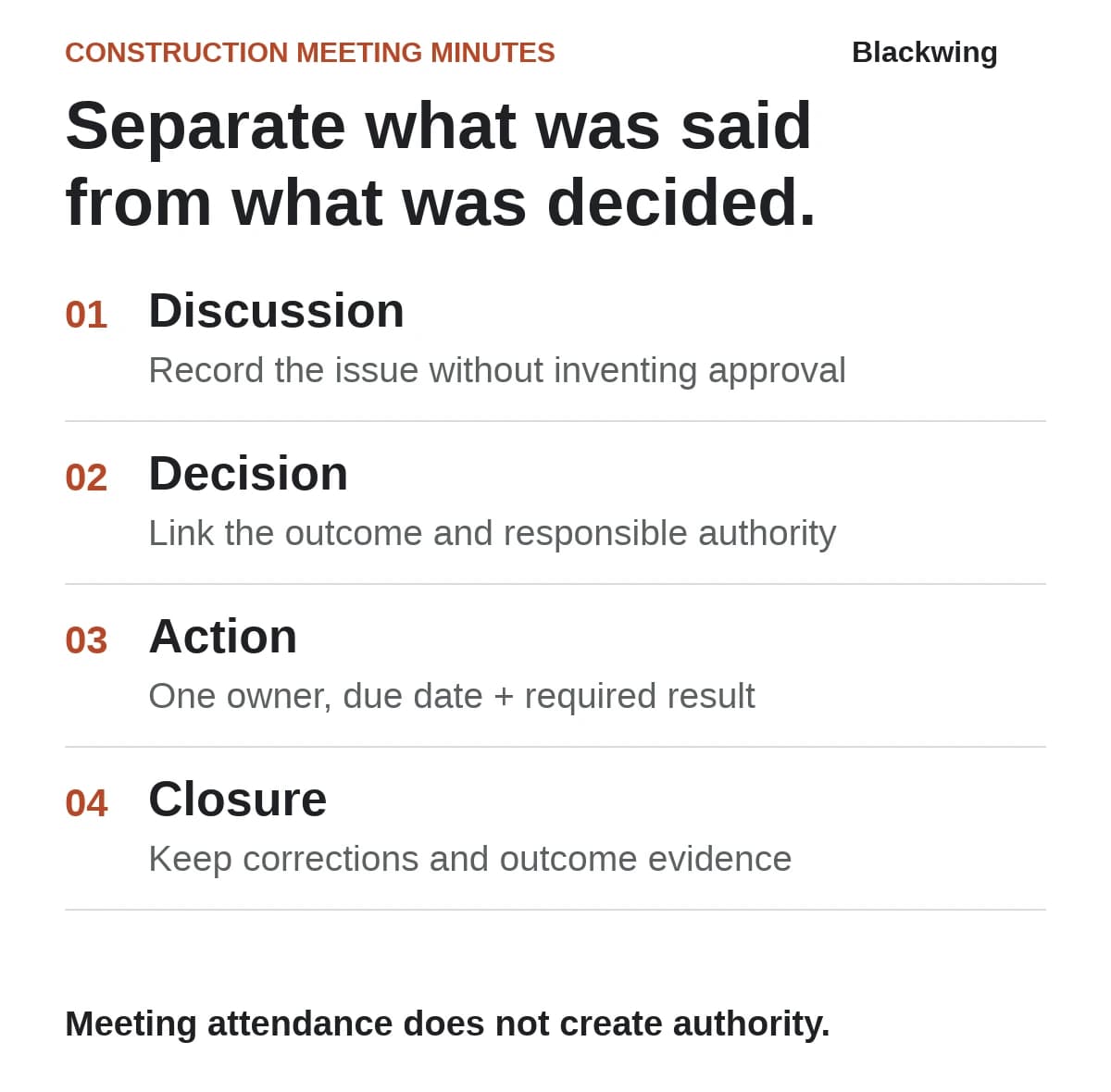
Do not label every spoken suggestion as an approved decision. A participant may be asking a question, proposing an option or describing a condition.
Record those states plainly. Where a decision was made, identify the decision, responsible authority and relevant limits. Where approval is still needed, name the route for obtaining it.
A meeting note is not a substitute for a contractual notice, accepted change order or required technical approval. The authorized process for those records remains separate. Link the records when they relate to the same issue.
This is especially important when an owner attends the meeting. Their presence does not mean every proposed scope adjustment has been formally accepted in the way the project requires.
Create an action that somebody can complete
"Review delivery" sounds active but says very little. Which delivery? What needs to be checked? What outcome is required?
A useful action describes the specific result, one accountable owner and the date or condition by which it is needed. Keep the related project record linked so the owner is not reconstructing the context from a paragraph of minutes.
Avoid assigning an action to "the team" unless a named person is accountable for coordinating it. Several people may contribute, but one person should know whether the result exists.
Also define closure. Sending a request, obtaining a response and receiving the necessary acceptance can be different actions. Closing at the first one may leave the original problem unresolved.
Preserve the record and its corrections
Draft the minutes promptly enough for participants to review the actual conversation. Define who checks the record and how corrections are handled.
If someone disputes the wording, keep the question visible and route it to the responsible reviewer. Do not silently replace the earlier minutes and hope everyone has the current copy.
Maintain version, distribution and correction history proportionate to the project. Procore's distribution documentation illustrates that updated minutes may need redistribution. The principle applies whether your business uses that product, a document library or a simple controlled log.
Distribution proves that a record was sent. It does not prove that the recipient accepted a commercial obligation or completed an assigned action.
Carry actions forward without duplicating them
Keep a stable action identifier across meetings. Update its state and link it to the later discussion instead of creating another copy each time.
Otherwise, one unresolved decision becomes four tasks with slightly different wording. Different people close different copies, and the status becomes impossible to trust.
The next meeting should review changed conditions, overdue actions and decisions requiring the participants' authority. Closed actions can remain in history without filling the active agenda.
Field observations belong in the daily reporting workflow. Formal clarification requests belong in the RFI process. Minutes should connect them when needed, not become a second uncontrolled version of every project record.
A short example of a better record
Consider a hypothetical coordination meeting. The team discusses a material substitution, a missing drawing response and a delivery date.
The substitution is a proposal requiring technical and commercial review. The drawing issue becomes an action to obtain the current response through the formal clarification route. The delivery date is recorded as a supplier statement needing confirmation against the planned work.
Those are three different states. Combining them into "team agreed to proceed next week" would erase important uncertainty.
The better record assigns the reviews, preserves the relevant references and states what has not been authorized. That clarity can feel less decisive than a neat summary. It is more useful to the person who must act on it tomorrow.
Use AI for drafting without giving it authority
AI can help structure notes or identify possible actions from a permitted transcript. A responsible reviewer should check speakers, dates, commitments and unresolved disagreements before distribution.
Do not upload confidential recordings to an unapproved service. Do not let a model turn ambiguous language into approval or infer a deadline that nobody agreed.
Measure actions lacking owners, repeat agenda items and corrections after distribution. These signals identify weaknesses in the meeting process. They do not establish that fewer meetings always improve project results.
Blackwing helps build a practical decision and action routine around the team's existing records. For an operations review, bring minutes from two consecutive meetings and check whether the unresolved items actually moved.
Frequently asked questions
What should construction meeting minutes contain?
Record the relevant discussion, confirmed decisions, unresolved questions and assigned actions. Identify owners, required outcomes and linked records. Keep formal approval, contractual notice and technical review separate where the project requires their own authorized processes.
Are meeting minutes the same as an action log?
No. Minutes preserve the meeting record. An action log tracks the resulting work across time. Link them with stable identifiers so repeated meetings update the same action instead of creating duplicate tasks and conflicting statuses.
Can AI generate construction meeting minutes?
AI can draft from permitted source material, but it needs human review before the record is relied on or distributed. Check who said what, what was actually decided and whether the tool invented commitments, owners or deadlines.
When should a meeting action be closed?
Close it when the agreed outcome and required evidence exist, not simply when someone sends a message. If another review or formal approval is still needed, preserve that remaining step rather than marking the original issue complete.