
The office has an answer. The subcontractor has an old screenshot. The foreman remembers a phone call. Everyone believes the question is resolved, but they are not working from the same information.
An answered email is not an operating outcome. Work changes only when the answer reaches the right person in a usable form.
What Is an RFI in Construction?
A request for information, or RFI, is a formal way to clarify incomplete, conflicting, or missing project information. Procore's RFI guidance describes it as a process for obtaining an official response to project questions. The appropriate respondent and route depend on the project.
An RFI is not automatically permission to spend more, change the scope, or depart from approved requirements. If the answer affects cost, time, or scope, route that impact through the applicable review and approval process.
Keep that distinction visible. A clarification, a technical direction, and an approved commercial change are not interchangeable records.
Why Small Contractors Lose Control of RFIs
The problem rarely starts with the template. It starts with ownership.
A field lead raises an issue in a group chat. Someone forwards it without the drawing reference. A project manager asks for more information. The answer eventually arrives, but nobody owns distribution or checks whether the affected trade received it.
Adding another software subscription will not settle those responsibilities. First define who captures the question, checks it, submits it, follows up, distributes the answer, and verifies the final handoff. One person can hold several roles in a small company. The roles still need to exist.
Build a Five-Step Construction RFI Workflow
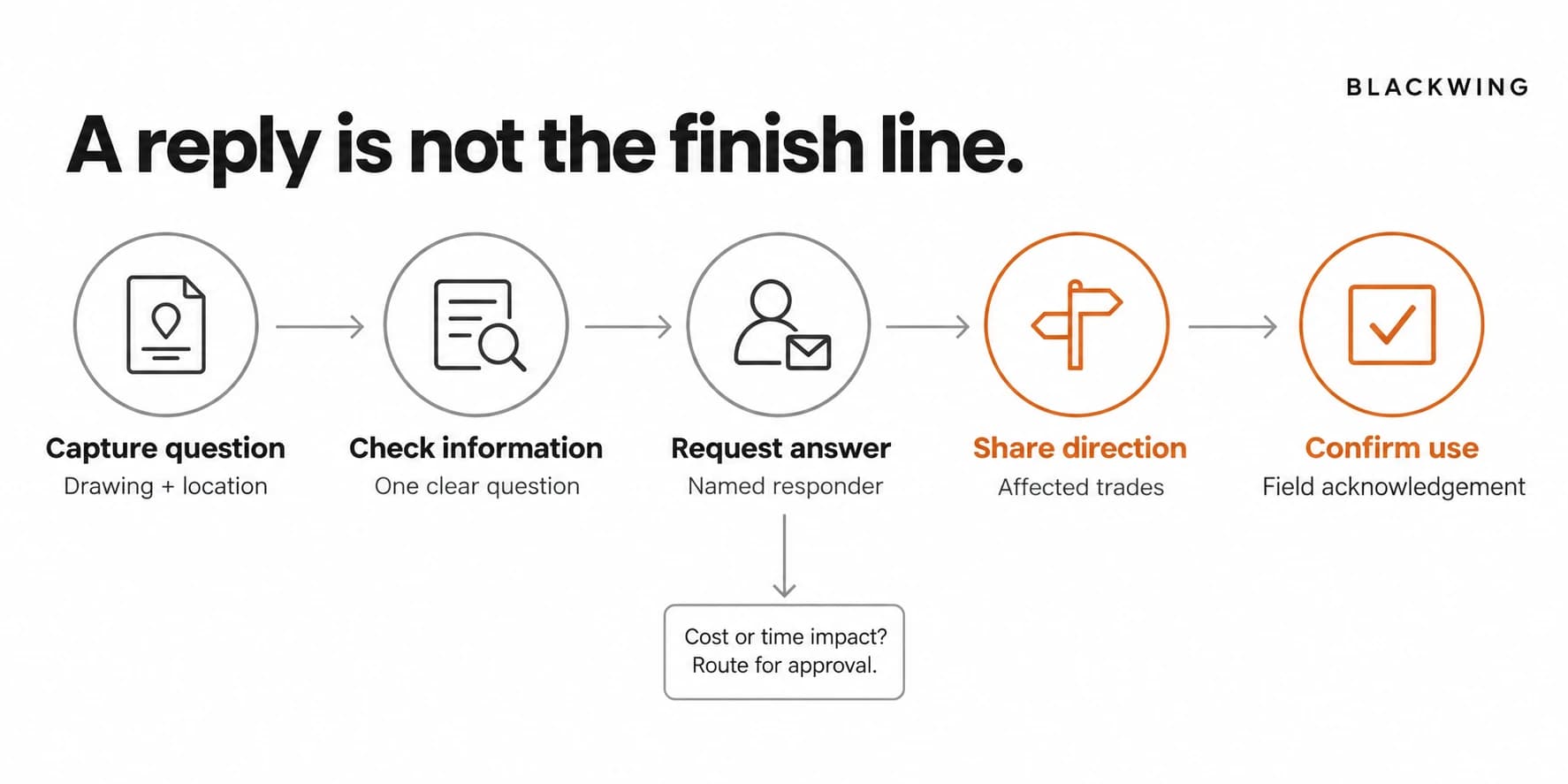
1. Capture one question with enough context
Give the RFI a stable reference. Include the project, exact location, relevant drawing and revision, question, supporting image, person raising it, and date the answer is needed for planning.
Describe the uncertainty, not just the inconvenience. "Please clarify the dimension between these two marked points" is more useful than "Drawing does not work."
If there are several unrelated questions, separate them. Otherwise one answered point can make the whole record appear complete while another remains unresolved.
2. Check before submitting
The coordinator checks whether the information already exists in the current project documents, whether the question is understandable, and whether the proposed recipient can answer it.
This is a completeness check, not an invitation to improvise technical advice. Where specialist interpretation is required, send it to the authorized professional.
Record missing information explicitly. "Awaiting marked-up drawing from field lead" is an actionable status. "Pending" is not.
3. Assign the response and follow-up route
Record the respondent, submission date, requested response date, affected work, and escalation owner. A requested date is a planning need, not proof that the recipient has committed to it.
Review RFIs against the next work sequence. An old question affecting next month's finishes and a new question blocking tomorrow's work should not receive identical attention simply because one is older.
4. Distribute the answer and separate impacts
Attach the actual response to the RFI record. Identify the affected trades and documents. State what has been clarified and what still needs a decision.
If there is a potential cost or schedule consequence, create a linked review item. Do not bury it in the email thread or silently mark it approved. Our guide to construction change order management explains that separate control.
5. Confirm the field handoff
The affected lead acknowledges the direction and identifies any remaining gap. Where the project requires formal distribution or acknowledgement, follow that route rather than replacing it with an informal checkbox.
Close your internal coordination item only when its agreed completion conditions are met. The technical or contractual RFI status may be managed separately by the authorized project party.
Use Statuses That Explain the Next Action
| Internal status | Meaning | Next owner |
|---|---|---|
| Needs information | Question or reference is incomplete | Person raising the issue |
| Ready to submit | Completeness check is done | RFI coordinator |
| Awaiting response | Submitted through the agreed route | Follow-up owner |
| Response received | Answer exists but is not fully distributed | Project coordinator |
| Impact review needed | Cost, scope, or time consequence needs review | Authorized decision-maker |
| Handoff confirmed | Affected lead has acknowledged the direction | Record owner |
Adapt these internal statuses to the project's formal system. Do not create competing sources of technical authority.
An Illustrative Example
Imagine a small commercial contractor preparing a ceiling installation. The field lead identifies an unclear interface between two drawings. The office obtains a clarification but only forwards it to the estimator.
The RFI is answered. The installation crew is still uncertain.
In the improved workflow, the coordinator records the affected trade, shares the actual response with its lead, flags a possible material change for separate approval, and confirms the updated work instruction was received. The record now distinguishes an answer from a usable handoff.
This is an illustrative operating example, not a reported project result or an instruction about how to resolve the design issue.
What to Measure
Start with unanswered RFIs affecting near-term work, incomplete submissions returned for clarification, and answered RFIs still awaiting distribution. Record waiting time separately from the time someone spends preparing the question.
Do not reward the team for closing records faster if it makes unresolved issues disappear. A useful measure should expose the bottleneck, not encourage a cleaner-looking list.
Conclusion: Manage the Answer, Not Just the Question
The best construction RFI workflow gives every question a clear route and every answer a clear destination. Start with one project, define the handoffs, and test the process on a normal clarification and an answer with a commercial impact.
Blackwing helps construction companies turn these coordination gaps into practical workflows, ownership rules, and systems teams can follow. Book an operations review to examine where your field-office handoffs are breaking.
Frequently Asked Questions
What should a construction RFI log include?
A construction RFI log should include a unique reference, project and location, current drawing references, question, respondent, submission and needed-by dates, response link, affected work, owner, and next action. Add impact-review and distribution fields when those steps are part of your responsibility.
Can a small contractor manage RFIs in a spreadsheet?
A small contractor can use a spreadsheet for internal coordination if it has clear owners, controlled links, and reliable updates. It should not replace a project-mandated RFI platform or formal communication route. Keep one agreed source for the official response.
Does an RFI response approve a change order?
An RFI response does not automatically approve a change order. If a clarification affects scope, cost, or schedule, assess it through the project's applicable contractual and approval process with the authorized parties.
When should an RFI be considered resolved internally?
An internal RFI coordination item is resolved when the required answer is recorded, affected people receive it, remaining impacts are routed, and the agreed handoff conditions are confirmed. Formal RFI closure remains subject to the project's authorized procedure.