
Then a subcontractor asks about a commitment made two weeks earlier. The client expects a decision nobody has documented. An open issue is treated as resolved because the last manager understood its context.
A construction project manager handover should transfer the ability to make responsible decisions on an active job. Access to the documents is necessary. It is not enough.
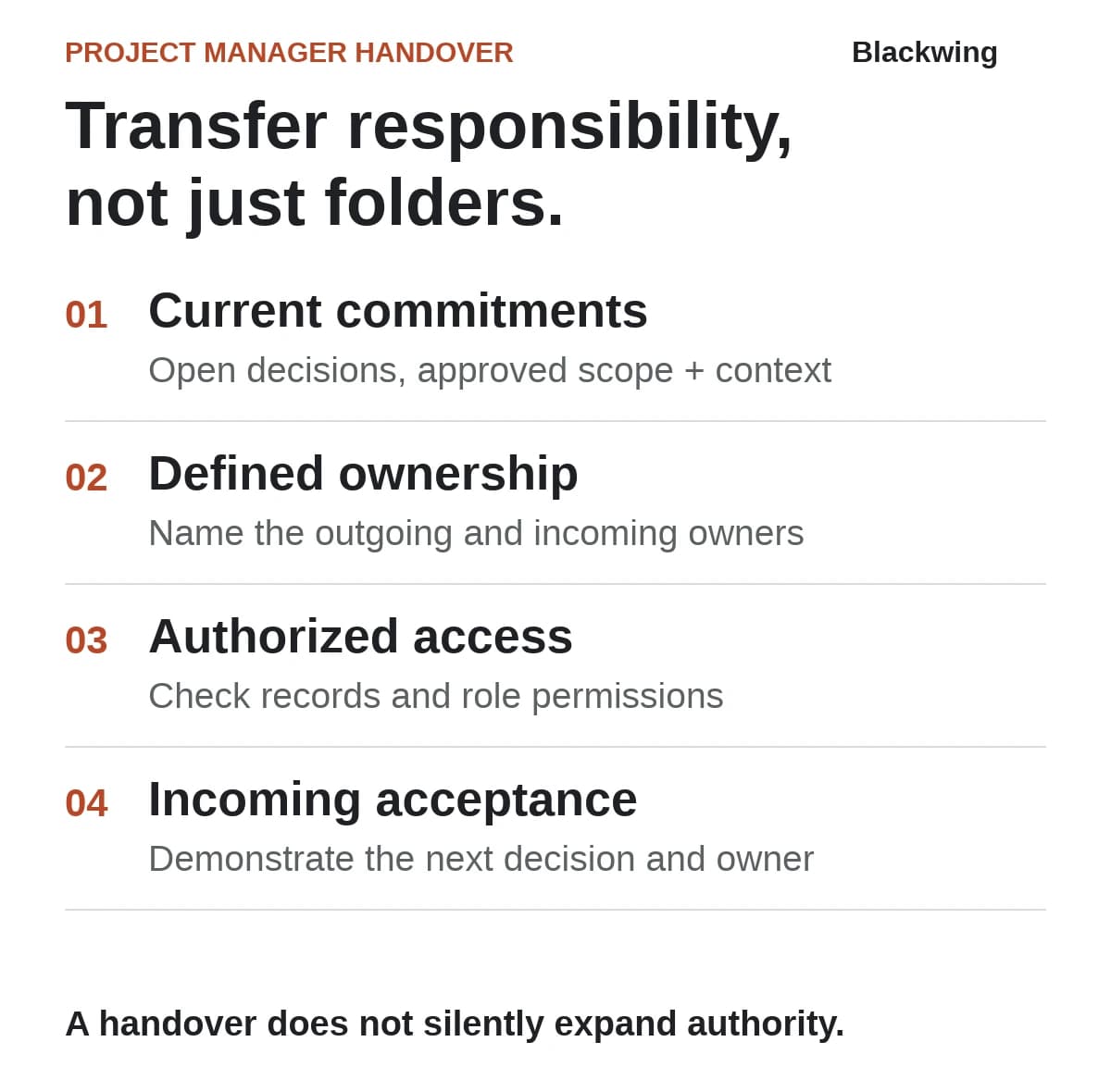
Treat management transfer as its own workflow
This is different from the estimate-to-execution handoff. That process prepares a new job for delivery. A management handover changes who carries responsibility while delivery continues.
Define the outgoing owner, incoming owner, transition date and the person who authorizes the transfer. State what happens during any overlap or temporary absence.
Do not leave two managers believing that the other one owns a decision. Also do not assume the incoming manager automatically inherits every approval limit or system permission. The company must define the role and authorize the relevant access.
Where an urgent transition leaves information missing, record the limitation rather than describing the handover as complete.
Prepare a packet around open commitments
Start with what can still change the job. The incoming manager needs the current plan, commercial basis and unresolved decisions, not an archive presented without priorities.
A useful packet includes:
- Current scope and the controlled contract references.
- Reviewed schedule and immediate dependencies.
- Active subcontract and supplier commitments.
- Open changes, clarifications and client decisions.
- Current cost forecast and the person responsible for its review.
- Inspection and acceptance items awaiting action.
- Communication arrangements and important escalation routes.
Link the authoritative record for each item. Do not copy values into a handover document that will immediately become another outdated version.
Keep completed history available where it explains a current decision, but separate it from the live action list.
Transfer the reasons as well as the status
"Waiting for approval" is difficult to manage without knowing whose approval, which version and what the decision affects.
Explain material assumptions and prior decisions. Include the evidence where it exists. Distinguish a documented customer commitment from somebody's recollection of a conversation.
The incoming manager should be able to identify what is known, what needs verification and what requires an authorized decision. Do not force them to convert every uncertainty into an immediate yes or no.
For important open items, record the next action and required timing. The handover should make it possible to act on Monday, not merely understand why the project was complicated last month.
Validate access without sharing accounts
Confirm that the incoming manager can open the records required for the role and use the approved systems. Test access with the appropriate administrator or owner.
Do not transfer a personal account or put passwords into the handover pack. Access should be individually authorized and limited to the relevant duties.
The document-control process should identify the current revisions. The incoming manager needs to know where approved information lives and which folders or copies are historical.
If the person can open the files but cannot distinguish current from superseded records, access has not solved the handover problem. Keep that as an explicit exception to resolve.
Ask the incoming manager to demonstrate acceptance
Use a short review of a few real open items. Ask the incoming manager to locate the source, identify the next decision and explain who is responsible for it.
This is not an exam designed to embarrass someone. It checks whether the packet supports the work.
Consider a hypothetical manager taking over an active fit-out. The schedule says a supplier package is confirmed. The underlying record shows a delivery date but not acceptance of the required specification. The incoming manager identifies the difference and keeps the dependency open for qualified review.
That is a useful acceptance check. A signature saying "all documents received" would not have exposed the gap.
Communicate the new ownership deliberately
Tell relevant team members and counterparties who now handles the work and which communication routes remain unchanged. Keep that message within approved authority.
Do not promise revised terms, dates or responsibilities during a simple ownership announcement. Those changes need their own decisions.
Define a short transition review after the incoming manager has worked with the records. New questions often appear only when someone uses the handover in practice. Capture and resolve them instead of interpreting them as proof that the person should already know everything.
Keep the outgoing manager's responsibilities and any access removal with the authorized company process. This article does not authorize employment decisions, account changes or a transfer of payment authority.
Make continuity less dependent on personal memory
Track handover exceptions, commitments without evidence and decisions that lose an owner during transitions. Use those findings to improve the normal project record, not to create a larger handover document every time.
A good project record makes the next transition easier because the important context is maintained as the work happens.
Blackwing can help design an active-job handover with clear sources, ownership and acceptance checks. An operations review can begin with one role change that required weeks of informal catching up.
Frequently asked questions
What is a construction project manager handover?
It is the controlled transfer of active-job responsibility, current commitments, decision context and authorized access from one manager to another. It should include an acceptance check and open exceptions, not only a list of files delivered.
How is it different from project closeout?
Closeout completes and transfers a delivered project through its required final records and acceptance. A manager handover can happen mid-project while commitments and decisions remain active. Its purpose is continuity of management, not completion of the job.
What if the outgoing manager is unavailable?
Identify alternative sources, verify important commitments and record unresolved context. Assign the missing information to an authorized owner. Do not present a reconstructed packet as complete or infer approvals that nobody can substantiate.
Does the incoming manager inherit every approval permission?
No. The company should define and authorize the role's decision limits and system access. A document handover or job-title change should not silently expand spending, contractual or security-sensitive authority.