
An approval process that begins there is already late.
A construction purchase order process should define what the business is authorizing before the commitment moves forward. A purchase order records specified goods or services, quantities and agreed commercial details. Procore treats it as a commitment record. Its contractual effect still depends on the relevant agreement and circumstances.
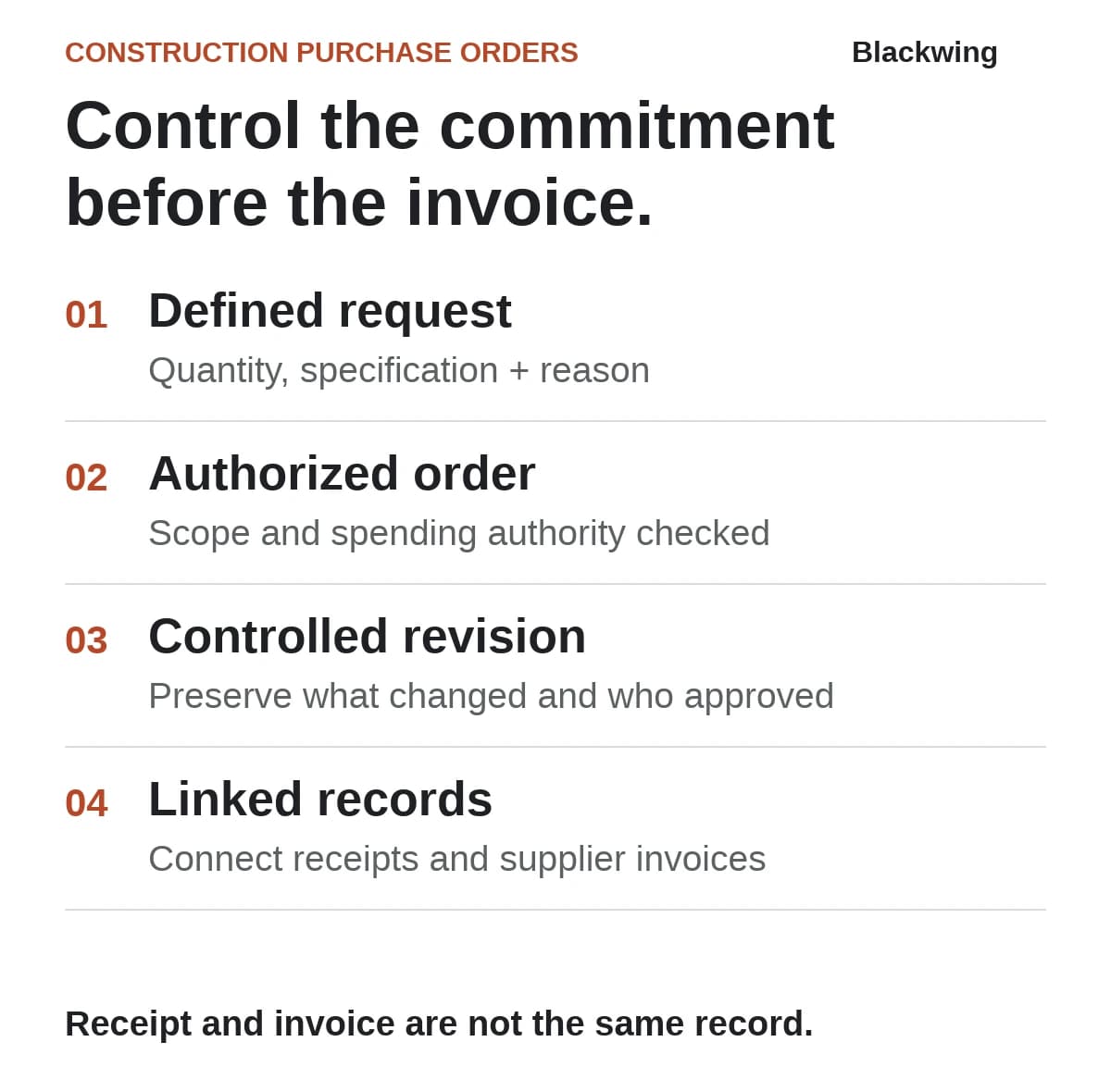
Separate the request from the authorization
Someone can identify a need without having authority to commit the company to it.
Capture the request with the job, needed item or service, quantity, required date and reason. Attach the specification or reviewed quote where relevant. A message saying "order the usual ones" is difficult to check and even harder for a replacement coordinator to understand.
The responsible reviewer should confirm scope, available information and the applicable spending authority. If technical suitability needs a qualified reviewer, a budget check does not replace that review.
Set your own approval rules. Do not copy a generic dollar threshold from a template and call it company policy. The process needs to reflect who is actually allowed to make which commitment.
Issue one controlled order record
Once authorized, give the order a stable identifier. Connect it to the supplier, project, approved request and accepted quote version.
Useful details include the item description, quantity and unit, price basis, delivery destination, required timing and the person responsible for resolving questions. Keep inclusions, exclusions and commercial terms available to the reviewers who need them.
Sending an order and receiving supplier confirmation are different events. Record whether the supplier has confirmed the relevant details. A generated PDF does not establish that the supplier can deliver what the team expects.
This is the point where the procurement workflow connects to commitment control. Procurement helps obtain a usable offer. The PO process records what the company is authorizing against that offer.
Treat revisions as decisions
A site team needs twelve additional units. The supplier offers a substitute. Delivery is split across two dates. These are not all harmless edits to a spreadsheet.
Identify what changed and whether it affects cost, specification, delivery or another approved condition. Route the change to the person with the relevant authority. Preserve the earlier record and the basis for the new revision.
If a coordinator corrects a typing error, distinguish that administrative correction from a change to the commitment. Otherwise, revision history becomes a list of unexplained edits.
Do not let an integration update the authorized value whenever a supplier email contains a new number. The system can draft an exception. A responsible person must determine whether the revised commitment is appropriate.
Link receipts without pretending delivery is complete
An order for twenty units can produce several receipts. Some units may arrive damaged. Others may be physically delivered but awaiting technical acceptance.
Keep those states separate. Link each receipt to the order line and preserve the quantity, date and relevant condition evidence. A partial delivery should not close the entire order because somebody signed a ticket.
The receiving record answers what arrived. The order answers what was authorized. The invoice answers what the supplier is charging. Their connection allows review, but none of them automatically proves the others are correct.
Your accounting and contract owners should define how receipt exceptions affect invoice review. Do not invent a rule that every mismatch automatically stops every payment.
Make exceptions easy to resolve
Consider a hypothetical order for ten doors. Six arrive in the first delivery. The invoice requests payment for all ten. One of the six also has a visible condition issue.
The reviewer needs the order revision, the two receipt states and the supplier's billing basis. They do not need five separate people to reconstruct the purchase from memory.
Assign the missing-delivery question and the condition question separately. They may have different owners and different closure evidence. Preserve the invoice decision and its authorization rather than treating a corrected receiving quantity as a payment approval.
For that downstream control, use the construction invoice-approval workflow. A PO makes its evidence easier to find; it does not eliminate the review.
Build a process the field can actually use
If the approved route is slow or inaccessible from site, people will keep placing informal orders. Find the delay before adding another required form.
Give the field a short request path, a named reviewer and visibility into the decision. Define an exception route for genuinely urgent purchases. Urgency should change the response timing, not silently erase authority or the record.
Review purchases made outside the normal process and why they occurred. Track unconfirmed orders, unexplained revisions and receipts that cannot be matched to a commitment. These signals show where the control is failing in practice.
Blackwing helps connect requests, approved commitments and receiving records without turning every purchase into an administrative project. An operations review can follow one recent order from the first request to the invoice decision.
Frequently asked questions
What should a construction purchase order process include?
Include a clear request, relevant technical and commercial review, authorized issue, supplier confirmation, controlled revisions and links to receipts and invoices. The company should define spending authority and exception handling rather than adopting universal approval thresholds.
Is a supplier quote the same as a purchase order?
No. A quote describes an offer on stated terms. A purchase order records the buyer's specified commitment or request under its purchasing process. The contractual relationship and acceptance requirements need review in the context of the actual transaction.
Should a partial delivery close the purchase order?
Not automatically. Record the quantities and condition actually received against the relevant order lines. Keep outstanding items and unresolved exceptions visible until the responsible owner has the evidence needed to close them.
Can purchase-order software approve changes automatically?
It can support defined routing and checks, but changes to price, quantity, specification or other commitments must stay within approved authority. An email or revised supplier document should not silently alter the company's authorized order.