
The register has become a picture of anxiety.
A useful risk record connects an uncertain event to its possible effect, a responsible owner and a reviewed response. PMI describes the importance of linking risk actions to the project plan. For a small contractor, the practical challenge is making that connection usable in ordinary work.
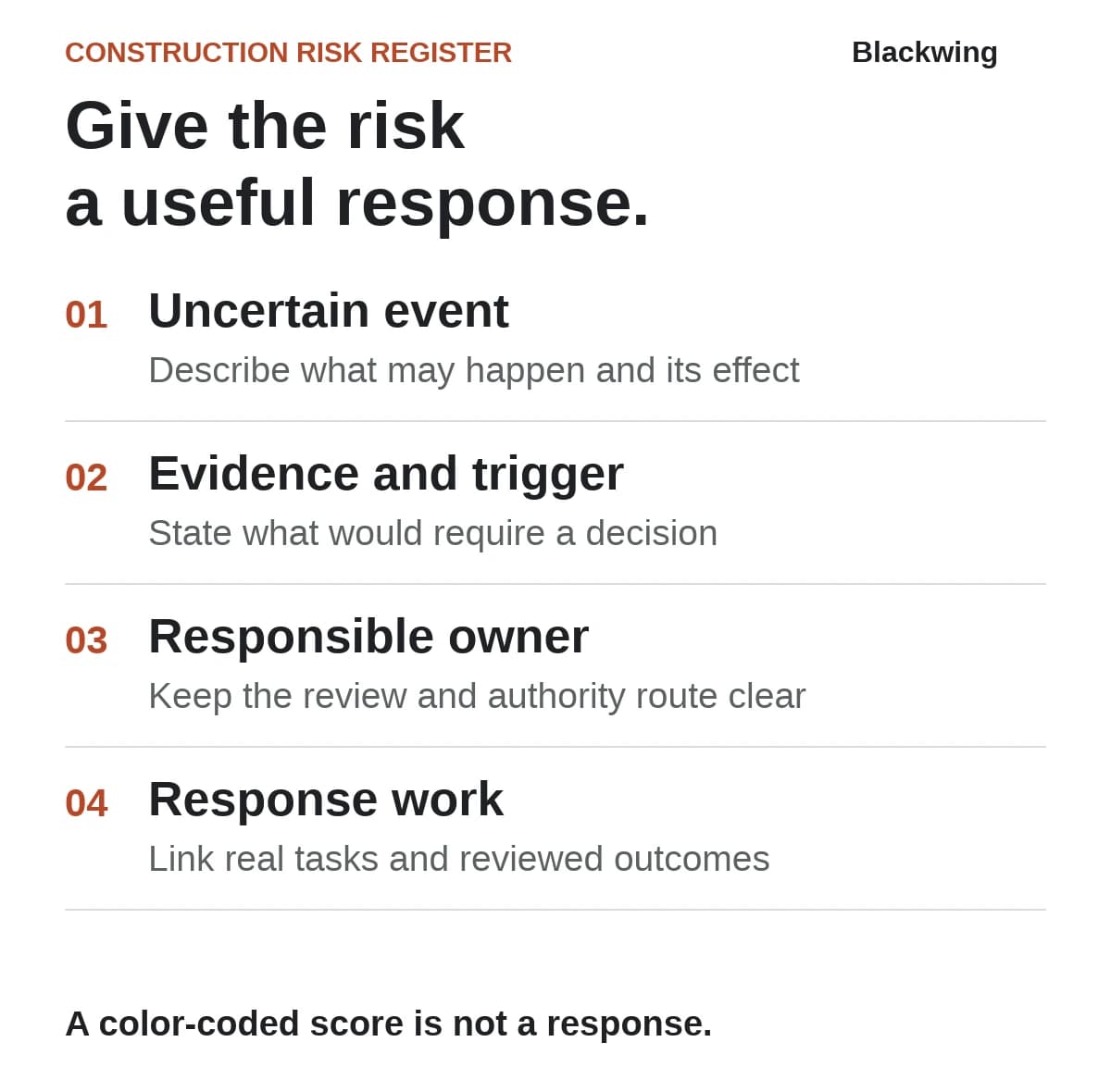
Describe an event the team can recognize
"Supplier risk" is too broad to act on. Explain the relevant condition, what might happen and which outcome could be affected.
For example, a required material has not received a confirmed production slot. If confirmation does not arrive in time, the planned installation sequence may need review. That statement creates a question the team can investigate.
Keep the risk distinct from an issue that has already occurred. An uncertain late delivery and an actual missed delivery need connected records, but their next actions are different.
Do not manufacture a probability because the template requires a number. Where uncertainty is substantial, state what is unknown and how the team will obtain better information.
Name the owner and the next decision
The risk owner is responsible for keeping the response moving. They may need help from purchasing, a project manager or a qualified specialist, but one person should know the current state.
Record a concrete next action and the point at which a decision is needed. "Monitor" should explain what signal is being monitored and what will happen if it changes.
Keep the authority limits visible. A coordinator may gather delivery evidence without having permission to approve a substitute, commit additional funds or promise a revised completion date.
Technical safety, engineering, legal and insurance risks require the relevant qualified reviews. This article describes an operating response record, not a substitute for those assessments.
Use triggers that match the project
A trigger is the condition that tells the team to reconsider or act. It might be a missed response date, a failed readiness check or a material change in the information supporting a plan.
Define triggers before the situation becomes urgent. The response can then be discussed with context rather than negotiated under pressure.
Avoid using a generic red-amber-green score as the only trigger. Two risks with the same color can require different actions and different authority. A low numerical score should not hide an unacceptable condition identified by the relevant professional.
The weather-delay workflow is an example of handling one category with specific preparation and review. A risk register connects different categories without reducing all of them to the same checkbox.
Link responses to real work
If the response requires a task, create or link the task with its owner and required outcome. If it requires a decision, identify the authorized reviewer. If it changes a plan, preserve the approved revision.
A response written only in the risk spreadsheet can remain invisible to the people executing the project. The schedule and action queue should represent the relevant approved work.
Keep the response state separate from the risk state. An action can be complete while the uncertainty still exists. For example, contacting an alternative supplier does not guarantee that the original delivery will arrive or that a suitable replacement is available.
Closure should explain why the risk no longer needs active review, not simply that somebody completed a reminder task.
Walk through a hypothetical risk
Imagine a contractor with a planned installation depending on one specialist supplier. The production slot remains unconfirmed. Purchasing owns the evidence gathering. The project manager owns review of the sequence. An authorized commercial reviewer would decide any alternative commitment.
The trigger is the reviewed date by which confirmation is needed to protect the current plan. If the date passes, the record moves to the agreed decision route.
The register does not claim a precise expected loss from invented assumptions. It shows the dependency, the uncertainty and the owners. When the delivery actually misses its date, link the active issue to the earlier risk history so the team can see what was anticipated and what happened.
Review changed conditions rather than every row
Use the routine review to examine new risks, changed evidence, approaching triggers and overdue responses. Keep closed history available without filling the agenda with items that no longer need action.
The weekly operations review can summarize the decisions required across projects. It should point back to the actual risk records rather than create a second list with different owners.
Learn from risks that became issues unexpectedly. Was the event genuinely unforeseeable, or was the signal recorded but not routed to anyone who could act? That difference informs an improvement without turning the review into blame.
Start with a manageable register
Choose the few live uncertainties that could affect important project decisions. Define them clearly and test whether the team can use the response process.
Useful measures include risks without owners, triggers passed without review and responses disconnected from the plan. These are operating signals, not proof that a numerical risk model predicts the outcome accurately.
Blackwing helps connect project uncertainty to assigned actions and reviewed decisions. An operations review can examine one risk that appeared on the dashboard repeatedly but never produced a useful response.
Frequently asked questions
What belongs in a construction risk register?
Include the uncertain event, its cause and possible effect, responsible owner, evidence, trigger, reviewed response and current status. Add the relevant specialist or decision authority where needed. Do not fill missing knowledge with invented probability scores.
How is a risk different from an issue?
A risk describes uncertainty about what may happen. An issue describes a condition that already requires action. Link the records when the event occurs so the project preserves its history while moving to the appropriate response.
Should every risk receive a financial estimate?
Only where a responsible analysis can support it. A precise number based on weak assumptions can be misleading. Keep the basis, uncertainty and relevant professional review visible rather than using a fabricated estimate to prioritize the response.
Can software manage project risk by itself?
Software can maintain records, reminders and linked tasks. It cannot replace the knowledge or authority needed to assess technical conditions and approve responses. The useful system makes those decisions easier to identify and follow through.