
Now the argument is about the spreadsheet instead of the work.
A schedule of values, or SOV, allocates the contract value across defined portions of work. AIA explains its relationship to payment applications. The form and review requirements depend on the agreement. The operational challenge is keeping that allocation understandable as the job changes.
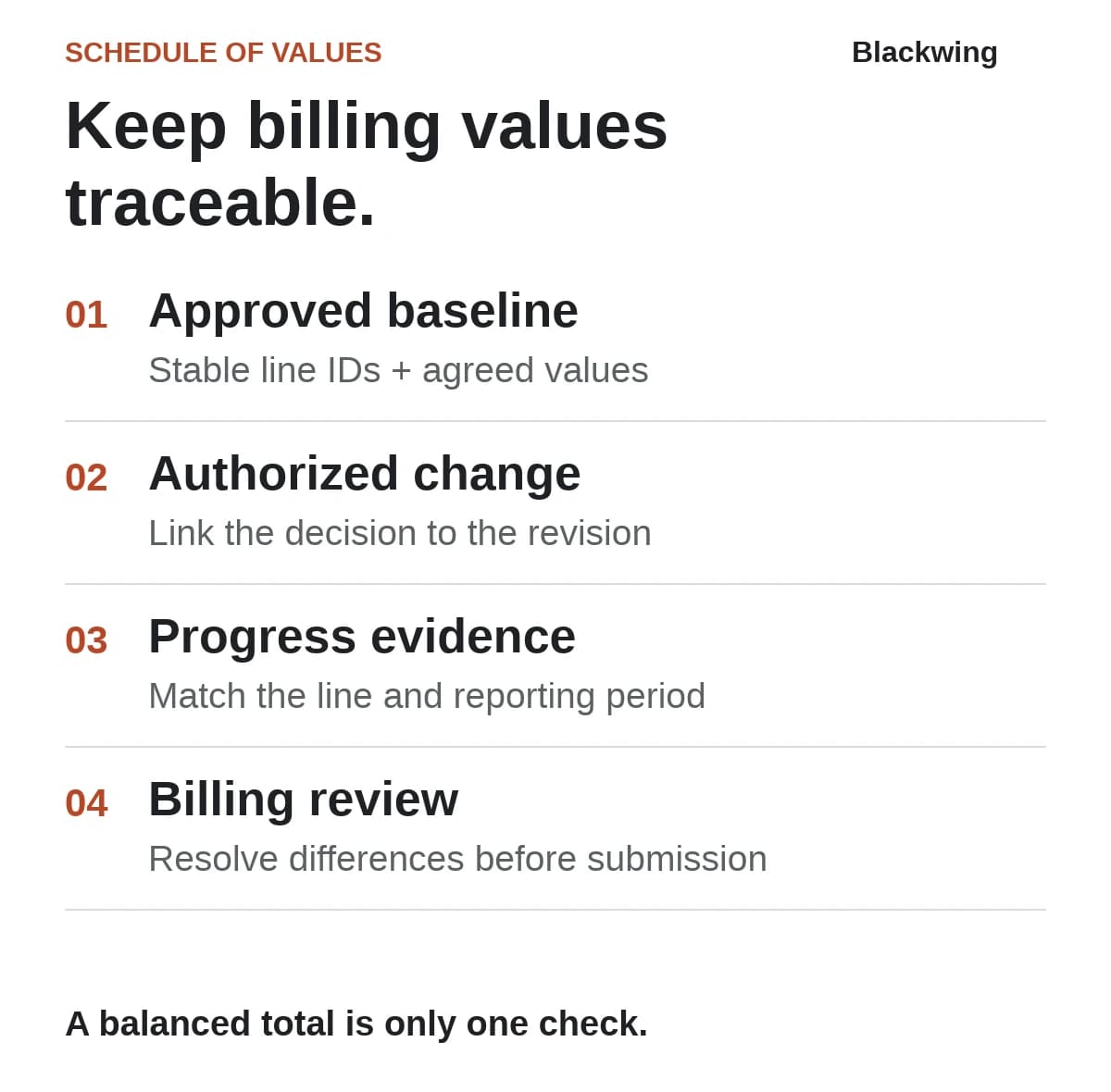
Keep billing values separate from cost budgets
An SOV and a job-cost budget can describe the same project without using identical categories. One supports the contractual billing structure. The other helps the contractor understand the cost of delivering the work.
Do not force them into one column because the numbers happen to be available. A billing value is not evidence of cost incurred, physical completion or cash received.
Where the systems use different structures, maintain an explicit mapping. A billing line might relate to several cost codes. One cost code might support more than one billing line. Have the responsible project and accounting people review the relationships rather than assuming a one-to-one match.
For the cost side, use the separate construction job-costing process. The two records should connect without pretending to answer the same question.
Give each line an identity that survives revisions
A description is helpful. A stable line identifier is more reliable.
Keep the approved baseline, its version and the person who maintains it. Record the line's description, agreed value and any mapping needed to connect it to project evidence. Avoid changing a line's meaning silently after billing has started.
If a reviewer requests a different breakdown, preserve how the earlier lines map to the revised ones. Otherwise, comparing periods becomes a guessing exercise. A row moved in a spreadsheet should not become a new scope item by accident.
The owner of the record does not need to approve every commercial change. They need a defined route to obtain the necessary authorization and maintain the resulting record accurately.
Reconcile approved changes before updating the total
Separate a proposed change from an authorized contract adjustment. Keep the decision evidence and the corresponding SOV revision linked.
Consider this hypothetical example. A small contractor has a $150,000 baseline allocated across three work packages: $40,000, $60,000 and $50,000. An approved $8,000 addition belongs to the second package.
If the applicable agreement and reviewer accept that allocation, the revised schedule totals $158,000. The record should explain the $8,000 difference. It should not add $8,000 to the second package and also leave an extra $8,000 line in the total.
A practical review checks the previous approved total, authorized additions or deductions and the revised total. Investigate the difference rather than overwriting it until the sheet balances. The related change-order workflow supplies the authority; the SOV records the accepted allocation.
Connect progress evidence to the correct line
The billing coordinator should not have to translate a collection of photos into a completion judgment alone.
Agree who verifies the work against each relevant line and which evidence the reviewer needs. Keep the reporting cutoff visible. Where a line combines several activities, explain the basis for the progress statement instead of selecting a percentage that feels plausible.
Stored materials, partial work and disputed quantities need the treatment required by the actual agreement and responsible reviewers. A delivery ticket is not automatic permission to bill. This article does not prescribe a valuation method or contractual entitlement.
The useful handoff is specific: this line, this period, this evidence, this review status. A broad message saying the job is progressing does not provide that connection.
Review exceptions before the billing deadline
Maintain a short exception list alongside the current SOV. Useful exceptions include an unexplained value change, an unmatched approved adjustment, unclear progress evidence or a requested reallocation awaiting review.
Each exception needs an owner and a next decision. A red cell without either simply describes the problem repeatedly.
For a small team, the routine can be brief. The project manager checks physical progress and open changes. The billing coordinator checks line identity and period consistency. The authorized reviewer resolves the items that cannot be settled administratively.
Do not let automation edit contract values from an email or a site note. It can flag a mismatch or draft a review request. The authority to change the record must remain clear.
Make the spreadsheet easier to trust
Test the process using one ordinary billing cycle. Can another person explain the baseline, the changes and the current request without relying on the person who built the sheet?
Measure unexplained revisions, evidence missing at review and packages returned for avoidable corrections. These are operating signals, not proof that a process change guarantees faster payment. Customers and contractual conditions still matter.
Blackwing helps connect the project record, change decisions and billing workflow. An operations review can start with one SOV whose history is difficult to explain. That is usually a more useful starting point than designing a larger dashboard.
Frequently asked questions
What is a construction schedule of values?
A construction schedule of values allocates the contract value across defined portions of work. It commonly supports progress-payment review. The required format, evidence and approval procedure depend on the project's agreement and responsible reviewers.
Is a schedule of values the same as a cost budget?
No. An SOV organizes contractual billing values. A cost budget organizes expected delivery costs. They can be mapped together, but they should not be treated as interchangeable records or evidence of the same business outcome.
How should approved changes affect the schedule?
Link the authorized change to a reviewed SOV revision. Preserve the previous total and explain the difference. The appropriate allocation and approval route should follow the agreement; a pending request should not silently become approved billing value.
Does a balanced SOV prove the billing request is correct?
No. Arithmetic is one check. Correct billing also depends on the applicable agreement, period, progress evidence and required review. A sheet can balance while containing duplicated scope, unsupported progress or the wrong version of an approved change.