
The plan is a coordination aid. It is not a safety specification, a traffic-control design, or a substitute for site-specific review by qualified people. Requirements differ by project and location. The team should use applicable approved procedures and have the relevant professionals determine what controls the specific site needs.
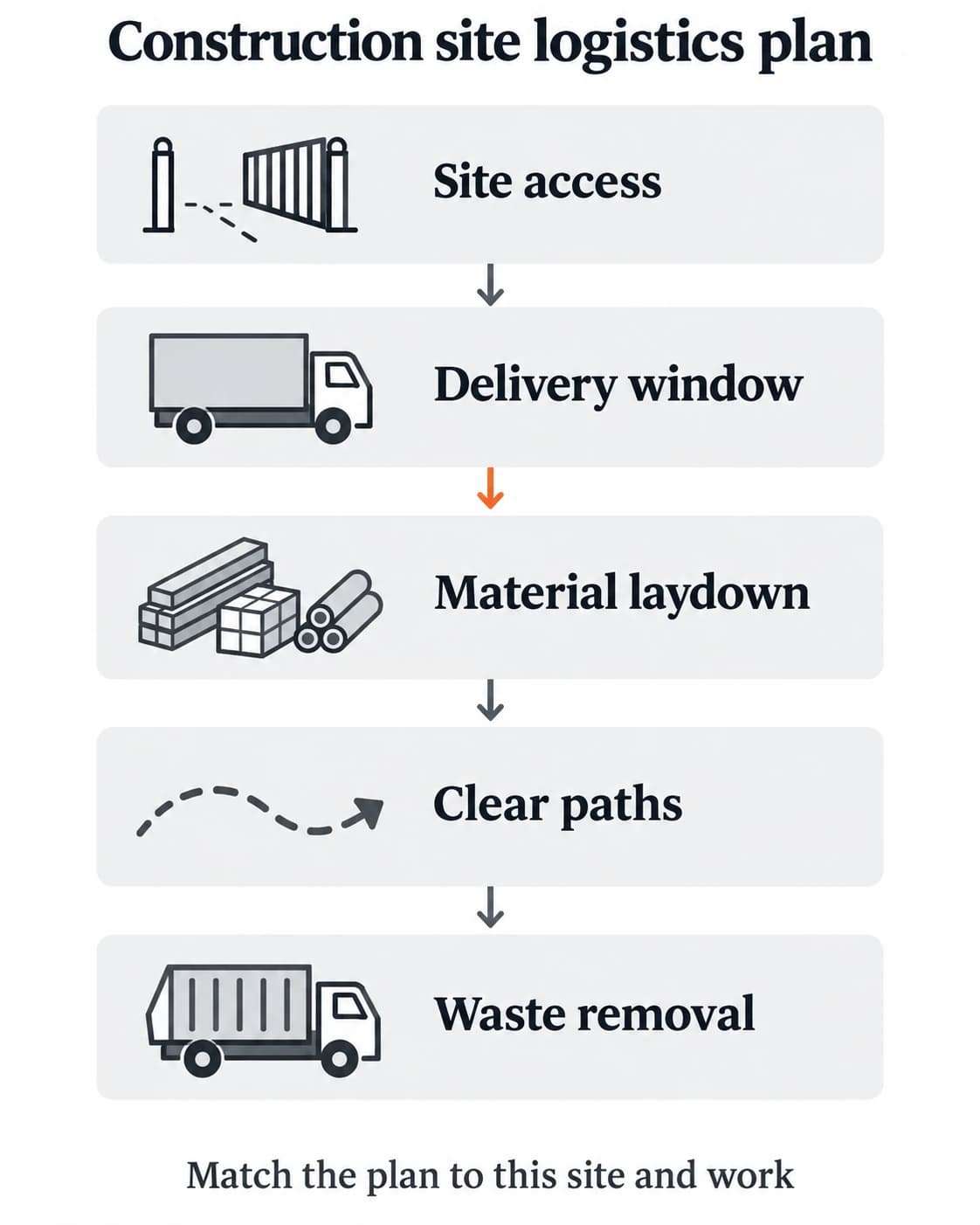
Map movement before promising a sequence
Start with the physical layout that the team can confirm: work areas, access points, constraints, neighboring activity, and any routes that need coordination. Note the source and date of the information, especially if it comes from a drawing or an earlier visit. If the plan relies on dimensions or conditions that have not been checked, label them for verification.
Then map the movement that matters to the upcoming work. Consider people, equipment, deliveries, material movement, and removal of waste. Do not assume that a route can serve every purpose at every time. Ask the responsible parties what needs to move, when, and what information they need before confirming the arrangement.
The purpose is not to prescribe a universal route. A useful map lets participants find the agreed route and reveals where two activities may conflict. If the site changes, update the map or annotate the affected area and tell the owners whose work depends on it.
Assign delivery, staging, and storage ownership
For each planned delivery, record the item or category, supplier contact, expected date or window, receiving owner, arrival instructions, and where the team expects it to go. Confirm constraints with the site and supplier rather than assuming that a truck, lift, or other equipment can reach the intended point. If a delivery date is tentative, mark it as tentative.
Staging deserves an explicit owner because space can disappear quickly. Identify the intended area, what may be placed there, who confirms availability, and when it must be cleared or reviewed. Record dependencies such as another trade’s work or a temporary use of the area. Avoid writing “store on site” if nobody has confirmed where or under what conditions.
Official sources illustrate why scope matters. OSHA’s U.S. construction standard on materials handling and storage addresses issues such as securing materials and keeping aisles clear. The standard applies within its U.S. regulatory context; it is not a complete logistics plan or a substitute for interpreting requirements for a particular project. OSHA 29 CFR 1926.250
Treat waste as a planned flow
Identify what waste streams the project expects, who will arrange removal, where material can be held pending removal, and how the team will verify that the arrangement still works. The details depend on the project and applicable local requirements. A logistics plan should point to the responsible procedure or provider instead of improvising instructions about handling or disposal.
Waste planning also affects deliveries and access. If a container, pickup, or removal window changes, update the parties who share the route or staging area. Keep the plan operational: what is expected, who owns it, and what action follows when the arrangement is unavailable.
Coordinate interfaces and changes
The plan becomes useful when each shared space or movement has an owner. List the responsible contact, the activity, the coordination point, and any boundary the team has agreed. Review overlaps during the project’s regular coordination meeting or another established forum. Keep decisions in the project record so a late-arriving participant can find the current arrangement.
Set a simple change path. If an access route closes or a staging area becomes unavailable, who can propose a revised arrangement? Who reviews its effect on other work? Who communicates the approved change? The answers should follow project authority and approved procedures. A map itself does not authorize a change.
Illustrative example: A compact renovation has a planned delivery and a temporary staging area. Another scheduled activity needs the same area. The coordinator records both activities, asks the owners to agree on sequencing, and updates the shared plan after the authorized project lead accepts the arrangement. The example demonstrates coordination; it is not a site instruction or claim about a specific project.
Keep the plan visible and current
Put the current plan where the people who need it can find it, using the project’s approved system. Include a date or revision, owner, and a short note describing what changed. Link the supporting schedule or delivery log where appropriate. Avoid multiple unmarked copies that may show conflicting routes or staging areas.
Review the plan at phase changes, when deliveries or site conditions change, and when participants report a conflict. Ask whether the plan remains workable, not simply whether it exists. If a repeated coordination failure appears, document the cause and propose a process improvement through the normal review route.
For teams that need to clarify recurring handoffs and exceptions, Business Process Mapping & Documentation can help define how the planning work is performed. For a focused conversation about operational friction, book a 30-minute Operations Review. Neither conversation replaces a project-specific logistics or safety review.
Frequently asked questions
Does every project need a formal logistics drawing?
The appropriate format depends on project complexity and applicable procedures. Some work may need a drawing; other work may use a concise written plan and marked-up site information. The team should decide what makes access, deliveries, staging, and waste arrangements clear to the people involved.
Who should prepare the logistics plan?
Assign a coordinator to compile and maintain it, while the relevant site, trade, supplier, and qualified professionals confirm their own inputs. Identify who has authority to approve changes.
What should the plan include first?
Begin with access, delivery timing, staging, storage ownership, waste flow, shared-space conflicts, and the contacts who coordinate changes. Add detail when a real project need requires it.
Is a logistics plan the same as a safety plan?
No. It supports coordination of physical movement and space. It does not replace site-specific safety planning, risk assessment, required procedures, or professional judgment.