
Start with a complete intake
When a customer reports an issue, record the project and handover reference, contact details, date received, description in the customer’s words, location, photos or other evidence supplied, and any immediate concern that must be triaged under the company’s existing procedure. Do not promise coverage or diagnose a defect during intake. A record can acknowledge receipt while the company checks the facts.
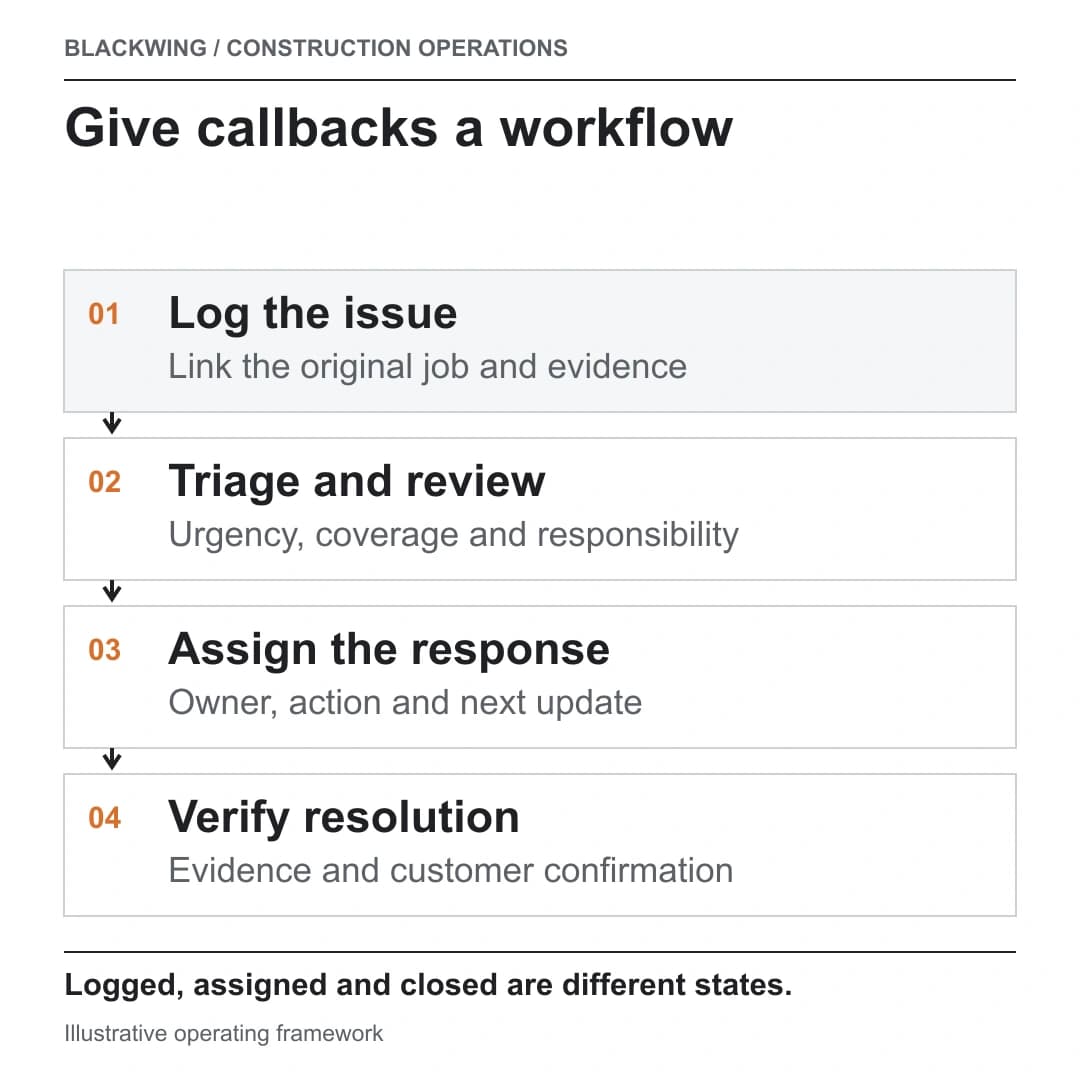
Use the same identifier through assignment, inspection, communication and closure. A warranty workflow may be managed in a spreadsheet, CRM or field system; the important point is that staff can see the current owner, status and next update. Buildertrend’s help material, for example, describes tracking claims, categories, assigned coordinators, follow-up dates and attachments in its product. This is an example of software features, not a universal warranty requirement. (Buildertrend warranty overview)
Review responsibility before deciding coverage
Gather the relevant contract, product or manufacturer terms, handover record, prior correspondence and project evidence. Identify which party is responsible for evaluating the issue under those documents. Terms, coverage periods, exclusions and legal obligations vary by agreement, product and jurisdiction. There is no universal coverage period or classification that can be stated here.
If the issue could involve an immediate hazard, follow the company’s established escalation procedure and involve appropriately qualified people. Do not use a general warranty checklist to make a safety judgment. Record the escalation and next update without suggesting that a particular remedy is guaranteed.
Hypothetical example
A customer reports a leak months after handover and sends a photograph. The coordinator logs the date and location, links the original job and stores the image. The assigned project role checks the applicable contract and product documents, reviews the installation and handover evidence, and determines the next inspection or response through the company’s authorized process. Until that review is complete, the coordinator records the request as under assessment rather than promising that it is covered or dismissing it as excluded.
Once a response is approved, the record captures who will act, when the customer will hear back, what work was completed, and the evidence used to verify the outcome. If responsibility remains disputed, the item stays open and follows the appropriate escalation path.
Separate request status from resolution
Useful statuses distinguish at least: received, under review, response assigned, work in progress, awaiting customer or supplier input, resolved pending confirmation, closed, and escalated. Choose labels the team can apply consistently. “Closed” should mean the defined work and follow-up are documented, not merely that someone visited the site.
Agree who can move a request between statuses, how overdue follow-ups surface, and where customer communication is saved. For repeat issues, link related requests without erasing their separate histories. This helps the team identify patterns while preserving what happened on each project.
Post-handover service differs from a completion punch list. The punch-list process handles completion-stage items; project closeout concerns handover and records. A later callback needs its own intake, terms review, assignment and resolution trail. Procore’s closeout overview describes closeout as a handover process; it is useful context, not warranty-law guidance. (Procore closeout)
Set a communication expectation the coordinator can meet. When the team needs an inspection or supplier response before deciding, tell the customer when the next update is planned instead of leaving the request silent. Record the communication date and what was requested. If the customer supplies additional evidence, attach it to the same history and note whether the urgency assessment changed.
Where several teams are involved, assign one coordinator who owns the customer update even if technical assessment, supplier contact and commercial review sit with different people. Make supporting actions visible with their own owners and due dates. This avoids a gap where everyone believes another person has replied. The coordinator can summarize status without promising an outcome still under review.
Choose closure criteria that suit the request. A completed visit may still require a report, customer confirmation or follow-up. State what remains open and who will check it. If the customer disagrees with the outcome, keep the record open or escalate under company procedure rather than clearing a dashboard by marking it closed.
Four questions about warranty callbacks
What belongs in a callback record?
Capture the project, request date, issue description, customer evidence, assigned owner, status, next update, relevant terms reviewed and documented outcome.
Is every callback covered?
Coverage depends on the actual agreement, product terms, facts and applicable jurisdiction. Review those sources with the authorized person; do not assume every request is covered or excluded.
How is a callback different from a punch list?
A callback is a post-handover service request. A punch list typically tracks completion-stage items before or during closeout.
When should a request be closed?
After the authorized response is complete, required evidence is recorded, the customer follow-up is made, and any remaining issue is resolved or escalated under the company’s process.
Keep the history useful after handover
One accountable record helps a coordinator answer what was reported, what terms and evidence were reviewed, who acted, and whether the customer received a follow-up. It also gives operations a basis to recognize recurring issues without treating every callback as identical. If you need to map post-handover ownership and records, request an operations review.
Written with the help of Laura, Ahmed Fahmy’s AI assistant, based on his ideas and under his supervision.