
Precision is not the same as a consistent reporting basis.
A work-in-progress report brings together financial and project information about ongoing contracts. Procore's WIP overview describes that connection. Your accountant should determine the relevant accounting treatment. Your operations team must supply inputs that the accountant can understand and challenge.
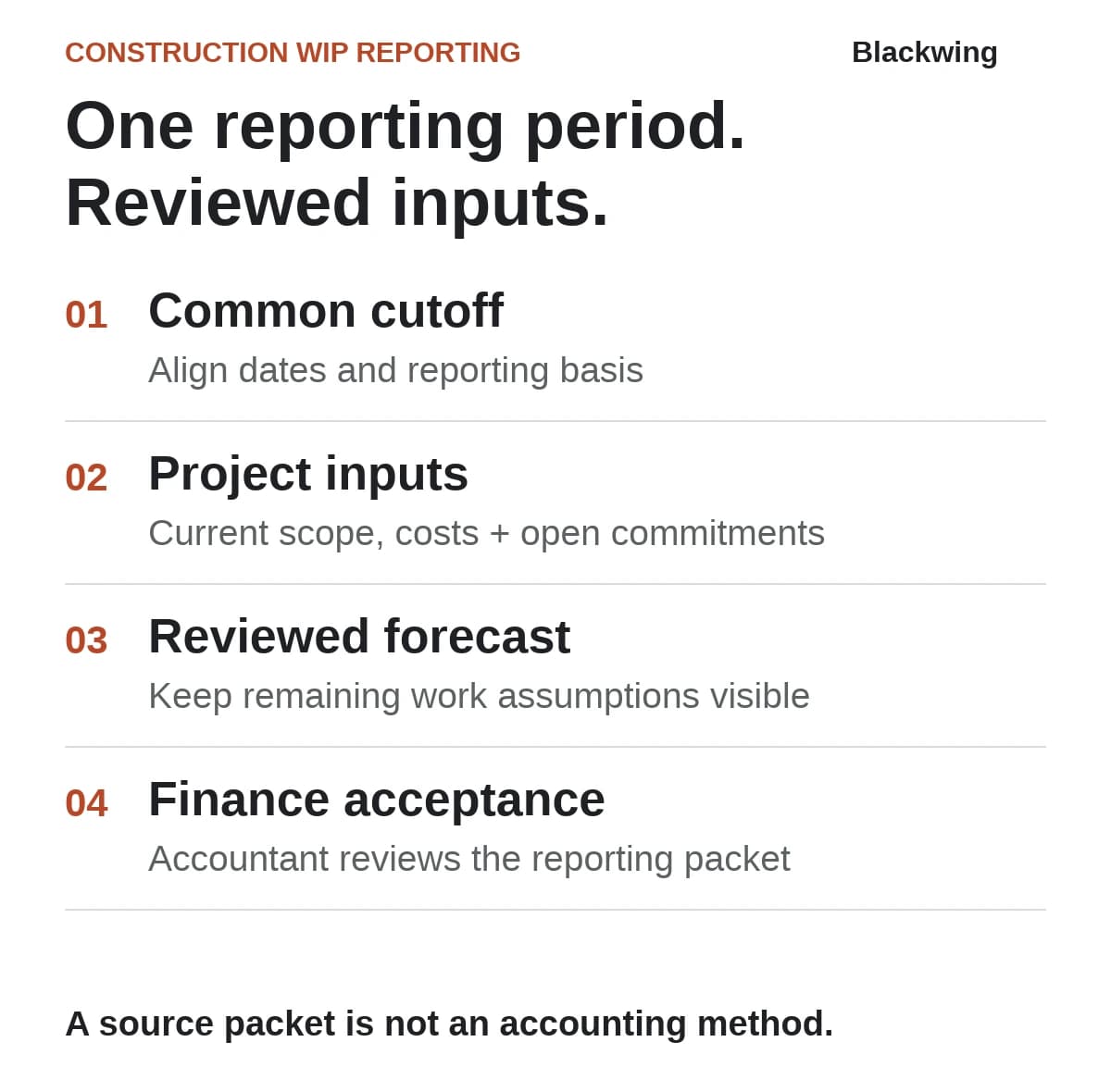
Define the reporting period before gathering numbers
Start with the cutoff, the included jobs and the source of each field. State whether a figure is a posted actual, a commitment, a forecast or a reviewed contractual value.
Those labels prevent a common problem: combining numbers that describe different dates or stages of approval. A forecast updated after the cutoff may be useful, but it should not be passed off as information available at the earlier reporting date.
Keep the original submitted packet and its review history. Corrections should explain what changed and why. Replacing the old workbook destroys the context needed to understand a later difference.
A small business does not need an elaborate finance department to do this. It needs an agreed date and a consistent handoff between the people holding the information.
Assign the inputs to the people who know them
The project manager usually understands remaining work and unresolved scope. Accounting understands posted costs, billings and the financial reporting basis. The contract owner knows which commercial adjustments have the necessary authorization.
Do not ask one person to improvise the other roles' answers because they are completing the spreadsheet.
A useful source packet contains:
- A stable job identifier and current contract record.
- Reviewed changes, with unresolved requests kept distinct.
- Posted costs and the ledger cutoff.
- Open commitments with their relevant status.
- A reviewed forecast of remaining costs and its assumptions.
- Billings recorded on the agreed basis.
- Exceptions that need an accounting or commercial decision.
The accountant can request different inputs. This is an operational starting point, not a universal WIP format.
Review the remaining-cost forecast separately
Copying the original budget into the remaining-cost field avoids a difficult conversation. It does not make the forecast more reliable.
Ask the project manager what remains to be delivered, what is already committed and what has changed since the last review. Keep the basis visible. An unplaced purchase, a subcontract adjustment and remaining internal labor should not all disappear into one unexplained number.
Also prevent double counting. A cost already posted should not be added again as an open commitment. The treatment of partially invoiced commitments must be consistent with the company's reporting approach.
For a fuller operating method, see construction job costing. The WIP handoff uses that forecast; it should not require accounting to reconstruct the project from scratch every month.
Keep unresolved commercial changes visible
A pending change may affect the work the team expects to perform without yet providing an authorized increase in contract value.
That difference matters. Keep the request, cost exposure, approval state and responsible decision owner visible. Do not assume the customer will approve it because the team has already started the work.
Equally, do not erase the issue from the source packet because it cannot be included in a particular financial field. It may belong in the exception notes for the accountant and company owner to evaluate.
The workflow should make uncertainty explicit. Accounting treatment, revenue recognition and tax consequences require qualified review. This article does not prescribe those decisions or provide a compliant financial-statement template.
Use a short acceptance check
Imagine a hypothetical contractor preparing its month-end packet. One job's ledger data has the correct cutoff, but its cost forecast predates a newly identified subcontract requirement. Another job's contract total contains an unapproved addition.
The answer is not to make both rows green. Return the specific exceptions to their owners. Keep the known facts, the missing information and the review decision separate.
Before the packet is accepted, confirm that job identifiers match, dates are consistent, material differences are explained and each open issue has a responsible person. Record whether the packet is ready, accepted with stated limitations or returned for correction.
Acceptance of a source packet is not approval of the final financial report. It establishes what operations supplied and what finance still needs to decide.
Make the next cycle less dependent on chasing
Track why a packet was returned. If the same commitment information is missing every month, improve that source workflow. If the forecast cannot be explained, work on how project managers update it.
Useful measures include packets complete at the agreed cutoff, unresolved exceptions and repeated corrections. Avoid treating a clean-looking WIP total as proof of job profitability or cash availability. Those questions require their own evidence.
The cash-flow process remains separate. A financial reporting view and a receipt forecast can connect without being the same thing.
Blackwing can help map the PM-to-accountant handoff, identify missing source records and configure a repeatable review queue. Bring one difficult reporting cycle to an operations review, with confidential figures removed where appropriate.
Frequently asked questions
What should operations contribute to a construction WIP report?
Operations should supply current project identifiers, reviewed remaining-work forecasts, commitment context, commercial-change status and explanatory exceptions on the agreed reporting date. The accountant determines the final format, calculations and accounting treatment required for the business.
Is a WIP report the same as a cash-flow forecast?
No. A WIP report addresses ongoing project financial reporting. A cash-flow forecast addresses the timing of expected receipts and payments. A job can create different signals in each, so one should not be used as an automatic substitute for the other.
Can software prepare the WIP report automatically?
Software can collect and calculate configured inputs. It cannot make an outdated cost forecast current or resolve an unapproved change without the relevant review. Automate collection and exception checks while preserving accounting and commercial decision authority.
Who should approve the accounting method?
A qualified accountant should determine and review the relevant method and reporting requirements. A project manager's progress estimate is an input, not authorization to choose revenue recognition, tax treatment or financial-statement presentation.