
Agree what good delivery means for this package
Before work begins, make the relevant expectations visible: scope boundaries, schedule milestones, required coordination, submittals or records, inspection and acceptance process, and how issues will be communicated. These should come from the actual project documents and authorized agreements. A performance review cannot fairly assess a subcontractor against expectations that were never communicated or changed without context.
Procore’s educational guide to subcontractor management discusses considerations such as performance, quality and selection. It is industry-vendor guidance, not a validated universal scorecard or benchmark. (Procore subcontractor management)
Record evidence, not impressions
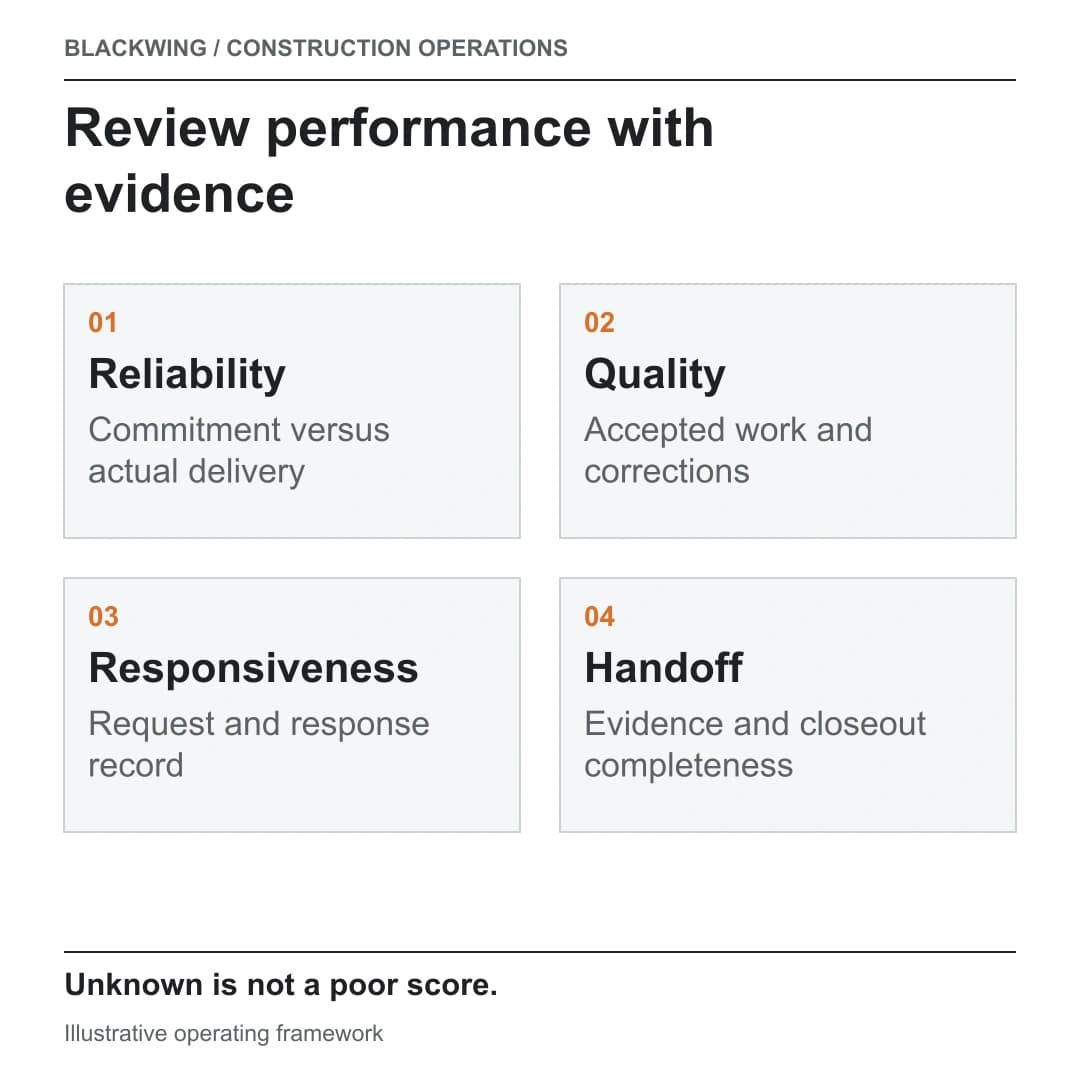
Use a few dimensions that connect to observable work. For each, record examples and context rather than assigning a number simply because a form has a rating column.
| Dimension | Evidence that may help | Context to capture |
|---|---|---|
| Reliability | Agreed milestone compared with actual delivery | Approved schedule changes, access or predecessor delays |
| Quality | Accepted work, documented exceptions and correction history | Scope, current reference, inspection and disposition |
| Responsiveness | Request, response and resolution dates | Whether the request was clear and routed to the right contact |
| Handoff | Required records or coordination delivered | Changes in requirements and dependencies outside the package |
Use “not observed” or “insufficient evidence” where appropriate. Unknown should not become a poor rating. If the company chooses a formal scoring method, define the scale, evidence standard and review process transparently, and allow a factual response before using it for consequential decisions.
Hypothetical example
A subcontractor’s work area was not ready on the date shown in the project schedule. A bare note saying “late” omits whether access was available, a preceding trade had released the area, or the schedule had changed. The review records the planned milestone and source, actual access and handoff dates, relevant communication, and the subcontractor’s explanation. The project team then separates controllable performance from dependencies it owned.
That record is more useful than a low score with no explanation. It identifies whether a specific coordination change or improvement action is warranted and avoids treating a single event as a complete judgment of the company.
Hold a fair review and assign next steps
Share the evidence with the subcontractor at a meaningful package milestone or close. Confirm the facts, invite context, and distinguish correction of a current issue from changes to future selection criteria. If the review identifies a gap, write a specific action, owner and due date. Record what each party agreed and any unresolved disagreement without rewriting the underlying project history.
The future-selection decision should consider package fit, current scope, capacity, commercial terms and evidence across relevant work. Prior experience is one input, not an automatic endorsement or exclusion. Keep onboarding requirements in the separate subcontractor onboarding process, and use multi-project subcontractor management for current commitment coordination. This article focuses on the feedback loop after observed work.
Keep the review narrow enough to be actionable. One package may provide evidence about coordination and handoff records but little about schedule reliability if access repeatedly changed. Say what the project could and could not observe. If a subcontractor disputes a record, retain the response alongside the original and correct factual errors through normal record control.
Separate project learning from commercial administration. A performance discussion does not itself change payment, scope, schedule or contract rights. Those matters follow the agreement and authorized project process. Keep the review limited to work-relevant information and people with a business reason to assess the relationship.
When the same issue appears across packages, compare like with like. Scope, site conditions, schedule pressure and project-team behavior may differ. A short narrative with source links can preserve distinctions better than a composite score. The aim is to give future teams evidence and context, not create a league table.
Four questions about subcontractor reviews
What should a subcontractor review measure?
Use expectations that were agreed for the package and can be observed, such as milestone delivery, accepted work, response records or handoff completeness.
How can feedback be fair?
Keep dated examples and their context, distinguish external dependencies from package performance, and give the subcontractor a chance to correct the record.
Should price determine selection?
Price matters, but selection also depends on scope fit, availability, terms, relevant evidence and the project’s decision criteria. No one factor determines every award.
How often should performance be reviewed?
Review at milestones that produce useful evidence and at package close. The right cadence depends on the work and project process.
Turn project history into a better decision
A useful review tells the team what happened, what evidence supports the observation, what context matters and what should change next time. Keep it specific enough to improve a future decision and fair enough that the record can be discussed. To map subcontractor handoffs and repeatable operating controls, request an operations review.
Written with the help of Laura, Ahmed Fahmy’s AI assistant, based on his ideas and under his supervision.