
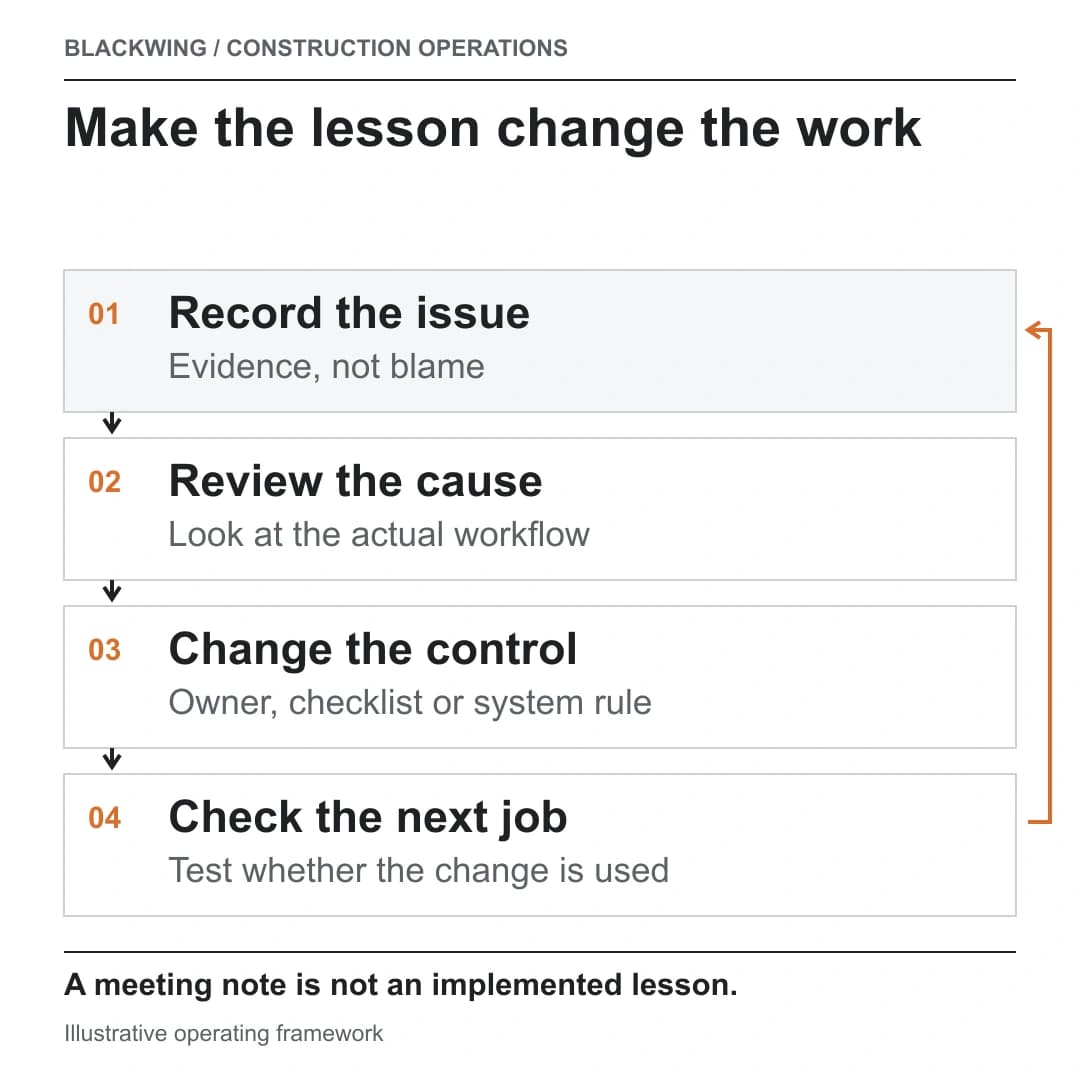
Start with a traceable issue
Choose a finding that can be tied to project evidence: a delayed handoff, repeated clarification, missed assumption, incomplete record, or correction. Record where it occurred, what the team expected, what happened, which source supports the observation, and who can explain the context. Avoid framing the entry as a person’s fault before the process has been examined.
Construction Industry Institute material describes lessons-learned programs in terms that include collection, analysis, implementation, resources and maintenance. Its cited program analysis is older research and does not prove a quantified result for any particular contractor. CII’s best-practice resources connect learning with continuous improvement. Treat them as program context, not a promise that a meeting will eliminate repeat issues. (CII lessons-learned program analysis; CII best practices)
Look for the condition the process can change
Ask what made the issue possible. Was a quantity assumption missing from the estimate? Did a required decision lack an owner or needed-by date? Was the current drawing difficult to identify? Did a system allow the handoff to move forward without evidence? Did the team lack a clear route for exceptions?
Keep the analysis proportional. A short cause review may be enough for a bounded issue; complex or recurring problems may need a more formal investigation by qualified personnel. Distinguish evidence from hypotheses and record unresolved questions. The purpose is to identify a change the company can test, not to claim certainty about every contributing factor.
Hypothetical example
On one job, a purchase request was raised after a selection changed, but the field team continued using the earlier option. The closeout file shows the approved selection date and the purchase record, yet there is no evidence that the field lead received the revision. The team identifies the process gap: approval and purchasing were recorded, but field notification was not an assigned handoff.
One possible change is to add a named field recipient and confirmation step to the selection workflow. The operations owner updates the checklist, tests it on the next relevant job, and checks whether the current selection reached the field before installation. If the confirmation adds friction without closing the gap, the owner revises it. This example is hypothetical and does not describe a Blackwing or client project.
Turn the finding into a controlled change
For each accepted lesson, record the specific change, affected document or system, accountable owner, approval needed, effective point, and evidence that will demonstrate adoption. Depending on the change, the owner may update an estimating assumption, checklist, standard operating procedure, training aid, template or system rule. Changes to approved policies or procedures should go through the existing review and approval process; an experiment does not become company policy by being written down.
Choose a next use that will test the change. The check might confirm that a field is completed, the right revision is visible, the approval occurs before ordering, or the project file contains required evidence. Decide in advance whether the owner will keep, revise or retire the change after reviewing results.
Lessons learned can draw from project closeout, but it is not the same as closeout. A project closeout checklist assembles handover tasks and records. The lessons process carries a finding into future work and checks implementation. Link the source record and the controlled change so a future reviewer can trace the reason.
Use the relevant operating record rather than a general impression. A cost finding should trace back to construction job-costing records. A revision problem should trace back to the document-control process. Each needs a different correction and a different test on the next job.
Limit the register to lessons someone can act on. A concise entry can include a clear title, source project, date, evidence link, affected process, proposed change, accountable owner, approval status and next review point. Keep suggestions separate from approved procedures. If approval is pending, the team must not assume the new process is already in force.
Choose verification before rollout. If the change adds a required field, check relevant future records for completion and usefulness. If it changes a handoff recipient, confirm that the role received and acknowledged the record. If it modifies an estimating assumption, compare later estimates with the evidence that prompted the change. The test should match the intended control, not merely count whether a document was edited.
Close the loop with people who contributed the finding. Tell them whether the change was accepted, assigned for review, or declined with a reason. This encourages useful evidence and reduces the chance lessons disappear into an unowned spreadsheet. Preserve the original source so future reviewers can distinguish the observation from the later decision.
Four questions about construction lessons learned
What makes a lesson actionable?
A specific process change, a named owner, an approval path where required, and a defined way to test the change on relevant future work.
Who should own a lesson?
Assign it to a role with authority over the affected process and enough access to implement or sponsor the change.
How can a team check whether the change worked?
Review evidence from the next relevant use, such as a completed handoff or controlled record. Decide whether to keep, revise or retire the change.
Is lessons learned the same as closeout?
No. Closeout may provide findings and records; lessons learned uses them to change and verify future work.
Make the next job different on purpose
Keep the loop small enough to finish: evidence, cause review, a specific control change, an owner and a test. Track open lessons until there is evidence of implementation, not just a meeting date. If your team needs help connecting project findings to repeatable procedures and systems, request an operations review.
Written with the help of Laura, Ahmed Fahmy’s AI assistant, based on his ideas and under his supervision.