
This guide is about the pre-award proposal workflow. It is not a substitute for contract drafting, legal review or the administration of a signed construction agreement. Keep those responsibilities distinct even when one software platform supports them all.
Give the proposal a clear identity
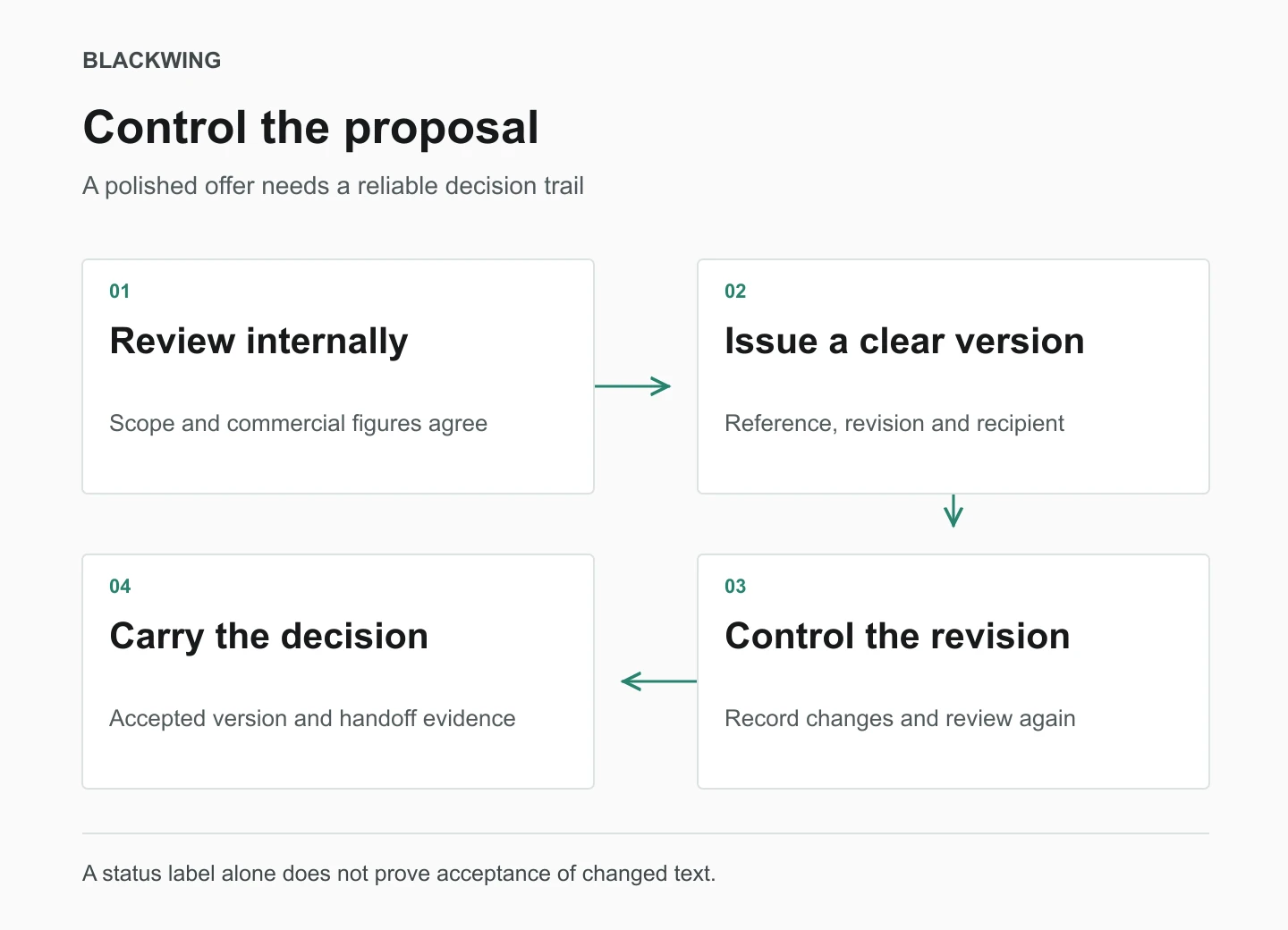
Start with a project reference, proposal reference, revision and issue date. Make the current version easy to locate. An attachment called “final revised new” may be familiar, but it is not a useful control when the customer and estimator have different copies.
Keep the offer’s status separate from the opportunity’s status. The opportunity may remain active while one proposal is superseded and another is being reviewed. Record the relationship rather than treating every PDF as a new sales opportunity.
Check the offer before sending it
| Check | Question the reviewer should answer |
|---|---|
| Scope | Are inclusions, exclusions, assumptions and options understandable? |
| Commercial consistency | Do the summary, line items and stated payment arrangements agree? |
| Responsibility | Who can approve the offer and any commercial exception? |
| Customer context | Does it address the current request rather than an old brief? |
| Decision route | What exactly must the customer do next? |
| Version | Can the issued file and its source record be identified later? |
A designer can improve readability without approving the commercial substance. An administrator can send a reviewed proposal without having authority to change payment terms. Make those boundaries visible in the workflow instead of relying on job titles to explain them.
Treat a requested change as a new review condition
When a customer asks for an alternative finish or a different project phase, record the request before editing the offer. Identify which assumptions, price lines, schedule statements and exclusions may change. Do not update the total while leaving an old scope paragraph attached.
The review can be proportionate. A corrected typo may need a different route from a changed price or scope. Define the categories and authority in advance, and preserve the reason for the revision. The point is not paperwork for its own sake; it is knowing what changed and who agreed it.
A software status is not always enough. Jobber’s quote-approval documentation explains that some edits can remove a signature while an approved status may remain. Check the actual behavior of your chosen tool instead of assuming the green label proves acceptance of the current text.
A simple illustrative revision trail
A contractor issues revision A with two optional work items. The customer asks to include one option and remove another. The estimator prepares revision B, the authorized reviewer checks the changed scope and commercial figures, and the sender identifies B as the version now being considered.
The previous version stays available as history but is clearly superseded. The customer’s response is linked to B. Nobody has to infer acceptance from a message that says “looks good” while referring to an attachment from last week.
Keep proposal, contract and payment states distinct
- Proposal issued: a reviewed offer was sent to the intended recipient.
- Customer decision recorded: the response and exact version are available.
- Commercial acceptance completed: the company’s required agreement steps are satisfied.
- Deposit or payment condition: recorded separately where applicable.
- Ready for project handoff: required information is accepted by the receiving owner.
These states can occur close together, but they are not interchangeable. A proposal page being opened does not prove understanding. A signature does not prove payment. A deposit does not prove that the project team received the latest exclusions. Follow the applicable agreement and authorized review rather than using this list as legal advice.
Make the receiving team check the package
At the handoff, link the accepted proposal, relevant agreement, scope clarifications, selected options and customer commitments. Ask the project owner to confirm whether the package is complete. Missing information should return to a named person, not become an assumption at kickoff.
Use the construction estimate-to-project handoff for that receiving check. For ongoing agreement obligations after award, use the separate construction contract-management register.
Use exceptions to improve the process
Review repeated revision causes: missing site information, unclear options, inconsistent commercial totals or customer decisions captured only in chat. Each suggests a different upstream fix. Do not respond to every revision by adding another signature box.
Track proposals returned for correction, active offers without a current version and accepted work missing a complete handoff. Keep customer-led scope changes separate from internal errors. Those measures show where control is weak without pretending that fewer revisions always mean better service.
Blackwing’s approach is to connect the process, record structure and permissions before automating delivery. A good-looking proposal should be the visible output of a controlled workflow, not the only part of the workflow that has been designed.
Blackwing helps small construction teams connect their sales process, records and operating systems. Start with the handoff that is failing, then agree the owner, information and exception route before automating it.
Questions contractors ask
What is construction proposal management?
Construction proposal management controls the preparation, review, issue, revision and decision history of an offer. It links the customer’s request to the current scope and commercial version, then carries the accepted information into the authorized project handoff.
How should contractors handle proposal revisions?
Record the requested change, identify the affected scope and commercial terms, obtain the appropriate internal review and issue an identifiable new version. Preserve previous versions as history and link the customer’s decision to the correct offer.
Is an approved quote status proof of a signed contract?
Not necessarily. Status meanings and edit behavior vary by system, and contractual requirements depend on the agreement and circumstances. Check the actual acceptance evidence, current version and required commercial review rather than relying on a label alone.