
A forecast is useful when it helps the owner make a decision under uncertainty. It becomes dangerous when a hopeful number is treated as permission to promise start dates, hire permanently or commit cash that has not arrived.
Keep three different views
| View | Question it answers | What it does not prove |
|---|---|---|
| Open pipeline | What opportunities are we pursuing? | That the work will be awarded |
| Expected awards | What may be won in the selected period, and why? | A confirmed start date or collected cash |
| Awarded backlog | What accepted work remains to be delivered under our definition? | That every resource or payment condition is ready |
Salesforce’s forecasting training distinguishes forecasts from the wider pipeline. For a contractor, add another explicit distinction: expected award timing is not the same as delivery timing.
Start with evidence on each opportunity
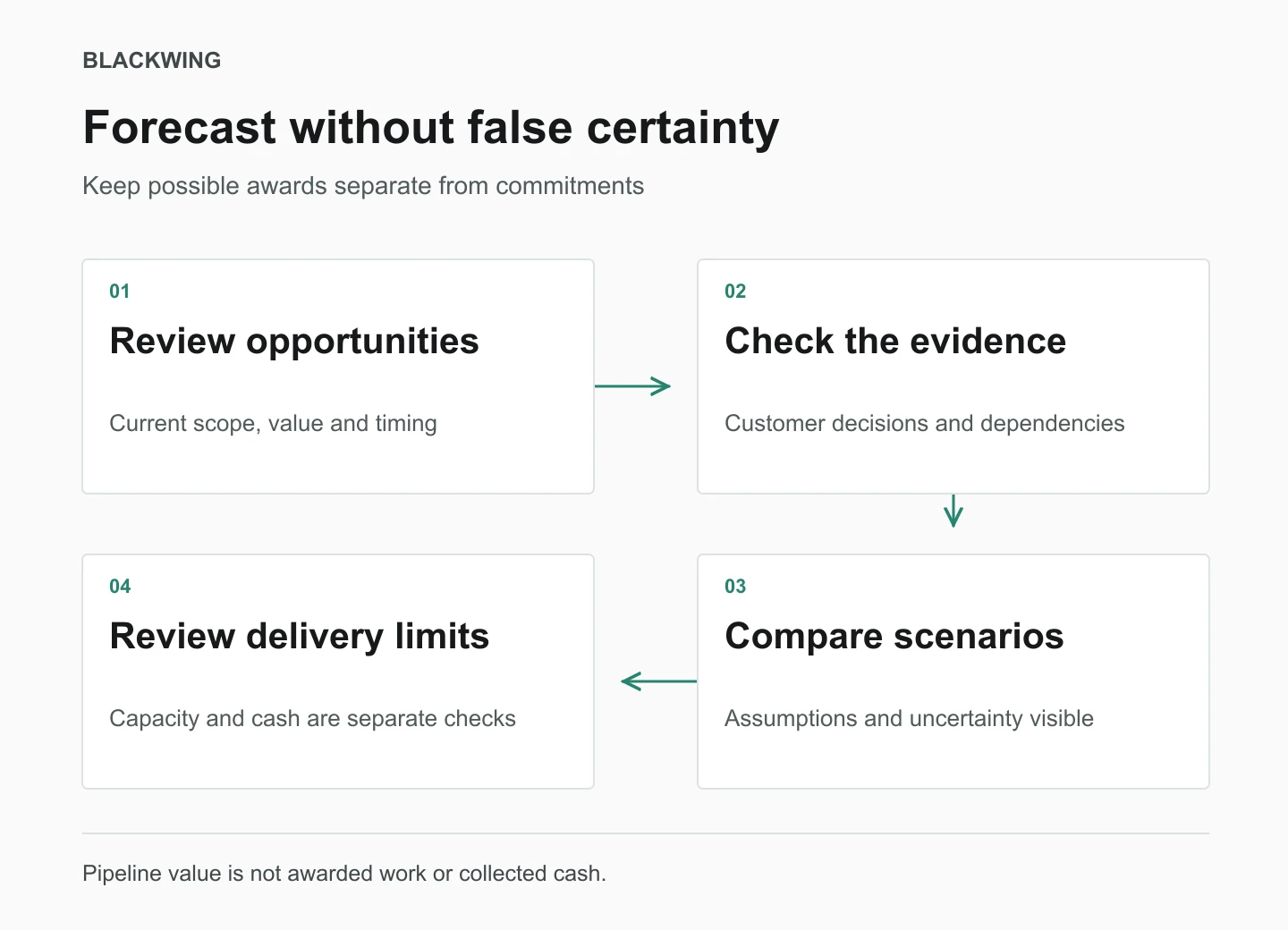
Record the project, current scope value or range, proposal version, customer decision timing, next action and the evidence supporting the expected award. Keep an unknown value unknown. An early conversation should not inherit the value of an unrelated completed project just to fill the forecast.
Use dates for different events: expected customer decision, possible award and requested construction start. If the customer says “we hope to begin in spring,” that does not establish when they will sign or whether your team can accommodate the work.
Use scenarios when your history is thin
Small contractors may not have enough comparable outcomes to assign reliable stage probabilities. That is not a reason to invent precise percentages. Show a grounded case, a downside case and a possible upside, with the assumptions visible. A range can be more honest than a single impressive total.
For an illustrative weekly review, one proposal has a confirmed decision meeting, another is waiting for financing and a third has not received a response. The first may belong in the grounded discussion, the second in a conditional scenario and the third outside the near-term forecast until its status is clarified. These are example rules, not universal categories.
If you weight values, label the arithmetic honestly
A weighted pipeline sums opportunity values multiplied by assigned probabilities. It can be a planning aid. It does not mean part of each project will be awarded, nor does it tell you which combinations of jobs your team can actually deliver.
If two hypothetical projects are each valued at $100,000 and assigned 50%, the weighted total is $100,000. The actual award could still be neither job, one job or both. The 50% assumptions in this example are invented for arithmetic, not observed contractor benchmarks.
Look for connected risks
Opportunities may depend on the same developer, funding source, permit decision or estimator. Treating them as independent can hide a concentrated downside. Add a short dependency note to important opportunities and discuss the effect if that shared condition changes.
The same issue appears on the delivery side. Two likely awards may require the same crew in the same week. A forecast should trigger a capacity review, not silently authorize a start-date promise.
Use construction capacity planning for that delivery decision and the construction sales dashboard for the broader operating view. Keep recognized revenue, invoices and cash collection in the appropriate accounting and cash-planning processes.
Save a forecast snapshot and explain changes
- Choose a reporting date and a defined award period.
- Save the forecast and its assumptions instead of overwriting history.
- Compare later outcomes with the original snapshot.
- Explain changes as timing movement, scope-value change, new opportunity, win or loss.
- Keep management adjustments visible rather than burying them in opportunity values.
A weekly review should ask why the view changed, not merely whether the total increased. Moving an expected award into next month may be the correct update. Punishing that update encourages optimistic dates and makes the forecast less useful.
Test the forecast against a real decision
Ask whether the current view supports a specific choice, such as reserving estimating time or reviewing subcontractor availability. If the forecast cannot show which opportunities drive that decision and which conditions remain open, it is not ready to support the commitment.
Measure forecast error for sufficiently mature, comparable periods and preserve the original basis. With very small samples, report the individual outcomes alongside the totals. The objective is better judgment, not a decorative accuracy percentage.
Blackwing helps small construction teams connect their sales process, records and operating systems. Start with the handoff that is failing, then agree the owner, information and exception route before automating it.
Questions contractors ask
What is a construction sales forecast?
A construction sales forecast estimates potential awards within a defined period using current opportunity evidence, expected decision timing and explicit assumptions. It is different from the full open pipeline, awarded backlog, recognized revenue and cash collection.
Should small contractors use standard sales-stage probabilities?
Do not treat generic percentages as measured probabilities. Use comparable company history where sufficient, or present clearly labeled scenarios and assumptions. Review which opportunities drive each scenario and what conditions could change the outcome.
Can pipeline value be used to promise project start dates?
No. A possible award does not establish delivery readiness. Start-date commitments require an authorized review of scope, agreement conditions, resources and other relevant dependencies. Keep the sales forecast connected to that review without allowing it to replace the decision.