
A small contractor does not need an elaborate appointment-setting department. It needs a reliable answer to four questions: why are we meeting, who owns it, what should be ready and how will we know the meeting happened?
Decide what the appointment is for
Separate a fit conversation from a technical site assessment and a proposal review. They need different preparation, durations and participants. Sending an estimator to a meeting that should have been a short discovery call is an expensive way to clarify the brief.
First confirm that the project has passed your lead qualification checks. Then choose the smallest useful next meeting. Record its purpose in one sentence, such as “confirm the requested scope and identify the documents needed for estimating.”
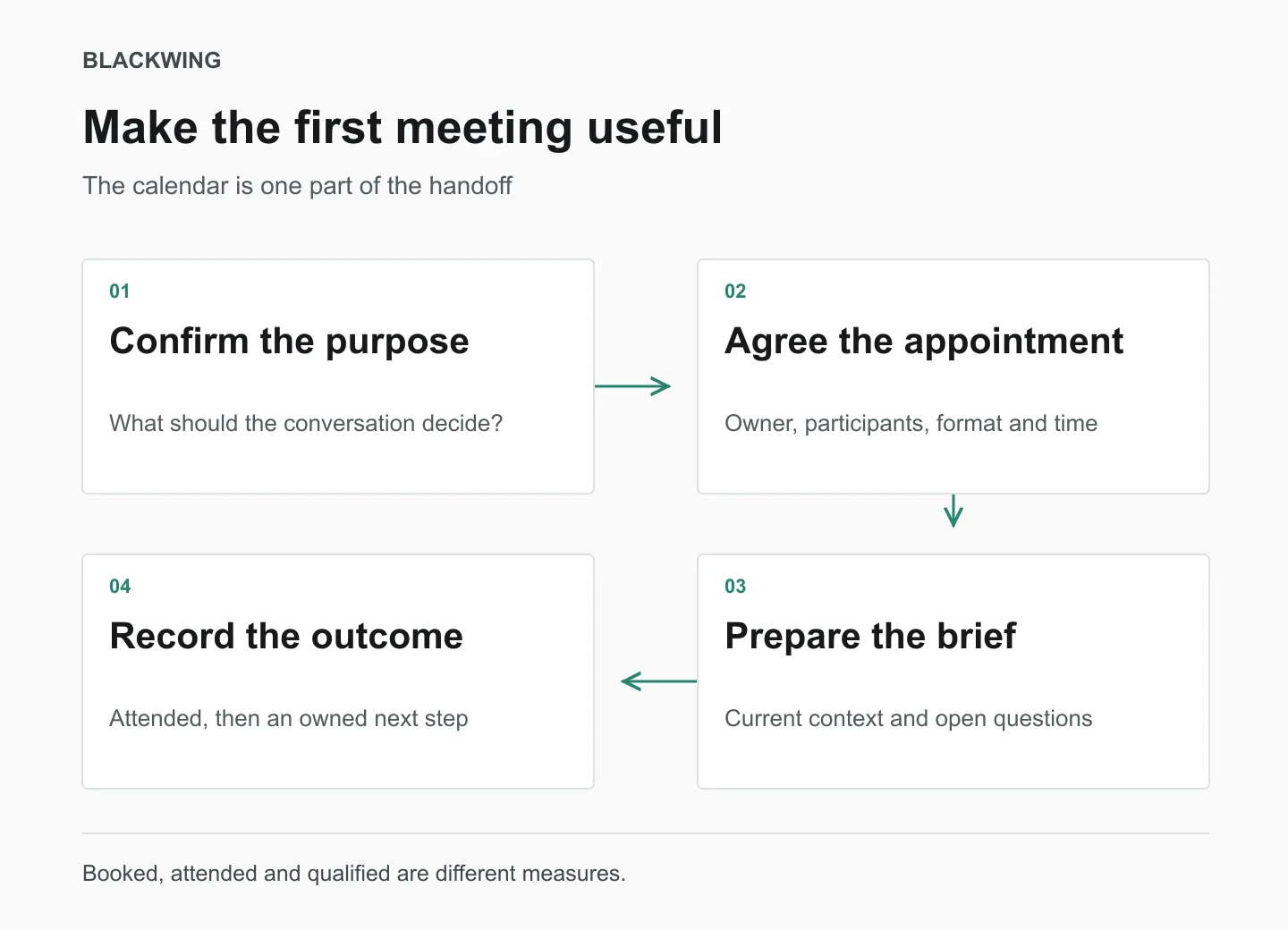
Build the handoff before sharing the calendar
| Control | What a small team needs |
|---|---|
| Purpose | The decision or information the meeting should produce |
| Owner | A named person responsible for the meeting and preparation |
| Participants | The customer and relevant project decision participants |
| Format | Call, video meeting or agreed site visit |
| Preparation | Available plans, photos or questions, with secure access |
| Outcome | Attended, rescheduled, canceled or not attended; then a next action |
Keep the requirements proportionate. A repair inquiry may need a photo and an access discussion. A larger tender may need a document review before anyone accepts the meeting. Do not make every customer complete a procurement exercise to speak to you.
Confirm an actual agreement
Offer workable options and identify the time zone when it could be ambiguous. Confirm the address or joining method, expected duration, meeting owner and what the customer should prepare. An internal calendar hold is not evidence that the customer accepted it.
For an on-site appointment, confirm that the person providing access can do so and that relevant site rules have been addressed. A sales appointment is not permission to enter restricted areas or perform an inspection outside the visitor’s competence.
Software can distinguish a request from a confirmed assessment. For example, Jobber documents separate request, assessment-booking and job-booking forms. The important operating choice is whether your team must review suitability before confirming the slot.
Write a confirmation that removes ambiguity
A practical confirmation might say: “We have agreed a 30-minute call on Tuesday to review the kitchen-remodel scope and decide whether a site assessment is the next step. Alex will lead it. Please send any available plans through the agreed upload link. Let us know if the scope or timing changes.” This is an illustrative message, not a promise about what every consultation includes.
Notice what is absent: a guarantee of an exact price, an implied reservation of construction capacity or a commitment to start the job. Those belong to later commercial decisions. If your consultation has a fee, communicate and obtain the appropriate agreement before the appointment rather than hiding it in a reminder.
Give the meeting owner a brief they can use
- The project and contact records, with one current link.
- The customer’s objective in their own words.
- Qualification notes and unresolved questions.
- Documents received, with version or capture date where useful.
- Commitments already made by the coordinator.
- The decision expected at the end of the meeting.
The meeting owner should confirm that the brief is usable. If essential information is missing, assign the clarification before the appointment. Do not discover five minutes before the call that the notes are in someone else’s messages.
Close the loop after the appointment
Mark attendance separately from booking status. A canceled appointment is not a completed consultation; a reschedule should not create a second unique lead. After the conversation, record the agreed next step, owner and date. When a proposal is not yet appropriate, say what needs to happen first.
For a missed appointment, use a respectful recovery action consistent with the customer’s contact preferences. Ask whether the project or timing has changed. Do not automatically send an indefinite series of reminders or mark the project lost solely because one meeting was missed.
Measure meetings that move work forward
Review qualified inquiries awaiting scheduling, booking-to-attendance outcomes and attended meetings missing a next action. Use a consistent inquiry cohort when evaluating conversion; do not divide this week’s meetings by this week’s inquiries when many meetings came from older inquiries.
This is one stage of the construction sales process, not a replacement for it. When the next step is a visit, the estimating site-visit checklist helps turn the conversation into usable scope information.
Blackwing helps small construction teams connect their sales process, records and operating systems. Start with the handoff that is failing, then agree the owner, information and exception route before automating it.
Questions contractors ask
What should a contractor collect before a sales appointment?
Collect the project objective, service and location fit, useful documents, relevant participants, meeting purpose and any unresolved questions. Keep the request proportionate to the work. A detailed estimate may require more information than an initial fit conversation.
Does a booking link replace appointment setting?
No. A link can help select a time, but the business still needs suitability rules, an assigned meeting owner, clear preparation, customer confirmation and an attendance outcome. The calendar should support those decisions rather than silently making them.
What is the difference between a booked call and a qualified lead?
A booked call is an appointment record. A qualified lead is an inquiry that meets agreed project-fit criteria. A call may involve an existing customer, supplier, known contact or unsuitable inquiry, so bookings should not automatically be counted as acquisition leads.