
A homeowner asking about a small repair and a developer inviting a major tender are not the same opportunity. Both deserve a clear response. Neither should enter the same estimating workflow without a decision.
Qualify the project, not the person
Define fit using legitimate project requirements: the work you perform, location, timing, information needed and available estimating capacity. Avoid personal assumptions about the caller. An unfamiliar accent or an incomplete first email tells you nothing useful about whether the project is suitable.
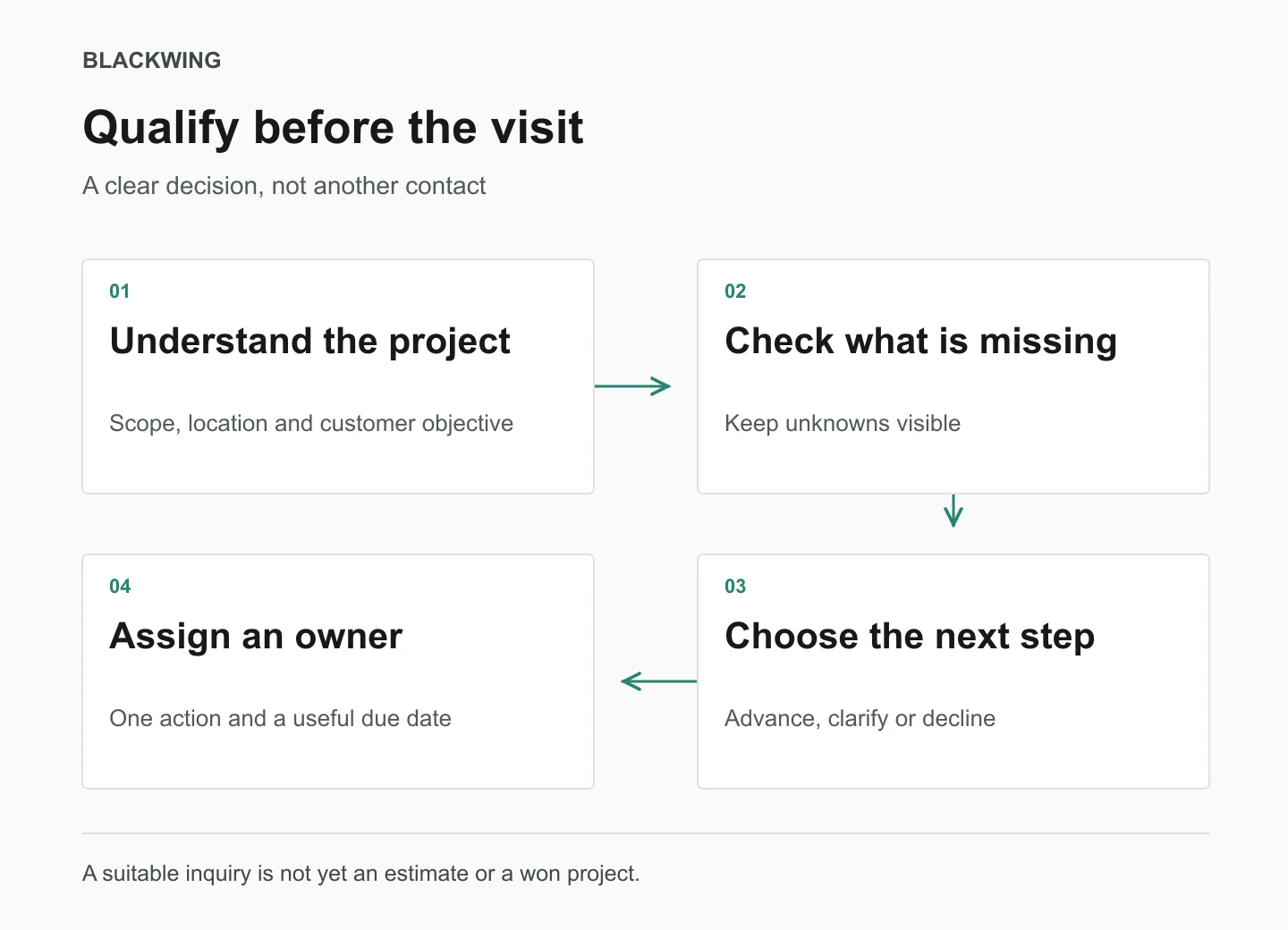
Use three outcomes: advance, clarify or decline. Clarify matters. A missing budget is not automatically a bad opportunity; it may mean the customer needs an initial discussion about scope before anyone can sensibly discuss price. Record what is unknown instead of filling the field with a guess.
Use a short first-call checklist
| Ask about | A useful question | What to record |
|---|---|---|
| Scope | What are you trying to change or build? | Project type and the customer’s stated outcome |
| Location | Where would the work take place? | Service-area fit, not an assumed travel commitment |
| Readiness | What plans or decisions are already available? | Documents available and missing information |
| Timing | Is there a required date, and what drives it? | Desired timing and reason, separate from your promise |
| Budget discussion | Is there a working range or a funding decision to make? | Customer statement, unknowns and assumptions |
| Next decision | Who should join the next discussion? | Relevant decision participants and agreed next action |
Treat the checklist as a conversation guide, not an interrogation. Explain why you are asking. “I want to make sure we send the right person and do not waste your time” is more useful than demanding six compulsory answers before anyone is allowed to speak.
Buildertrend’s initial client-meeting checklist also places fit questions before committing to the next step. Your thresholds should come from your own service model, not another contractor’s example.
Put the decision in the CRM
Keep the contact and the project separate. One property manager may discuss several buildings; one household may return with a different scope next year. Reusing the contact should not overwrite the history of the first inquiry.
- Assign one inquiry owner, even if several people help.
- Record the actual qualification outcome and its reason.
- Give a clarification request an owner and a review date.
- Create or advance an opportunity only when your agreed criteria are satisfied.
- Preserve unsuitable and withdrawn outcomes for learning, without keeping unnecessary personal information indefinitely.
Use the construction CRM record structure for the underlying relationships. This checklist owns the decision to advance; the CRM guide owns how the records connect.
A practical example: the inquiry is promising but incomplete
Consider an illustrative remodeling inquiry. The work matches the contractor’s services, but the customer has not decided whether a wall will move. The customer wants an exact price before that decision. Booking a full estimating visit immediately may create an expectation nobody can meet.
The coordinator records the uncertainty, explains what the next conversation can establish and asks the estimator whether a scoping call is appropriate. The next action becomes “estimator to review the available sketch,” with a date. It does not become “quote pending” when no quote can yet be prepared.
Keep exceptions visible
Some opportunities deserve an exception: a repeat commercial customer, unusual access restrictions or work outside the normal project mix. Name the person allowed to make that decision. Record the reason and what additional review is required. An exception should be deliberate, not a favor hidden in somebody’s inbox.
Review a small sample of advanced, clarified and declined inquiries. Did unsuitable work still reach estimating? Were good projects declined because the form was too rigid? Adjust the questions based on those records. A qualification process should improve judgment, not replace it with a score that nobody can explain.
Measure the quality of the handoff
Track the share of reviewed inquiries with a recorded decision, the number waiting for missing information and the share of meetings rejected later for basic fit problems. Keep new inquiries, qualified opportunities and attended meetings as different counts. A busy calendar is not proof of a healthy pipeline.
Once the project is ready to advance, use the contractor appointment-setting workflow to agree the purpose, attendees and confirmation. Blackwing’s construction process and systems work connects these decisions to the actual tools your team uses.
Questions contractors ask
What is contractor lead qualification?
Contractor lead qualification is the review of a project inquiry against agreed service, location, readiness, timing and capacity criteria. Its output is a documented decision to advance, request clarification or decline, with an owner and next action. It does not guarantee a sale or a profitable project.
Should every qualified construction lead get a site visit?
No. Qualification means the inquiry is suitable for a defined next step. That step may be a scoping call, document review or site visit. Choose the meeting type according to the information needed rather than treating every inquiry as ready for an estimate.
What if the customer does not know their budget?
Record the budget as unknown and decide what clarification is needed. Discuss scope and the kind of pricing guidance your company can provide. Do not invent a budget or automatically reject an otherwise suitable project solely because the first conversation is incomplete.