
This is a commercial information-capture guide. It does not replace a competent technical inspection, survey, design assessment or site safety procedure. The visitor should work within their competence and the project’s access and safety requirements.
Prepare the visit around an estimating question
Before booking, agree what the visit needs to establish. Is the team validating the requested scope, identifying information gaps or collecting inputs for a detailed estimate? The customer should understand what the visit will and will not deliver.
Use the appointment-setting process to confirm access, participants and available documents. Send the visitor the original inquiry, qualification notes and known uncertainties so the customer does not have to repeat the entire brief at the door.
Capture facts, requests and assumptions separately
| Category | Capture | Do not confuse it with |
|---|---|---|
| Customer objective | The outcome and requested scope | A technical solution already approved |
| Observed condition | What was visible, where and when | A conclusion about concealed conditions |
| Measurements | Units, location, method and relevant limitations | An unverified sketch treated as a final survey |
| Access and logistics | Known access constraints and questions | Permission to enter or disturb restricted areas |
| Documents | Drawing or specification reference and revision | Whatever attachment happens to be newest in chat |
| Open item | Question, answer owner and required follow-up | An allowance or assumption silently accepted by the customer |
The distinction matters when pricing depends on something the visitor could not verify. “Customer reports a leak behind the wall” and “confirmed cause of leak” are different statements. Preserve the source of the information. Let the appropriate qualified person decide what further investigation is needed.
Make every useful photo identifiable
Attach photos to a room, elevation, work area or other understandable location. Add a short description of the condition relevant to estimating. A folder of close-ups can be almost impossible to interpret after the visitor leaves the site.
Collect only what is necessary and permitted. Avoid capturing unrelated people, private documents or security details. Store the evidence through the company’s approved route, with access appropriate to the project. Personal camera rolls should not become the only business record.
Record what the customer actually requested
Use the customer’s wording for the desired result, then separately note questions about how to achieve it. If the customer changes their mind during the visit, capture the change and confirm which option the estimate should consider. Do not price both versions without labeling them.
Record any commitment made by the visitor, including an expected response date. A casual “we can probably start next month” can be heard as a promise. Make it clear when a date is only a request or subject to a later capacity decision.
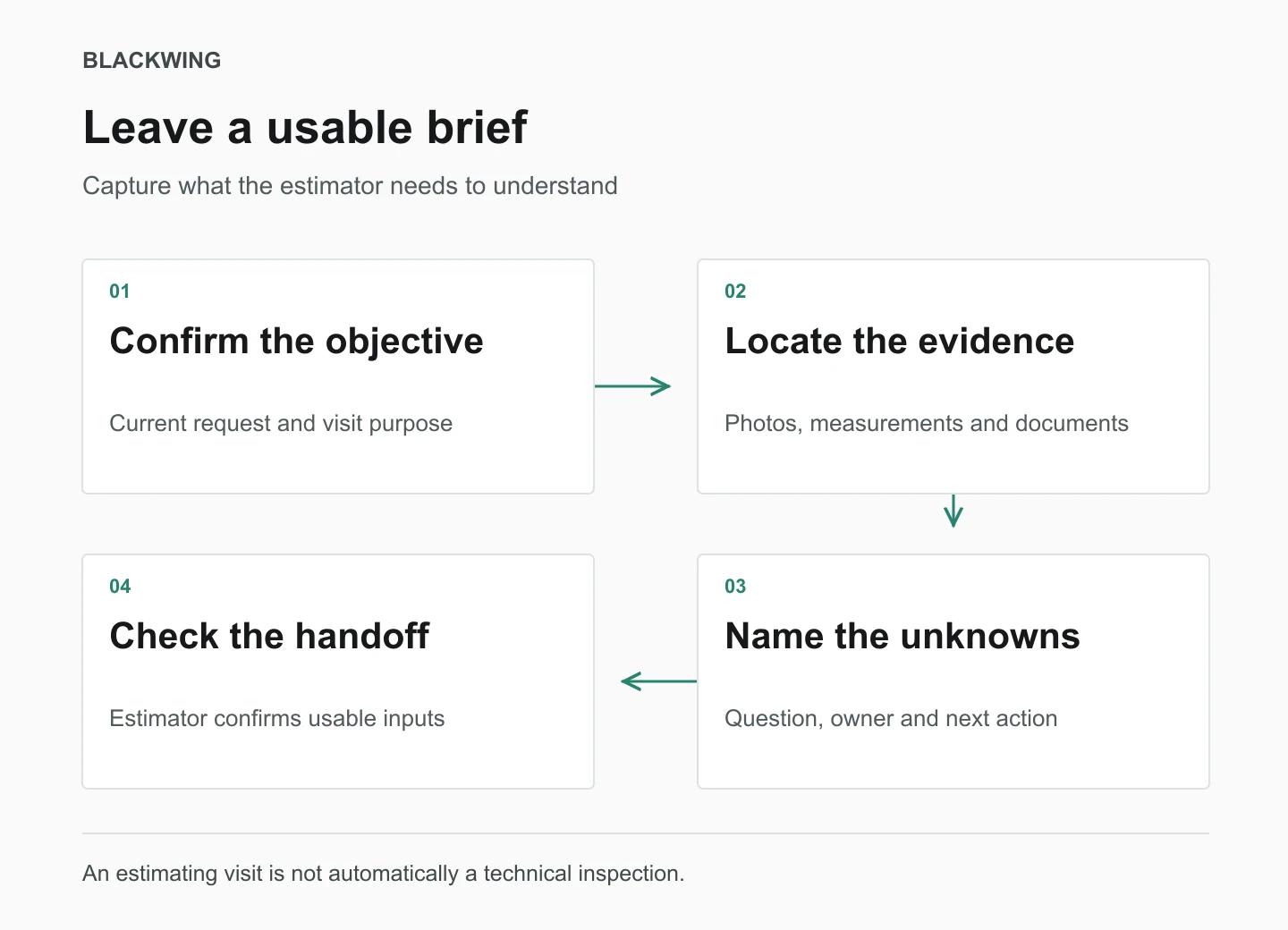
Finish with an estimator acceptance check
- Can the estimator identify the scope to be priced?
- Are measurements and supporting documents understandable?
- Are uncertain conditions and exclusions visible?
- Does every missing input have an owner and a next action?
- Are options separated from the base scope?
- Is the target date for the next response realistic and owned?
The receiving estimator should be able to mark the brief accepted, accepted with defined limitations or returned for clarification. A visit being complete is an activity outcome. A usable estimating package is a separate handoff outcome.
Jobber’s construction estimating guide includes site investigation among the estimating inputs. This checklist adds the operating control: how information reaches the person preparing the offer without losing its context.
An example of an incomplete brief
In an illustrative bathroom project, the visitor uploads photos and writes “replace fixtures.” The estimator cannot tell which fixtures, whether the layout stays the same or which finish option the customer preferred. Sending the estimate quickly would not solve that ambiguity.
A usable brief identifies the room and items, the requested option, the customer’s stated preferences and the unresolved layout question. The layout question goes back to a named owner. The estimator can then decide whether to clarify before pricing or present an explicitly conditional option through the authorized review process.
Improve the inputs that repeatedly come back
Review why briefs are returned: missing locations, unclear scope, old drawings or unresolved customer choices. Update the form and preparation instructions for the recurring cause. Do not add twenty compulsory fields because one unusual project needed them.
The same discipline continues after the offer is accepted through the estimate-to-project handoff. Blackwing helps contractors define these receiving checks before configuring forms and automations.
Blackwing helps small construction teams connect their sales process, records and operating systems. Start with the handoff that is failing, then agree the owner, information and exception route before automating it.
Questions contractors ask
What should an estimating site-visit checklist include?
Include the customer objective, scope, located observations, measurements with limitations, document revisions, access considerations, options and unresolved questions. Assign an owner to each missing input and have the receiving estimator check whether the brief is usable.
Is an estimating site visit a technical inspection?
Not automatically. A visit to collect pricing information does not establish a qualified inspection, survey or design assessment. State the visit’s purpose and limitations, and route technical or safety questions to appropriately competent reviewers.
How can contractors reduce repeat visits caused by missing information?
Prepare the visitor with the current brief, capture evidence with clear locations and have the estimator review the package promptly. Record why clarification or another visit is needed. Use recurring return reasons to improve the form rather than assuming every extra visit was avoidable.