
Before chasing an answer, check what you actually sent. The right contact needs the current proposal, an understandable scope and a clear explanation of the next step. Following up quickly on the wrong attachment is still following up on the wrong attachment.
Agree the decision process when you send the estimate
Ask whether the customer expects to decide after a family discussion, funding review, design decision or comparison of options. Record their stated timing, not the date the salesperson wishes they would choose. Explain what happens if scope changes or the quote’s stated validity ends.
Offer a specific next conversation where useful. “Would a short scope review next Thursday help you compare the options?” gives the customer a reason to respond. Do not treat silence as acceptance, or a read receipt as evidence that the customer understood the exclusions.
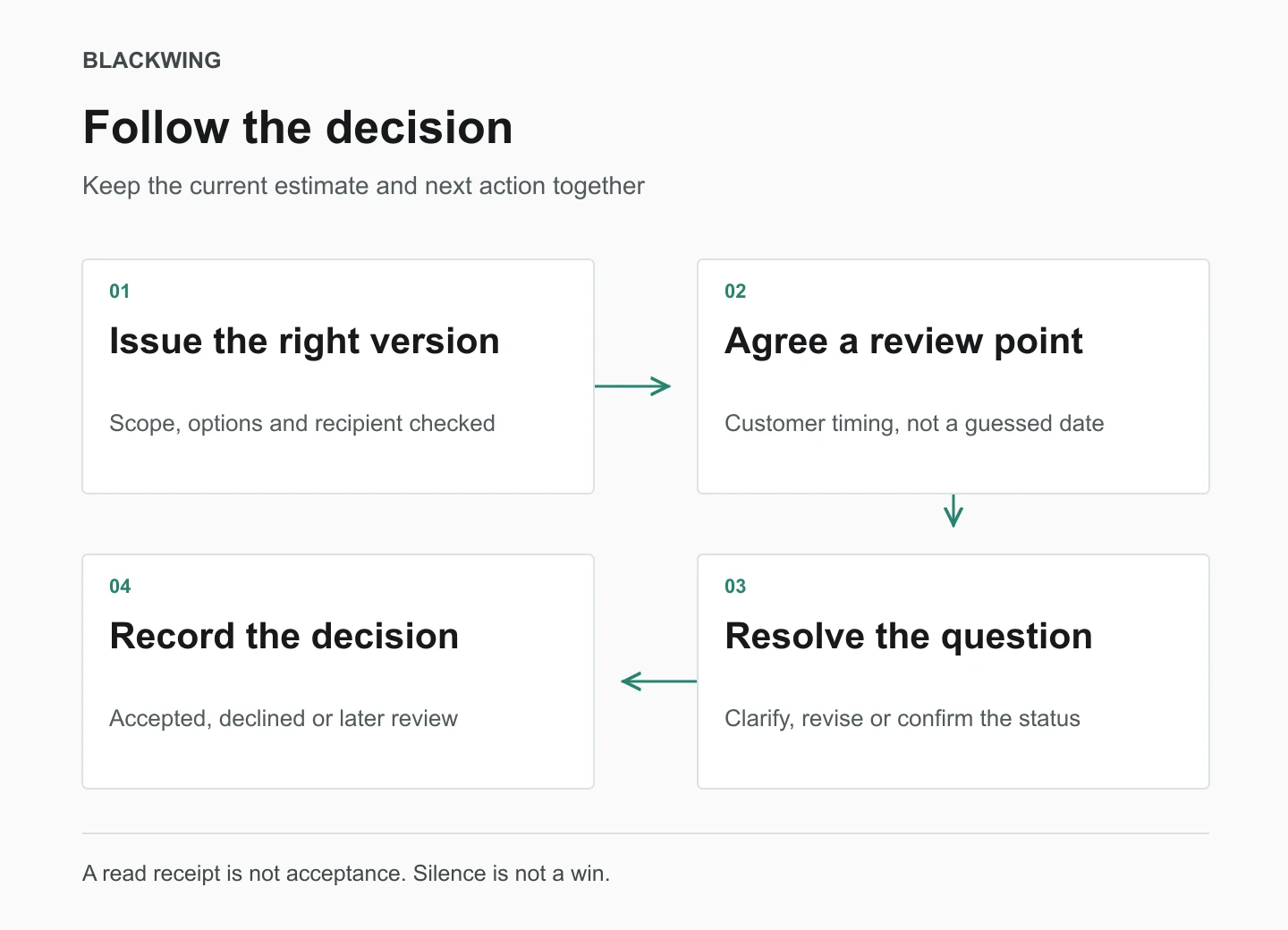
Use a cadence based on an agreement, not a magic number
There is no universal sequence that fits an emergency repair, a kitchen remodel and a commercial tender. Start with a delivery check if needed, an agreed review point and a final status clarification when the discussion goes quiet. Treat any example timing as a starting assumption to test, not an industry conversion benchmark.
- Before sending: verify recipient, scope, version and the relevant documents.
- At the agreed review point: ask what question is preventing a decision.
- If the customer wants a change: record the requested revision before changing the price.
- If the project is delayed: agree a later review trigger and remove false near-term expectations.
- If the customer declines or asks to stop: record the outcome and stop the sequence.
Jobber describes quote reminders and follow-up tools. Product features and plan availability vary; your company still needs to decide which customer situations should trigger, pause or stop a reminder.
Give each message a useful purpose
When the customer has a scope question
Illustrative message: “You mentioned wanting to compare the two flooring options. The current proposal lists them separately. Would it help to walk through the differences before you decide? I can arrange a short call with the estimator.”
When an agreed decision date passes
Illustrative message: “We had planned to reconnect after your design review. Has the scope or timing changed? If the project is on hold, that is useful to know too, and we can agree whether a later check-in makes sense.”
When you need a clear status
Illustrative message: “I do not want to keep chasing a project that has moved in another direction. Would you like us to keep this proposal open, revisit it later or close it for now?” Respect the answer. A clean loss reason is more useful than an indefinitely optimistic pipeline.
Keep the current proposal and the follow-up connected
| Record | Minimum useful detail |
|---|---|
| Proposal | Reference, revision, issue date and recipient |
| Decision | Customer’s expected timing and decision participants |
| Question | Specific uncertainty, answer owner and response date |
| Follow-up | Last meaningful contact, next action and responsible person |
| Outcome | Accepted under the agreed process, declined, revision needed, postponed or unresolved |
A customer saying “the price looks fine” is not necessarily an authorized contract award. Preserve the comment and follow the company’s actual commercial approval process. Do not let a convenient CRM status create commitments the business has not accepted.
Use construction proposal version control when the customer requests revised options. Once the commercial decision is properly confirmed, use the estimate-to-project handoff rather than copying a sales note straight into a live job.
Test the process on five open estimates
For an initial internal review, choose a small sample of genuinely open estimates. Can the owner identify the current version, last meaningful discussion, customer decision timing and next action for each one? Fix those four fields before building a complex automation.
Review unanswered questions separately from unresponsive customers. If three proposals are waiting for the estimator to clarify an exclusion, the bottleneck is not customer follow-up. Assign the internal answer and set a date. A reminder cannot compensate for a question your team has not answered.
Measure resolution, not message volume
Track issued proposals with a known next action, overdue internal answers and outcomes for comparable proposal cohorts. Report unresolved cases separately. More emails sent does not establish better conversion, and a smaller open pipeline may simply mean the team finally recorded old losses honestly.
Blackwing helps small construction teams connect their sales process, records and operating systems. Start with the handoff that is failing, then agree the owner, information and exception route before automating it.
Questions contractors ask
How often should a contractor follow up on an estimate?
Base follow-up on the customer’s agreed decision timing, the project’s complexity and the questions still open. Confirm delivery where necessary, agree a useful review point and stop when the customer declines or requests no further contact. There is no universal sequence for every construction project.
What should a construction estimate follow-up say?
Refer to the current proposal and a specific decision or question. Offer clarification, confirm whether scope or timing changed and make the next step easy to understand. Avoid vague repeated check-ins, invented urgency or promises that construction capacity is reserved.
Should an unanswered estimate stay in the forecast?
Do not keep it in a near-term forecast merely because it has not been marked lost. Record the uncertainty and review it under your forecast rules. Keep a postponed opportunity distinct from a current decision and from confirmed awarded work.