
The practical fix is not necessarily a new phone platform. It is a visible callback queue with an owner, a due time and a result. Start there before adding automated texts or an AI receptionist.
Separate a phone event from a business inquiry
A missed call may be a new project, a current client, a supplier, spam or a wrong number. Do not create an opportunity for every event. Preserve the call record, match it to an existing contact where reliable and let the callback establish the reason for contact.
A second call from the same person about the same issue is another event, not automatically another lead. Keep the event history while linking the callbacks to one open issue. If the number is withheld or shared by several people, avoid pretending the match is certain.
The distinction exists in real tools. Housecall Pro’s call-log guide describes call records and missed-call filters. Viewing or clearing a missed-call badge is not, by itself, evidence that the customer received a response.
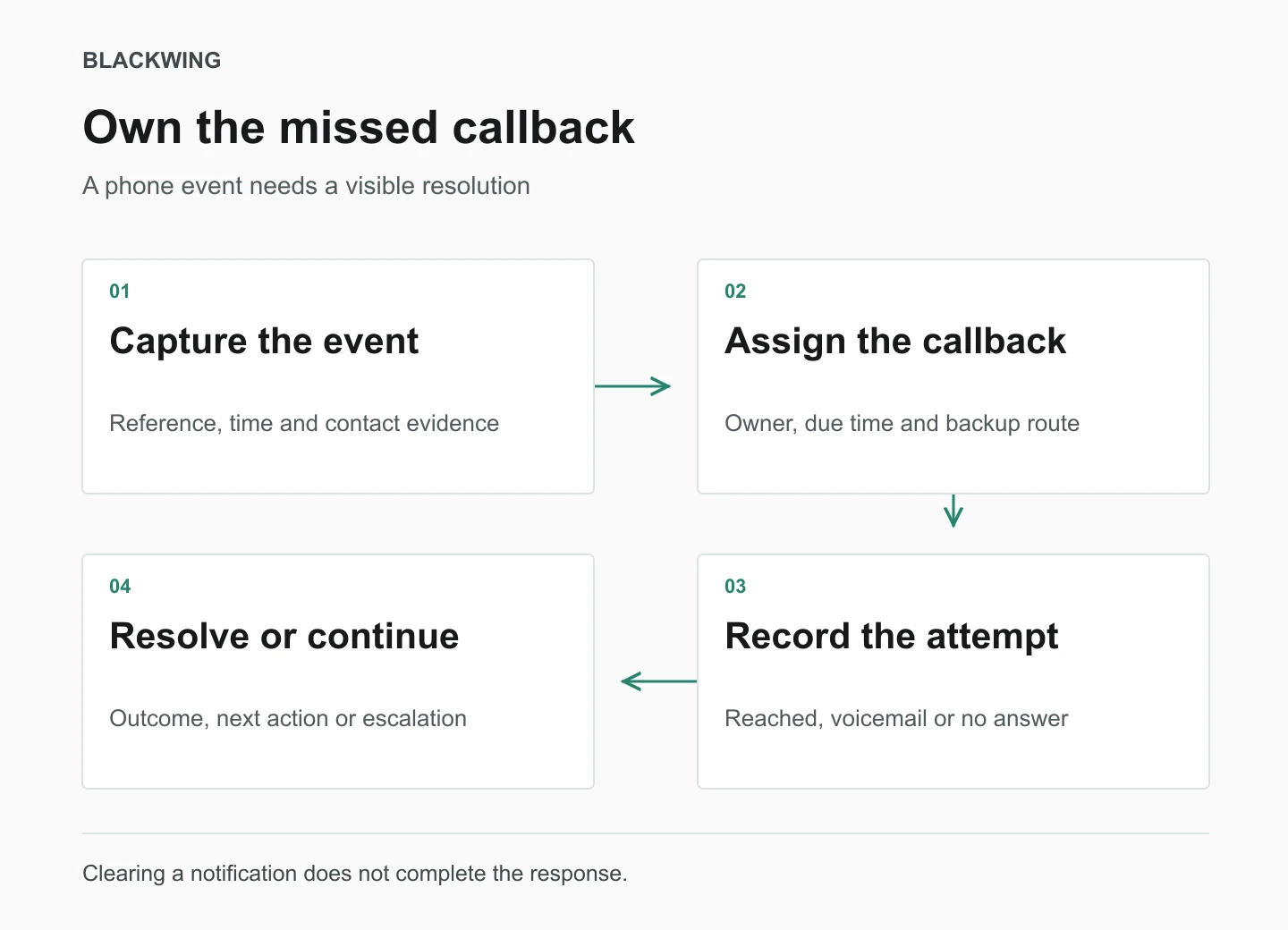
Give the queue a small, useful set of fields
| Field | Why it matters |
|---|---|
| Call reference and received time | Trace the callback to the original event |
| Matched contact or unknown | Avoid confident guesses and duplicate records |
| Reason, if known | Route a live-job issue differently from a sales inquiry |
| Assigned owner and due time | Make responsibility and urgency explicit |
| Last attempt and outcome | Distinguish no answer from a completed conversation |
| Next action | Keep unresolved work out of a finished status |
Choose a response target your staffed team can actually maintain. State whether it applies during business hours and how out-of-hours calls are handled. Do not publish a rapid-response promise that depends on the owner noticing a personal notification.
Route urgent issues without guessing
Current-job access problems, a customer complaint and a request for a new estimate need different owners. Give the coordinator a clear escalation route. Suspected emergencies should follow the company’s established emergency instructions and appropriate emergency services; a sales callback queue is not an emergency-response service.
When the reason is unknown, the first action is to establish it. Do not let an automation invent a project type from a phone number or assume that a missed caller wants marketing messages.
Make attempts and outcomes honest
Use simple outcomes: reached and resolved, reached with next action, voicemail left, no answer, invalid contact or not a business inquiry. “Called back” is too vague. It can mean a useful conversation or three seconds of ringing.
If you leave a message, identify the business and give a clear return route without exposing project details to an uncertain recipient. Use contact channels and follow-up permissions appropriate to the relationship. Do not automatically enroll callers in campaigns.
An illustrative morning handoff
Imagine a small contractor receives four calls while the office is closed. Two relate to the same active job, one is a new inquiry and one is a supplier. The coordinator groups the repeated job issue without deleting either event, routes it to the project owner, assigns the inquiry callback and sends the supplier issue to purchasing.
The owner sees one exception that needs their decision rather than four unexplained phone alerts. The new inquiry becomes a sales record only after the conversation establishes what the caller needs. No conversion claim is implied by this example.
Add automation after the queue works
- Create a task from a verified missed-call event, with duplicate handling.
- Assign according to an agreed roster rather than broadcasting to everyone.
- Alert a backup when an unresolved callback passes its due time.
- Keep a failure queue for events that could not be matched or assigned.
- Require review before generated summaries change opportunity stages or customer commitments.
For the next conversation, use the contractor lead qualification checklist. For a model-assisted record, use the separate AI call-summary review workflow. These are later decisions, not reasons to automate every missed call into a deal.
Review unresolved calls, not only answered-call totals
Measure missed events, unique callback issues, time to first attempt and time to a meaningful response separately. Review unresolved items by age and owner. Exclude spam, internal calls and duplicates from lead-generation measures while preserving the underlying operational history.
Start with a few working days of records. If the queue cannot explain what happened to each missed inquiry, another notification channel will not fix the process. The useful outcome is a caller with a response and an owned next step.
Blackwing helps small construction teams connect their sales process, records and operating systems. Start with the handoff that is failing, then agree the owner, information and exception route before automating it.
Questions contractors ask
How should a small contractor manage missed calls?
Use a shared callback queue that records the original call, responsible person, due time, contact attempts and final outcome. Match existing contacts carefully and keep unresolved callbacks visible. A phone notification or a voicemail being played is not a completed response.
Should every missed call create a CRM opportunity?
No. Calls can come from existing clients, suppliers, spam or repeated attempts about the same issue. Establish the reason for contact, match the contact and qualify a genuine project inquiry before creating or advancing an opportunity.
Should contractors automatically text every missed caller?
Not by default. Decide which messages are appropriate, what permissions apply, how replies are handled and when the automation must stop. A text should support an owned callback process, not create an unmonitored second inbox or an unsolicited marketing sequence.