
Market data is context, not a project adjustment
U.S. indicators show why contractors should review exposure, but they do not calculate any individual project’s cost. AGC reported that the U.S. producer-price index for inputs to new nonresidential construction rose 8.9% between August 2025 and August 2026 in its public release. The Bureau of Labor Statistics explains that a PPI measures changes over time in prices domestic producers receive for their output. It is not a contractor’s realized cost, a bid adjustment formula, or a forecast. NAHB’s remodeling survey separately described material cost pressure among surveyed U.S. remodelers, a population that does not represent every contractor. (AGC, September 10, 2026; BLS Producer Price Index; NAHB, October 8, 2026)
Use those signals to ask where your own assumptions may have expired. Do not multiply a national index by a contract value and call the result a project exposure.
Sort work by commitment stage
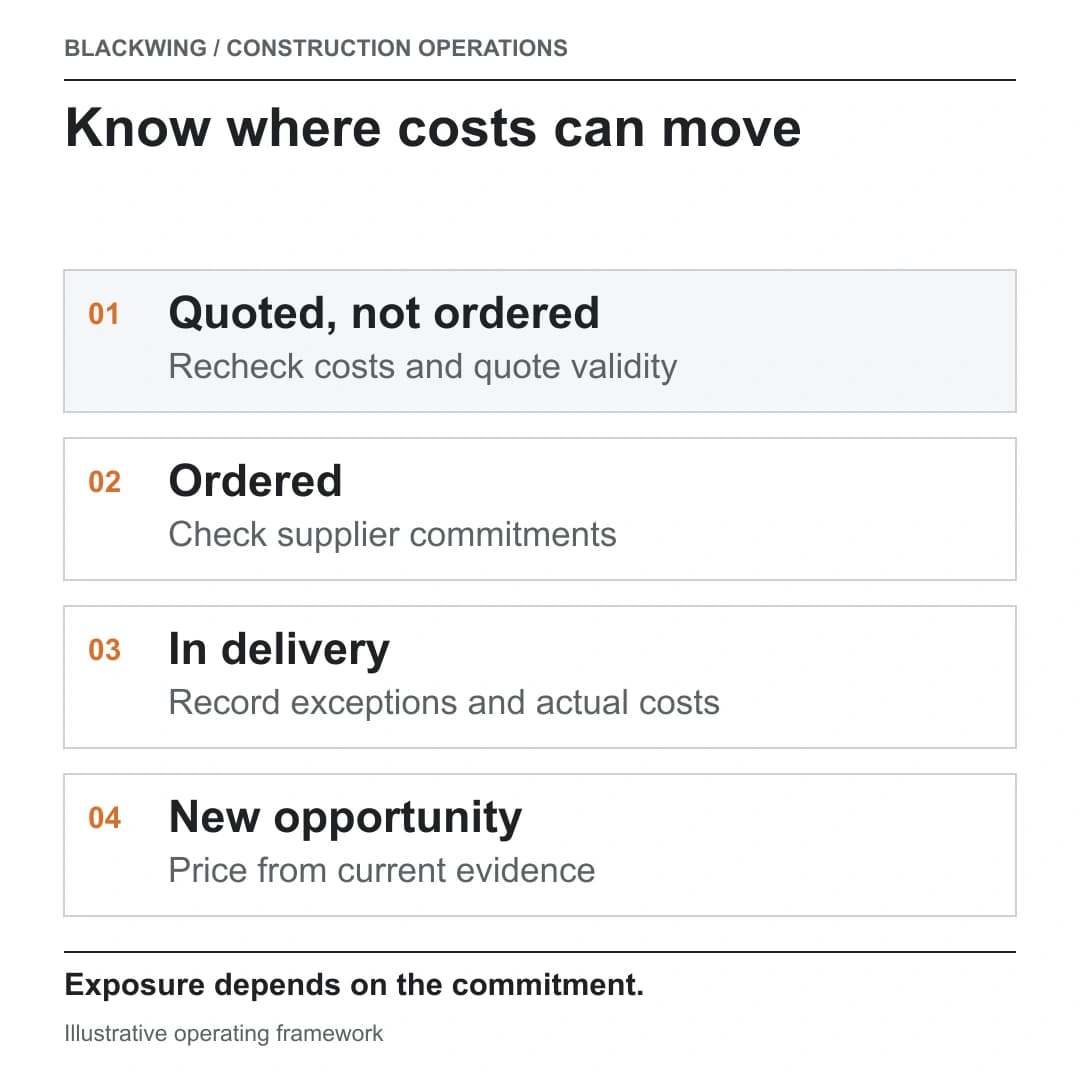
Different stages create different questions. This table is a practical review structure; project documents and supplier terms control the actual commitments.
| Work stage | Evidence to collect | Owner’s question |
|---|---|---|
| Quoted, not ordered | Quote date, validity, scope, allowances and current supplier pricing | Which assumptions need revalidation before award or purchase? |
| Ordered | Purchase order, accepted terms, quantity, delivery window and any open conditions | What is actually committed, and what remains variable? |
| In delivery or installed | Receipt, approved substitutions, quantity used and documented exceptions | What did the project actually receive and consume? |
| New opportunity | Current quotes, labor assumptions, scope and schedule dependencies | Is this price based on evidence current enough for the decision? |
Record the date, source, quantity, unit, exclusions and person who confirmed each figure. A screenshot of a price without its scope or validity can be difficult to use later. For labor, financing, or other categories, use the company’s current project evidence and have a qualified owner verify assumptions.
Identify exposure before changing price
Start with cost categories that could materially affect the work: key materials, subcontract packages, equipment, labor availability, freight, or financing where relevant. Do not list every conceivable cost. Focus on exposure that has both a plausible change mechanism and a decision that remains open.
For each item, note what is already priced or ordered, what quantity is still uncommitted, when the underlying quote expires, and what event requires review. This makes the difference between a price movement and a business decision clear. A purchase order may reduce uncertainty for one item while leaving delivery, quantity, or scope conditions unresolved.
Hypothetical example
An estimator is reviewing a not-yet-awarded renovation. The quote includes a supplier price that expires before the anticipated purchase date. Another similar job has already placed its order under different terms. The team should not assume the first job has the same protection as the second. It can request a current supplier quote, verify whether scope and delivery assumptions still match, and document the result for the authorized commercial decision-maker. If the customer’s scope or timing changes, route that issue through the contract’s actual process.
The example does not imply the customer must accept a revised price. It shows how to discover the exposure before the team quietly absorbs it or cuts price without knowing what changed.
Set a revalidation and response path
Define triggers such as quote expiration, a changed lead time, a supplier exception, a scope revision, or a material gap between assumed and confirmed quantities. Then specify who checks the evidence, who has authority to revise an estimate or offer, and how the customer communication is recorded.
If a contract is already in place, review its actual pricing, escalation, notice and change provisions with the appropriate commercial or legal specialist. There is no universal right to raise a price after signing. A market index cannot create that right, and a supplier increase does not by itself establish what the customer owes.
Keep portfolio-level exposure separate from job-level forecasting. A cost code and actual commitment record help explain one job’s performance; see construction job costing. Quote comparison and purchasing handoffs are separate controls, covered in supplier quote changes and construction estimate quote comparison.
Four questions about construction cost exposure
How can a contractor check exposure before lowering a bid?
List the major cost assumptions, their dates and validity, and the quantities not yet committed. Refresh the evidence that matters to the decision, then route the price decision to its authorized owner.
Which costs should be reviewed?
Review categories material to the particular scope and schedule, based on available evidence. A generic list cannot determine which item creates risk for your project.
Does a producer-price index show my job’s cost?
No. A PPI measures producer selling-price changes for a defined population and period. Your contracts, quantities, suppliers, timing and actual project records determine job exposure.
When can a contractor change a price?
Before award, follow the quote and negotiation process. After agreement, check the actual contract and obtain qualified commercial or legal review; no universal escalation rule applies.
Protect the decision record
Margin protection begins with knowing which assumptions remain open. Keep dated evidence beside the affected work, distinguish priced commitments from uncommitted inputs, and record who approved the response and why. That gives the team a defensible operating trail without promising that every increase can be passed through. For help mapping the estimate-to-purchase controls, request an operations review.
Written with the help of Laura, Ahmed Fahmy’s AI assistant, based on his ideas and under his supervision.